Categories
Events

Annual Transnational Modernisms Research Event, 20 May 2013

Annual Transnational Modernisms Research Event

When: MONDAY 20 MAY 2013; From 2pm-6pm
Where: ARTS COMPLEX LR1, 3-5 Woodland Road, Bristol BS8 1TB
Take a break from marking and examining and come and join colleagues from the University of Bristol’s Faculty of Arts for an afternoon of informal research sharing, preceded by a sandwich lunch from 1pm -2pm in the Humanities Student Common Room, (11Woodland Rd) and followed by drinks from 5.30pm.

Programme
2.00 Welcome and Introduction
Dr Dorothy Rowe (History of Art, TMRC Lead, HUMS)
2.15 Transnational and Transhistorical Modernism? The Case of Leon Bakst Dr Nicoletta Momigliano (Classics and Archaeology, HUMS & ARTS)
3.00 Modernism’s Convulsive Aesthetics
Dr Ulrika Maude (English, HUMS)
3.45 Tea Break
4.00 Back to the Future
Dr Rhian Atkin (Hispanic, Portuguese and Latin American Studies, SML)
4.45 Maria Schneider and Digital Patronage
Dr Justin Williams (Music, ARTS)
5.30 Closing remarks followed by drinks

Categories
Events Postgraduate

Silent Spring: Chemical, Biological and Technological Visions of the Post-1945 Environment

Silent Spring: Chemical, Biological and Technological Visions of the Post-1945 Environment

An AHRC collaborative skills project hosted by Birkbeck, University of London

June 7th 2013
School of Arts, Birkbeck, University of London

‘In this now universal contamination of the environment, chemicals are the sinister and little-recognised partners of radiation in changing the very nature of the world – the very nature of its life.’ – Rachel Carson, Silent Spring, 1962.

Rachel Carson’s classic polemic Silent Spring celebrated its 50th anniversary in 2012: it still stands as one of the most influential texts on the damage caused to the natural environment by chemicals and nuclear fallout in the twentieth century. Taking Carson’s book as its starting point, this interdisciplinary postgraduate workshop aims to explore how a growing awareness of the biological, chemical and technological changes to the environment has shaped cultural explorations of nature and landscape in the post-1945 period, through visual art, literature and film.

Each participant will have the chance to join a specialised focus group during the afternoon session before reuniting for the final part of the day. When registering, please rank these groups in order of preference (1=first choice, 3=third choice). We will try to match you with your first choice.

Group 1: Researching Silent Spring
Led by John Wills, School of History, University of Kent

This workshop explores Rachel Carson’s research for Silent Spring. Drawing from examples held at the Beinecke Library (Rachel Carson Papers), Yale, the workshop looks at how Carson initially planned her expose of the chemical industry. In particular, it reflects on how she balanced the roles of scientist and popular writer in her research. How did this negotiation affect her ideas and early drafts for the book, her hope to win over a mass audience, her sense of unfolding environmental disaster, and specifically, how did it filter into her opening chapter ‘A Fable for Tomorrow’. The workshop also considers our own challenges in researching Silent Spring, and how we might navigate the science/humanities ‘divide’ through the lens of Carson.

Group 2: The Importance of Fieldwork for Writers
Led by George Ttoouli, Warwick Writing Programme, University of Warwick

Exploring strategies for taking writing out of the garret and into the world, one could go further and explore parallels between writing and scientific research. Discussion will centre around ‘scientific’ techniques – transects, gardening, field observation, permaculture and culture – in the context of writing techniques. Writing ‘in the field’ is as much about writing outside of entrenched disciplinary and ideological habits, from damaging environmentalist stances to isolationism in academic subjects.

Group 3: Agency, Animation and Nature
Led by Amanda Rees, Department of Sociology, University of York

This workshop will consider the issue of agency in relation to environmental history and the extent to which including animals would enable one to conceptualise power relationships in the context of human interactions with natural systems.

Other confirmed speakers include Jessica Rapson, Amy Cutler and Emily Candela. The workshop will be followed by poetry readings and a wine reception. Registration also includes lunch and coffee.

To register for the workshop, please email silentspring2013@gmail.com listing your institution (if any) and a sentence or two about your research, as well as ranking your focus group preferences.

For further details and the full schedule, please visit http://www.silentspringboard.org

Categories
Events

Literature and Visual Cultures Research Seminar, Wednesday 22 May

Literature and Visual Cultures Research Seminar, Wednesday 22 May, 6 pm
11 Bedford Square, WC1B 3RF (room F1)

Dr Derval Tubridy (Goldsmiths College)
‘Samuel Beckett’s Quatre Poèmes between Music, Image and Text’

More information can be found here, along with the four poems:

The Programme

Categories
Events

London Modernism Seminar – Saturday 11 May

The final London Modernism Seminar of 2012-13 will take place on Saturday 11 May, 11-1pm in Room G35 at Senate House. Please note that because of the bank holiday this is not the first Saturday of the month.

The theme of the seminar is socialism and communism and we are very pleased to welcome as speakers Matthew Taunton (UEA) and Ben Hickman (Kent). Matthew’s paper is titled ‘2+2=5: (Anti-)Communism and Arithmetic in Orwell, Koestler and Others’ and Ben’s is titled ‘”What is Objectively Perfect”: Poetic Realism and Utopia in the 1930s US Avant-Garde’. Abstracts and biographies of the speakers can be found below.

We’d like to take this opportunity to thank everyone who has attended the seminars this year. It’s been a good year for the seminar and we’re hoping to build on this success going into the next academic year.

Best wishes,

Suzanne Hobson, Queen Mary, University of London, s.hobson@qmul.ac.uk
Tim Armstrong, Royal Holloway, University of London, t.armstrong@rhul.ac.uk
David Ayers, University of Kent, David Ayers, dsa@kent.ac.uk
Rebecca Beasley, Queen’s College, Oxford, rebecca.beasley@ell.ox.ac.uk
Helen Carr, Goldsmiths, University of London, h.carr@gold.ac.uk

Ben Hickman (University of Kent), ‘”What is Objectively Perfect”: Poetic Realism and Utopia in the 1930s US Avant-Garde’

This paper will analyse the aesthetic and political tensions and possibilities engendered by the influence of reactionary traditions in American high modernism on two radical, communist poets of the 1930s.

Firstly, I will chart the development of Louis Zukofsky’s relationship with Ezra Pound, from its beginnings in the late 20s, through its crisis and eventual end in the later 30s. Zukofsky’s pained negotiation between Marxist-Leninist philosophy and a Poundian sense of literary tradition, and the problems created by their opposed ideas about history and politics, have much to teach us about the legacy of the Modernist avant-garde in relation to vanguard politics. The paper will first perform a correction of revisionist histories of Zukofsky’s involvement in communist aesthetics during the Depression, before going onto explore the conflicting impulses, in his Objectivist poetics, between a materialist art of objectives and a transcendent notion of the poem as object. From here I will present Zukofsky’s ‘Mantis’ poems as his fullest achievement in reconciling and capitalising on these various dichotomies.

Secondly, I will investigate the influence of T. S. Eliot’s mythical mode on Muriel Rukeyser’s 1938 The Book of the Dead, an extraordinary documentary epic recounting a contemporary Union Carbide mining disaster. After briefly surveying the reception of Eliot in radical literary circles in the 1930s, I will investigate the debt of Rukeyser’s poem to The Waste Land, but more significantly its conscious dialogue with it. Specifically, I will outline the strategies by which Rukeyser exploits but simultaneously attempts to invert various Eliotic priorities, including that of the past over the contemporary, male fertility over female fertility, and ahistorical myth over political agency.

Ben Hickman is Lecturer in Modern Poetry at the University of Kent, having studied at Kent and University College, London. His John Ashbery and English Poetry came out last year with Edinburgh University Press, and his new book, entitled Poetry and Real Politics: Crisis and the US Avant-Garde, will be published next year, also with EUP.

Matthew Taunton (University of East Anglia), ‘2+2=5: (Anti-)Communism and Arithmetic in Orwell, Koestler and Others’

Why did British writers, when they wrote about the Soviet Union, often deploy the imagery of numbers, arithmetic and mathematics? This paper scrutinises a number of such instances, including Orwell’s famous use of the equation “2+2=5” in Nineteen Eighty-Four and Koestler’s fascination with Euclid’s proof of the infinitude of prime numbers in The Invisible Writing. These are put into relation with a number of instances in less celebrated works where questions of number or of mathematical reasoning are politicised by being applied to the Soviet Union.

The paper proposes to situate these literary representations in relation to three key debates that intersected in interesting ways. Firstly, a debate about utilitarianism’s attempt to quantify social goods and the romantic rejection of that attempt; secondly, a debate about the philosophical foundations of mathematics (which involved Peano, Russell, Wittgenstein and Heidegger); and finally, a debate about the relation between mathematics and dialectical materialism, which involved key British and Soviet scientists and mathematicians and reflected on the position of science under Communism.

Taking my cue from recent calls (by Alain Badiou, Steven Connor and others) for a rapprochement between the humanities and mathematics, I will argue that this was a period in which numbers and arithmetic were profoundly politicised—and frequently anathemised—in literature.

Dr. Matthew Taunton is a Leverhulme Early Career Fellow in the School of Literature, Drama and Creative Writing at the University of East Anglia, where he will be taking up a lectureship in September. He is the author of numerous articles and book chapters as well as his monograph Fictions of the City: Class, Culture and Mass Housing in London and Paris (Basingstoke: Palgrave, 2009), and his present research project explores the cultural resonances of the Bolshevik revolution in Britain. He is associate editor of Critical Quarterly.

Categories
Events Postgraduate

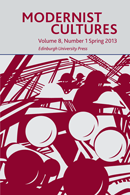
Out Now: Modernist Cultures 8.1 (Spring 2013)

Latest Issue of Modernist Cultures – out now

Modernist Cultures seeks to publish the best and most interesting scholarship in the field of modernist studies. Past contributors include Daniel Allbright, Thomas Elsaesser, Fredric Jameson, Michael Levenson, Herbert Lindenberger, Laura Marcus, Susan McCabe, Marjorie Perloff, Thomas Pfau, and David Trotter.


Free for BAMS Members

As the official BAMS journal, members of the Association receive a year’s subscription to Modernist Cultures. Becoming a member of BAMS is also a great way to keep updated on new research and support the scholarly community, including postgraduate training and and free or reduced entry to BAMS events. Membership costs £30 (£25 unwaged) for those based in the UK, and £45 (£35 unwaged) for overseas members, to cover international mailing costs.


To join BAMS go to bams.ac.uk/membership

MC8.1

Modernist Cultures Issue 8.1 (Spring 2013)

Edited by Andrzej Gasiorek, Deborah Longworth and Michael Valdez Moses

Special Issue: Musicality and Modernist Form

Guest Editors: David James and Nathan Waddell


Contents

Editorial Introduction: Musicality and Modernist Form (David James and Nathan Waddell)

Wagner as Dramatist and Allegorist (Fredric Jameson)

Modernism’s Handmaid: Dexterity and the Female Pianist  (William May)

Wyndham Lewis’s ‘Very Bad Thing’: Jazz, Inter-War Culture, and The Apes of God (Nathan Waddell)

‘Why then grieve?’: Virginia Woolf’s Mournful Music (Tanya Dalziell)

Samuel Beckett and Morton Feldman’s ‘Text-Music Tandem’ in Words and Music (Francis Hutton-Williams)

For Frank O’Hara: Morton Feldman’s Three Voices as Interpretation and Elegy (Scott W. Klein)

Koffi Kwahulé’s Coltranean Theatre of Cruelty (Eric Prieto)

Categories
CFPs Events

Edith Wharton Symposium: 22 and 23 August 2013, Liverpool Hope University, UK

Edith Wharton Symposium: 22 and 23 August 2013, Liverpool Hope University, UK
Organisers: William Blazek and Laura Rattray
Keynote Speakers: Pamela Knights and Gary Totten
Call for Papers: extended deadline 27 May 2013

We warmly invite papers on the life and work of Edith Wharton for an international symposium, co-sponsored by the Wharton Society, to be held in Liverpool in August 2013.

The symposium marks the 100th anniversary of the publication of Wharton’s much-read and much-analyzed novel The Custom of the Country. Described as the writer’s “greatest book” by Hermione Lee in her 2007 biography, and listed by Wharton herself at the end of a long and prolific career as one of her own favourite works, The Custom of the Country arguably remains the author’s most complex and controversial novel. To mark the centenary, many of the panels and keynotes will be devoted to topics pertaining specifically to this landmark text.

However, we also warmly welcome papers on any aspect of Wharton’s life and work, and the work of her contemporaries, both male and female, canonical and non-canonical, European and American. Papers might offer readings of any of Wharton’s texts, in any genre; Wharton’s work in relation to any of its nineteenth- and twentieth-century contexts; Wharton in a transatlantic literary context; Wharton and her contemporaries; narrative strategies; the writer’s dialogue with modernism and modernist aesthetics; Wharton’s influence on contemporary writers and popular culture. As another centenary approaches, we also seek papers treating Wharton and her contemporaries in the contexts of World War I.

We are delighted to confirm that the keynote speakers for this event will be esteemed Wharton scholars Dr. Pamela Knights (Durham University) and Professor Gary Totten (North Dakota State University). Dr. Knights, who has published extensively on Wharton, is perhaps best known as the author of The Cambridge Introduction to Edith Wharton, while Professor Totten is the immediate past president of the Wharton Society and editor of Memorial Boxes and Guarded Interiors: Edith Wharton and Material Culture.

The symposium will be held on the Hope Park campus of Liverpool Hope University, located within five miles of the Liverpool city centre. Moderately priced, ensuite campus accommodation will be available to delegates for the duration of the symposium. Day rates are also available. For those wishing to stay on and explore Liverpool after the symposium, an additional night’s accommodation will be available, and we will be arranging a morning tour of the city and/or – by special request for Beatles fans – of influential sites for the group, followed by lunch together before departing.

Please send any queries and 250-word abstracts for 20-minute papers (indicating any equipment/technical requirements) and a brief biographical note by 27 May 2013 to Laura Rattray via e-mail: custom@hope.ac.uk

Registration will open at the beginning of June. Further information and updates will be posted on the symposium website: http://www.hope.ac.uk/custom

We hope you’ll join us for this friendly and timely gathering of Wharton and early twentieth century scholars in August.

Sponsors: Liverpool Hope University and the Edith Wharton Society

Categories
Events

Modernist Magazines 1880-1940. Book Launch and Symposium (Tuesday 21st May)

Symposium and book launch at the Scottish National Gallery of Modern Art, Tuesday 21st May.

A collaborative event organised in partnership with the National Galleries of Scotland, the event will celebrate the publication of the final volume of a multi-authored history of Modernist magazines by Oxford University Press, and will feature talks by:

Professor Peter Brooker (Emeritus Professor, University of Nottingham)
Dr Sascha Bru (University of Leuven)
Dr Christian Weikop (University of Edinburgh)
Dr Debbie Lewer (University of Glasgow)
Professor David Hopkins (University of Glasgow)
Professor Christina Lodder (Honorary Fellow of the History of Art,
University of Edinburgh).

The symposium will take place in The Studio at Modern One, and will be followed by a book launch and drinks reception at Modern Two.

This is a free but ticketed event: tickets are available here:
http://www.eventbrite.co.uk/event/6240917753

For any queries, please contact 0131 624 6268.

Christian Weikop and Kirstie Meehan (event organizers)

Categories
Jobs

2 x Senior Lecturer/Lecturer in Modern English Literature, University of Birmingham

The University of Birmingham wishes to appoint TWO Lecturers/Senior Lecturers in English Literature with teaching and research interests in any area of British Literature after 1900 and/or world literatures in English. The posts will commence on 1st September 2013 or as soon as possible thereafter. We seek individuals who will make an outstanding contribution to the research profile of the Division of English Literature and Creative Writing, and will be able to teach across a wide range of relevant modules. It could be an advantage if one of the appointees complements our strengths in research and teaching in new interdisciplinary or digital humanities.

Closing date: 7 May 2013

A full job description is available in PDF format: http://www.download.bham.ac.uk/vacancies/jd/51042.pdf

Categories
Events Postgraduate

LAST REMAINING PLACES AVAILABLE: BAMS Postgraduate Training Day, Thursday 9th May

LAST REMAINING PLACES AVAILABLE

The British Association for Modernist Studies (BAMS) Postgraduate Training Day: Research Skills

The fourth annual BAMS postgraduate training day will be held at King’s College London on Thursday 9th May. Please find attached the event poster and programme.

The event is open to 70 postgraduate researchers. The day will include both practical advice and conceptual research training, covering interdisciplinary and archival research, as well as highlighting some of the socio-historical and theoretical contexts of modernism and contemporary modernist studies. Students from all relevant disciplines are welcome.

Registration deadline: Friday 26th April

To register, and for further information, please contact Chris Mourant: christopher.mourant@kcl.ac.uk

The event is free to members of BAMS and costs £10 for non-members.

BAMS Postgraduate Training Day 2013

Programme – BAMS Postgraduate Training Day 2013

Categories
CFPs Events

Altered Consciousness, 1918-1980 (16-17 November 2013, Queen Mary)

Call for Papers

Date of event: 16-17 November 2013
Venue: Queen Mary, University of London, E1 4NS
Closing date for submissions: 14 June 2013
Keynote speaker: Jeffrey Kripal (Rice University)

This meeting will explore the theme of altered consciousness in relation to popular culture, psychology, philosophy, religion, medicine and literature during the period 1918-1980.

Many literary and popular authors and performers during the mid twentieth century represented altered states of consciousness in their work, responding to and participating in research relating to such topics as interplanetary contact, ESP, clairvoyance, telepathy, mind-altering drugs, psychic therapies, spiritualisms, shamanism, erotics, conversion, revivals, somnambulism, precognition, distraction, group mind, multiple personality, hypnotism, lucid dreaming, Vedanta, hysteria and automatism.

What was the continuing legacy of nineteenth-century approaches to mind and spirit? How did work at the fringes of psychiatry and psychology intersect with mind sciences that consolidated their authority during the mid-twentieth century? What are the key interactions between European, North American and non-Western sources? How did investigations cross the borders between arts, sciences, religion, education and the military?

Priority will be given to submissions that show potential for sparking discussion across disciplinary boundaries, and are accessible to a non-specialist audience.

We are especially keen to hear from women contributors, and those whose work extends beyond British and North American contexts.

Please send a talk summary of approx 300 words and author bio of approx 50 words to: altconsc@qmul.ac.uk by 14 June 2013.

Speakers accepted onto the programme will have 20 minutes to speak.

This event is generously supported by: the British Society for the History of Science, and the Faculty of Humanities and Social Sciences, the Centre for the History of the Emotions, and the School of English and Drama at Queen Mary, University of London.