Blackwell’s Rare Books is pleased to announce its second ‘Modernisms’ catalogue, focusing on literary innovation in the first half of the twentieth century – the catalogue includes important first editions, limited editions, inscribed copies, and manuscript material. The catalogue is now available at: http://rarebooks.blackwell.co.uk/rarebooks/assets/images/catalogues/cat_mf2.pdf
Author: modernistudies
SCR, Park House, University of Reading, Wednesday 9th September 2015
“If civilisation is to recover, if Europe is ever again a world centre of humane art and thought, we must shake ourselves free from the passions and prejudices and even the just resentments of war.” (Gilbert Murray, The Gate: International Review of Literature and Art in English and German, 1947).
In recent years scholarship on literary modernism has increasingly focused on the “making” of modernism through the agents involved in writing, editing, illustrating, publishing, translating and reviewing modernist texts. The focus has ostensibly been on a period running from the opening years of the twentieth century to the Second World War. Yet modernist texts were eagerly seized by editors and publishers in the years immediately following the cessation of hostilities as a means by which to revive literary production, to span the breach in international intellectual exchange represented by the war years and, in the words of Gilbert Murray, to use the world of letters as “the right meeting place for men of thought and good will, irrespective of nationality”. This one-day symposium, which focuses on the publication of modernist writing in the period from 1945-1955, will give scholars the opportunity to explore the complications and tensions, but also the possibilities, that the end of the war brought to those involved in literary production itself or more generally working in the wider publishing landscape of the period. Papers are invited from scholars and groups of scholars working on modernist writing in the immediate post-war years. These papers might explore themes and concepts related to:
– the role of writers, editors, illustrators and publishers in the authorship, (re)publishing and (inter)national transmission of modernist writing;
– the role of translation and international language policies and practices in restoring literary and intellectual exchange;
– the national and international politics of literary publication in the immediate post-war period;
– new fora: the emergence of “little magazines” and small presses;
– new approaches: the potential for revision, reinterpretation and innovation;
– new visions: the forging of new networks of intellectual exchange.
Please submit abstracts for papers (250-300 words) to:
Dr Alison E. Martin – a.e.martin@reading.ac.uk – by Friday 26th June 2015.
Dr. Alison E. Martin, FHEA
————————————-
Lecturer, Department of Modern Languages and European Studies
University of Reading
Whiteknights PO Box 218
READING RG6 6AA
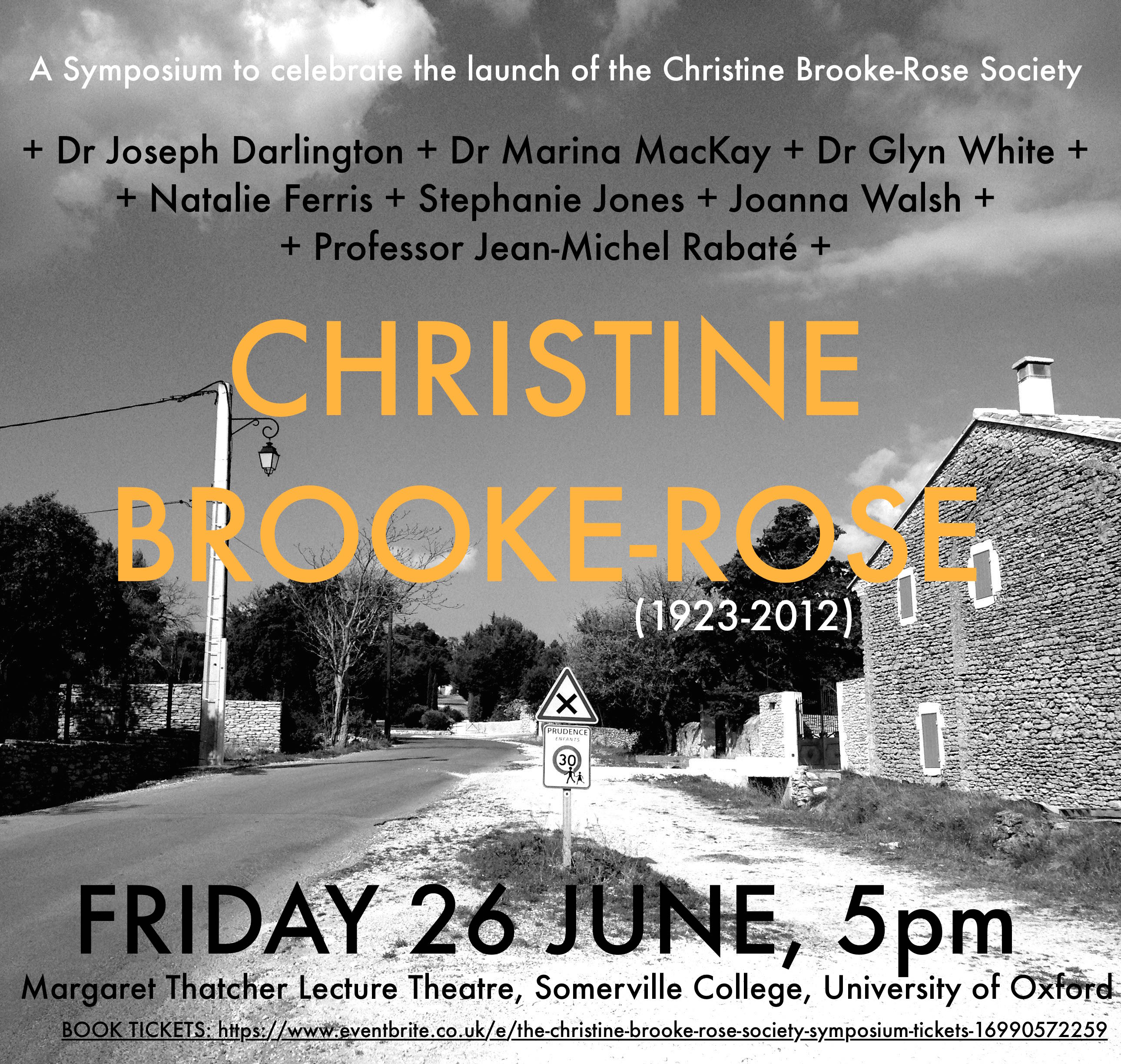
Please find the attached poster for the launch of the Christine Brooke-Rose Society. The launch will incorporate a number of speakers including Professor Jean-Michel Rabaté (UPenn), Dr Glyn White (Salford), Dr Joseph Darlington (Salford), Dr Marina MacKay (Oxford) and Joanna Walsh. The event will take place from 5pm-8pm on 26th June 2015 at Somerville College, Oxford in the Margaret Thatcher Conference Room, including a wine reception. This is a free event but we ask that all delegates register their attendance via the Eventbrite page on the poster as spaces are limited.
Many thanks to those who have already submitted abstracts for the inaugural MONC conference. Upon request, we have now extended the CFP deadline to 30 June. To complement the papers already received, we are especially keen to receive proposals relating to the visual arts, material culture and women artists and writers.
This interdisciplinary conference will bring together scholars to reflect upon the past, present and future of both modernism and modernist studies in Wales. We welcome proposals on any aspect of modernism, as defined in the widest sense, but we particularly welcome proposals relating to Welsh modernist writers and artists, as well as modernist art and writing in Wales.
Proposals for 20-minute papers should be sent to modernistnetworkcymru@gmail.com by 30 June 2015.
To download revised versions of the CFP in English and Welsh, please visit http://modernistnetworkcymru.org/2015/06/16/cfp-deadline-extended-a-century-on-modernist-studies-in-wales/ Please do circulate the CFP to any interested colleagues, especially postgraduates.
CFP: Edith Wharton Society
Please join the Edith Wharton Society for its upcoming Conference in Washington, DC. The conference directors seek papers focusing on all aspects of Wharton’s work. Papers might offer readings of any of Wharton’s texts, including the short fiction, poetry, plays, essays, travel writing, and other nonfiction, in addition to the novels. While all topics are welcome, the location of the conference in the U. S. capital invites readings related to nationalism, cosmopolitanism, transatlanticism, seats of power, Americana, museum cultures in the 19th C, material cultures, and the work of preservation. Further, given the centennial years of World War I, papers offering new examinations of Wharton’s relationship to the war are particularly invited. Proposals might also explore Wharton’s work in the context of such figures as Teddy Roosevelt and Henry Adams or Wharton’s work in relation to that of her contemporaries, such as Gertrude Stein, Willa Cather, F. Scott Fitzgerald, Ernest Hemingway, Nella Larsen, Anita Loos, Henry James, and more. All theoretical approaches are welcome, including feminist, psychoanalytic, historicist, Marxist, queer studies, affective studies, disability studies, and ecocritical perspectives.
We plan to organize paper sessions, roundtables, and panel presentations. In addition, there will be a keynote speaker and opportunities for tours of local exhibits. Further details forthcoming at the conference website https://whartoninwashington2016.wordpress.com/.
Please submit 350-500-word abstracts and brief CV as one Word document to WhartoninWashington2016@gmail.com by July 15, 2015. All conference participants must be members of the Edith Wharton Society at the time of registration.
For more information about the conference, contact Conference Directors Melanie Dawson (College of William & Mary) and Jennifer Haytock (The College at Brockport, SUNY) through the conference email account.
Please find below an announcement for Modernity and the European Mind: an International, Interdisciplinary Colloquium
The colloquium is hosted by the Centre for Studies in Literature, University of Portsmouth, and will take place on 25-26 June 2015.
Speakers include: Jean-Michel Rabaté (University of Pennsylvania), Catherine Bernard (Univ Paris-VII), Mary Ann Caws (City University of New York), Joanna Hodge (Manchester Metropolitan), Tone Selboe (University of Oslo), Doug Haynes (University of Sussex), Sissy Helff (Goethe-University, Frankfurt), Monika Pietrzak-Franger (University of Hamburg), Monika Szuba (University of Gdansk)
Where does Modernity begin, how is it defined, and how does it define itself? What does it mean to be European, or to think in terms of Europe and / or non-Europe? How does Europe understand itself in relation to all that perceives as ‘not-Europe?’ How do those who are not gathered into the ontology of ‘the European’ see or represent themselves against the notion of a European identity, or address the question of ‘Europe’? And in what ways do ‘modernity’ and ‘European thought’ determine, and define one another? Modernity is a fraught, often contested term in the Humanities and Social Sciences. There is little agreement as to its parameters, its definition, its starting point, or the understanding of its epoch. Similarly, the notion of Europe is equally contested, unavailable to a final consensus, irreducible to a single epistemological, historical or ontological determination.
For information on registration, contact: Julian Wolfreys, Director, CSL, julian.wolfreys@port.ac.uk
AMSN3: Modernist Work
Date: 29-31 March 2016
Venue: University of New South Wales, Sydney
Abstracts due: 1 October 2015
Notification of acceptance: 1 November 2015
This conference aims to explore the manifold intersections of modernist culture and the concept of “work”. Modernism emerged during a moment of rapid transformation in the conditions and meaning of labour. New jobs and professions proliferated with dizzying speed in the wake of the second industrial revolution, along with new techniques of “scientific management”. Under the influence of these and other changes, the kinds of work available to women changed markedly during the modernist period, while legal gender restrictions were abolished in a growing number of professions. At the same time, many strands of modernist culture involved a rethinking of the concept of “work” in literary and aesthetic domains, in often contradictory ways. Modernist writers and artists repeatedly interrogated the nature and function of an artistic career in an age of mass culture, and radical critiques of the notion of the art “work” itself—as organic, as self-contained, as a product of artistic skill—were launched from various sectors of the avant-garde. Numerous subsequent interventions in critical and aesthetic theory can be placed in the lineage of this initial modernist questioning of the work itself.
We are seeking papers on the relationship between modernism and work in any of its myriad configurations—formal, historical, empirical, theoretical, literal, metaphorical, textual, contextual, material and everything in between. We also welcome papers that test the boundaries of the concept of modernism itself, whether by extending its chronological scope, rethinking its traditional canon or questioning its privileged media.
How did modernist artists and writers respond to revolutions in the world of work? How did modernists construe the occupation of the artist and the category of the work of art? Which theoretical perspectives are best suited, today, to understanding the meaning of “work” in modernism? And what kinds of work are we doing, anyway, those of us who “work on modernism”? These and many others are the kinds of question that we will work on, through and over at this conference.
Possible topics include, but are by no means limited to:
– the office
– modernists’ day jobs
– networks and networking
– brainwork
– dreamwork
– facework
– women and work
– “Professions for Women”
– alienation/reification/rationalization
– professionalism/specialization
– mechanization/automatization
– the emergence of the concept of unemployment
– Marx and Marxist aesthetics
– trade unionism and Labour politics
– working-class writing and reading
– “the working of the work” (“die Wirklichkeit des Werkes”)
– “The Work of Art in the Age of its Technological Reproducibility”
– unworking/worklessness (“désoeuvrement”)
Confirmed keynote speakers:
Professor Christopher Nealon (Johns Hopkins University)
Professor Morag Shiach (Queen Mary University of London)
Other keynote speakers to be advised
Proposals are invited for 20 minute papers or panels of three papers examining any aspect of the conference theme. Proposals from postgraduate students are especially encouraged.
Please send 300 word abstracts and a brief biographical note to j.attridge@unsw.edu.au by Thursday 1 October 2015.
Registration and other information will be available through the AMSN website, at http://amsn.org.au/

Professor Clare Hanson
‘Katherine Mansfield and Psychology’
Sunday 18 October 2015, 2.00pm
Keynes Library,
Birkbeck, University of London,
43, Gordon Square, London, WC1H 0PD
Tickets £15 members and £20 non-members, to include a glass of wine, cake, and a copy of the birthday lecture booklet.
Please go to Eventbrite to book your tickets: https://eventbrite.co.uk/event/17242300184/
The School of Arts and Humanities seeks to appoint two Lecturers in English, fixed term for one year from 1 September 2015. Applications are sought from candidates with teaching experience in two or more of the following areas:
- Post one: Postcolonial literatures, 19C and 20C American literature, feminism/women’s writing, gender and sexuality.
- Post two: Modernism, travel writing, feminism/women’s writing, gender and sexuality, post-colonial literatures, 19C and 20C American literature.
You will be able to demonstrate experience and expertise in teaching, curriculum design and assessment in English literary studies and within your own specialist area. Candidates for this post must possess a commitment to teaching and learning and be able to work in a team-based and interdisciplinary context. You will work under the direction of the Head of English, Culture and Media and with the supervision of the Academic Courses Manager in English, Linguistics and Philosophy in delivering high quality teaching, learning and pastoral support to students.
The School of Arts and Humanities delivers inspiring and supportive undergraduate and postgraduate teaching; provides doctoral supervision; collaborates and engages with local, national and international industries, professions and communities; and undertakes high quality research. In the 2014 Research Excellence Framework exercise, 70% of English research was judged to be of world-leading or internationally excellent quality. Academics in the School work in partnership with colleagues nationally, as well as in Europe, Asia, North and South America, and Australia. This has the benefit of creating a varied and dynamic community that enhances research and the student experience more generally. The School hosts a range of innovative Research Centres and Projects, offering opportunities for collaborative work in many areas. You will have an excellent publication profile, consisting of REF-returnable monographs and articles in top international journals and the aptitude to teach to the highest standards at both undergraduate and postgraduate levels.
Closing date: Sunday 28 June 2015
Interviews: Tuesday 21 July 2015
If you have any specific queries in relation to these positions, please contact the Head of English, Culture and Media Studies, Professor Nahem Yousaf, via email: nahem.yousaf@ntu.ac.uk or the Subject Leader for English, Dr Sharon Ouditt, via email: sharon.ouditt@ntu.ac.uk
To submit an online application for this position please click the ‘Apply’ button below.
This role does not meet the minimum requirements set by UK Visas & Immigration to enable sponsorship of migrant workers. Therefore we cannot progress applications from candidates who require sponsorship to work in the UK.
The School of Arts and Humanities seeks to appoint a full-time Professor in English Literature with a profile combining research excellence and inspiring teaching. Applicants will have an excellent publication profile, consisting of REF-returnable monographs and articles in top international journals, and the aptitude to teach to the highest standards at both undergraduate and postgraduate levels. Applications are sought from highly qualified candidates with teaching experience spanning two or more of the following areas: Romanticism, 19C British literature, American literature, travel writing studies, Modernism. Demonstrated strengths in research leadership, grant capture and/or external partnership working and knowledge transfer will be an advantage.
The School of Arts and Humanities delivers inspiring and supportive undergraduate and postgraduate teaching; provides doctoral supervision; collaborates and engages with local, national and international industries, professions and communities; and undertakes high quality research. In the 2014 Research Excellence Framework exercise, 70% of English research was judged to be of world-leading or internationally excellent quality. Academics in the School work in partnership with colleagues nationally, as well as in Europe, Asia, North and South America, and Australia. This has the benefit of creating a varied and dynamic community that enhances research and the student experience more generally. The School hosts a range of innovative Research Centres and Projects, offering opportunities for collaborative work in many areas.
You will be able to demonstrate experience and expertise in teaching, curriculum design and assessment in English literary studies and within your own specialist area. Candidates for this post must possess a commitment to teaching and learning and be able to work in a team-based and interdisciplinary context. You will work under the direction of the Head of English, Culture and Media and with the supervision of the Academic Courses Manager in English, Linguistics and Philosophy in delivering high quality teaching, learning and pastoral support to students.
Interviews: Thursday 23 July 2015
If you have any specific queries in relation to these positions, please contact the Head of English, Culture and Media Studies, Professor Nahem Yousaf, via email: nahem.yousaf@ntu.ac.uk or the Subject Leader for English, Dr Sharon Ouditt, via email: sharon.ouditt@ntu.ac.uk
To submit an online application for this position please visit www.ntu.ac.uk/vacancies.
Applications from candidates who require sponsorship to work in the UK will be considered alongside other applications. However, candidates who require sponsorship cannot be appointed if a suitably qualified, experienced and skilled EEA applicant is available due to the UK Visas & Immigration requirements. For further information on this please visit the UK Visas & Immigration website.