Categories
Call for submissions Postgraduate

CFP: American Literature and the Transnational Marketplace

The last fifteen years have seen substantial changes in the way scholars have engaged with US literature and culture. In particular, the rise of two methodological paradigms, TRANSNATIONALISM and PRINT CULTURE STUDIES, have paved the way for exciting new approaches to key questions that have always been at the heart of the discipline: the relationship between literature and nationhood, the role of writing in international circuits of knowledge and commodity exchange, and the artistic labour of the author.

The Open Library of Humanities is a unique platform for interdisciplinary work, and provides us with an opportunity to collect together a more diverse range of new work in this area than would be possible within more traditional publishing outlets. The aim of this special curated collection is to reflect on the history of international markets, copyright, and the book trade as shaping forces in American literature and culture. We seek work representing the entire history of the United States from the earliest instances of print culture in the colonies, to the market revolution of the nineteenth century and contemporary digital media and new publishing or distribution formats. Essays may be literary-historical in nature, focus on issues of academic methodology, or adopt forms of close reading informed by transnationalism and print culture studies. The American Literature Section Editor, Dr. Michael Collins, will then curate a special collection from work that passes the peer review process. Topics may include, but are not limited to:

  • American Literature and Copyright
  • Literary “Nationalism” and the International Marketplace
  • The Book as “Commodity”
  • Literature and Digital Media/ Digital Humanities/ Open Access
  • Representations of the Literary Marketplace in Fiction
  • Transnationalism and Literary Form
  • US Print Culture and Transnationalism (Magazines, Newspapers, Pamphlets, Chapbooks, “Little Magazines”, Broadsides)
  • Literary Labour in the Marketplace
  • The Politics of the Transnational Marketplace
  • American Studies, Transnationalism and The Academic Job Market
  • Review Essays

The special collection, edited by Michael Collins, is to be published in the Open Library of Humanities (ISSN 2056-6700). The OLH is an Andrew W. Mellon Foundation-funded open-access journal with a strong emphasis on quality peer review and a prestigious academic steering board. Unlike some open-access publications, the OLH has no author-facing charges and is instead financially supported by an international consortium of libraries. Work appearing in the Open Library of Humanities is compliant with funder audits, such as the UK’s Research Excellence Framework.

Submissions should be made online at: https://submit.openlibhums.org in accordance with the author guidelines and clearly marked for the AMERICAN LITERATURE AND THE TRANSNATIONAL MARKETPLACE CFP. Submissions will then undergo a double-blind peer-review process. Authors will be notified of the outcome as soon as reports are received. As per the Author Guidelines of the OLH, submissions should be no longer than 8,000 words. The publishing format of OLH allows for a uniquely expansive approach to publishing research. Consequently, shorter pieces, creative works, or hyperlinked article formats are encouraged. For advice, please contact the Editor.

Deadline for submissions: 1 August 2015.

To learn more about the OLH, visit: https://www.openlibhums.org.
Categories
Postgraduate Registration open

Modernism’s Chronic Conditions: Temporality, Medicine, and Disorders of the Self

Xfi Building, University of Exeter
Friday 17 April 2015
Registration is Free

Speakers

  • Dr Marion Coutts, author of The Iceberg (Goldsmiths)
  • Prof Lois Oppenheim (Montclair State University)
  • Dr Lisa Baraitser (Birkbeck)
  • Prof Jeremy Holmes (University of Exeter)
  • Jonathan Heron (University of Warwick)
  • Dr Kirsty Martin (University of Exeter)
  • Prof Zoe Playdon (University of London)

Respondents

  • Prof Alan Bleakley (University of Falmouth)
  • Prof Chris Code (University of Exeter)
  • Prof Paul Dieppe (Exeter Medical School)
  • Dr Joanne Winning (Birkbeck)

About the Event

This workshop brings together scholars, creative practitioners, medical educators, and clinicians concerned with disorders of the embodied mind, to consider how artistic modernism might offer specific resources for understanding what it means to live with conditions which resist narrative shapes of closure and completion.

This workshop is the first event organized by the AHRC funded network ‘Modernism, Medicine and the Embodied Mind: Investigating Disorders of the Self’. [Read More]

Categories
Events Postgraduate Registration open

 Scotland and Russia: Cultural Perception Since 1900

10-11 April, 2015

This is the second event of the ‘Scotland and Russia: Cultural Encounters since 1900’ project, dedicated to uncovering the history of cultural exchange between the two countries over the last hundred years (www.englit.ed.ac.uk/scotland-and-russia).

The two-day symposium at the University of Aberdeen will feature talks by historians, sociologists and literary scholars from both Scottish and Russian studies.  It will explore the role of travel writing, poetry and art in cultural mediation, the experience of national bridge-building organisations, as well as political perceptions circa 1914 and 2014, in relation to the Great War and Revolution and the Scottish Independence Referendum.  Speakers include Prof Anthony Cross and Lt Cdr Dairmid Gunn

The event is free and open to the public.  Programme attached.

Please register here: https://www.eventbrite.com/e/scotland-and-russia-cultural-perception-since-1900-tickets-15802193787

University of Aberdeen
Research Institute of Irish and Scottish Studies
Humanity Manse
19 College Bounds
Aberdeen AB24 3UG

Contact Organiser: Anna Vaninskaya (anna.vaninskaya@ed.ac.uk)

Sponsored by the University of Aberdeen Research Institute of Irish and Scottish Studies, the University of Edinburgh Challenge Investment Fund and the Royal Society of Edinburgh

Scotland Russia Cultural Perceptions Since 1900 Programme

Categories
CFPs Postgraduate

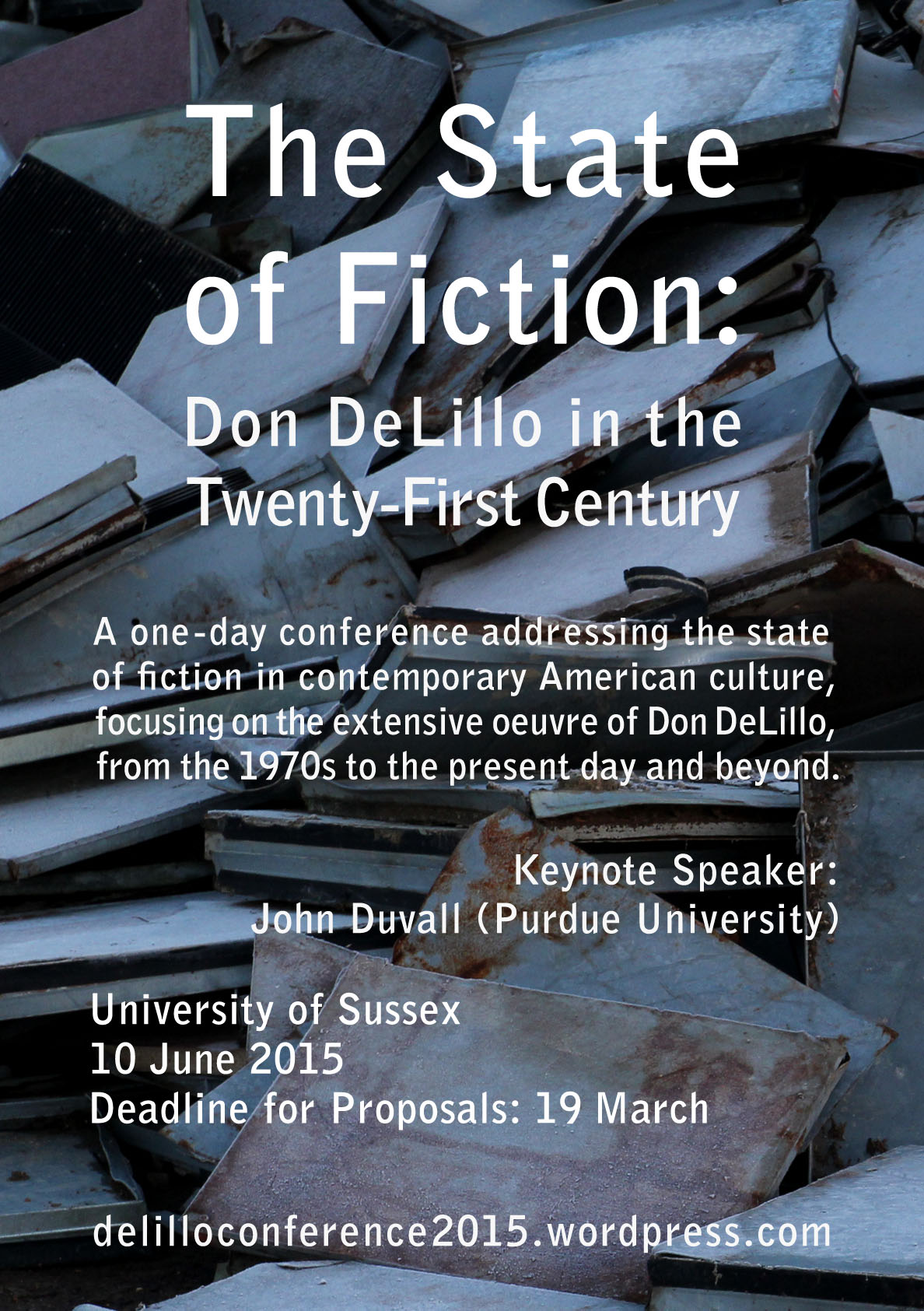
Call For Papers: The State of Fiction – Don DeLillo in the Twenty-First Century

The State of Fiction: Don DeLillo in the 21st Century

10 June 2015, University of Sussex

Writing also means trying to advance the art. Fiction hasn’t quite been filled in or done in or worked out. We make our small leaps. Don DeLillo, 1982

This one-day conference will address the state of fiction in contemporary American culture by focusing on the extensive oeuvre of Don DeLillo, from the 1970s to the present day and beyond. DeLillo commented shortly after the publication of The Names that fiction had not yet been ‘filled in,’ ‘done in,’ or ‘worked out.’ How do we read this thirty years later, in the shadow of not only DeLillo’s major works but also the events that have characterised our move into the Twenty-First Century? How have DeLillo’s small leaps between the New York of Players (1977) and the New York of Falling Man (2007) ‘filled in’ fiction? Has DeLillo’s pervasive influence across contemporary American culture ‘done in’ postmodernism? Is the novel in the Twenty First Century already ‘worked out’?

Proposals for presentations of 20 minutes or for pre-formed panels of 1 hour are invited; topics, which should be rooted in the work of DeLillo, may include but are not limited to:

·       The novelist in contemporary (American) culture: canonicity, influence, consumption

·       New contexts: 9/11, Occupy, neoliberalism, globalisation

·       ‘The Power of History’: the state and the shadow-state, popular culture, paranoia

·       New realisms: crisis, terror, apocalypse, childhood, metafiction

·       Language: the individual and the crowd, the everyday and the event, ekphrasis

·       New forms: genres, adaptations, translations, multilingualism

·       The ends of postmodernism? Forebears, afterlives, lateness

·       Environment, global warming and waste

Submissions that are interdisciplinary in nature are particularly encouraged. Abstracts of up to 250 words in length and a brief biographical note should be submitted at delilloconference2015.wordpress.com by 19 March 2015.

The State of Fiction Poster

Categories
CFPs Postgraduate

CFP: Symposium on Modernist and 20th Century Publishing Houses

To be held at the University of Reading, Special Collections, Friday 10th July 2015

“We are thinking of starting a printing press, for all our friends stories. Don’t you think it’s a good idea?” (Virginia Woolf to Lady Robert Cecil, October 1916. Letters 2:120).

Much scholarship has been undertaken in recent years on the “institutions”, producers, and materialmakers of literary modernism. Such work has aided our understanding of the cultural and textual production of modernist writing and has been particularly prominent with regards to the important role played by periodicals and small and little magazines. The Modernist Journals Project http://modjourn.org/ is one example among many of the dynamic research taking place in this area.

This one-day symposium, taking inspiration from such scholarship, will offer an opportunity to focus on the publishers and publishing houses who also helped to make and produce modernism. Papers are invited from scholars and groups of scholars working on any global publishing house related to modernist writing – from Faber & Faber to Mills & Boon, from Chatto & Windus to the Gregynog Press, from Grant Richards to Tauchnitz. We hope that the day will offer an opportunity to explore some of the multifarious connections between these publishing houses and the writers, illustrators, press workers, managers and editors with whom they were associated. The day is being organised to coincide with the launch of the Modernist Archives Publishing Project (MAPP, funded by SSHRC 2013-15) which we hope, through working with other teams, to expand from the Hogarth Press as case study into the wider publishing landscape of the period.

Papers might explore themes and concepts such as:

–       Publishing and textuality

–       Publishing history and the history of reading

–       Publishing books and the little magazines

–       The roles of publishers, editors, press workers

–       Censorship and innovation

–       Editing

–       Digital initiatives in book and publishing history

Please submit abstracts for papers (300 words max) to Dr Nicola Wilson, n.l.wilson@reading.ac.uk no later than Friday 8th May.

Further information about the symposium can be found at https://publishinghistory.wordpress.com

Co-organised by Dr Nicola Wilson and Dr Claire Battershill, University of Reading and MAPP

www.modernistarchives.com

Categories
CFPs Postgraduate

CFP: Sensory Modernism(s): Cultures of Perception

‘Sensory Modernism(s)’, seeks to address the interrelationship of modernism with sensory perception. The spirit of the conference is interdisciplinary, and invokes characterisations of modernism derived from a wide range of discursive domains. The one-day conference will be held at the University of Leeds on Thursday May 21.

Keynote Speakers: Dr Richard Brown, Dr Christina Bradstreet, Caro Verbeek

http://http://modernismsenses2015.weebly.com/

We invite proposals for twenty-minute papers which address the theme of modernism and the senses. Papers may address, but are in no way limited to, the following topics and their relevance to the general scope of the conference:

Philosophy
Psychoanalysis
Cinematography
Radio
Medicine
Anthropology
Aesthetics
Linguistics
Literature and the marketplace
Animals
Sexuality

Abstracts of 200-300 words, with a brief bio of no more than 200 words, should be emailed tosensorymodernisms2015@gmail.com by 15 April 2015.

Categories
Events Postgraduate

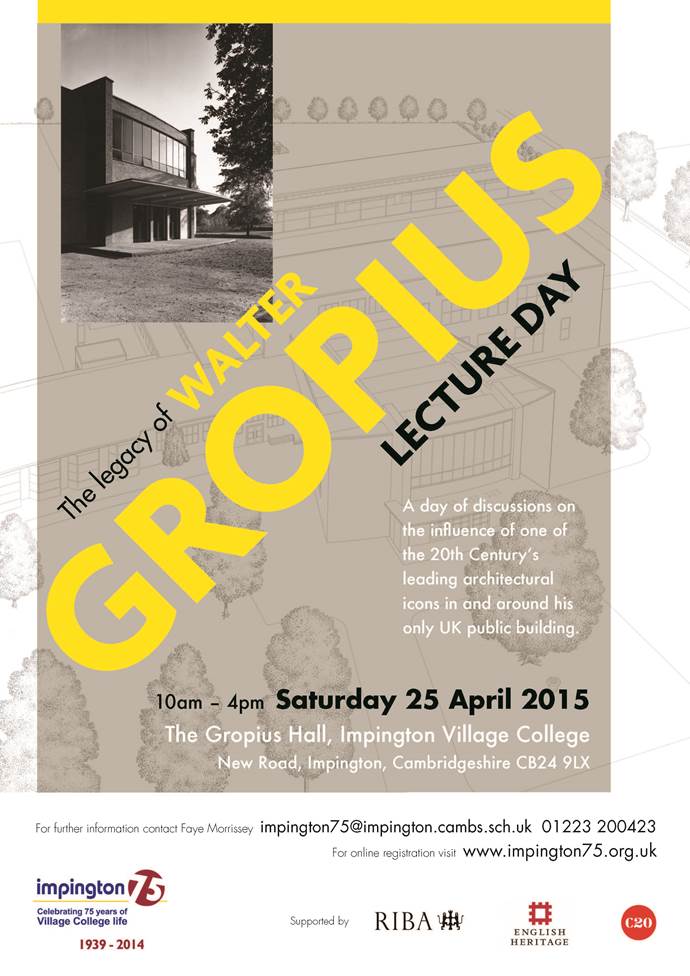
Lecture Day: The Legacy of Walter Gropius

Saturday 25 April, 10am – 4pm, Impington Village College, Cambridgeshire

This special lecture day will take place in the Grade 1 Listed Building at Impington Village College – the only public commission in the UK by Gropius.

Walter Gropius (1883 –1969), Architect and founder of The Bauhaus School, is widely regarded as one of the pioneering masters of modern architecture.  The lecture day will bring together experts from different fields to discuss the influence of Gropius’ work at Impington and how his work which penetrated the wider world is still significant today.  There will be presentations on the built environment in the 1930s, conservation principles and the impact of modernist architecture on practice today.  Speakers include leading Architectural Historian Dr Alan Powers, English Heritage and RIBA Architects.  There will include a tour of the building, an introduction about Henry Morris and panel discussion.

Adults: £25, Students: £15.

10% discount for groups of 10 or more.

Please find attached a flyer with further information including full programme. 

Buy your tickets online here

image001

Categories
CFPs Postgraduate

CFP: Relatability (MSA 17)

A specter is haunting university classrooms: the specter of “relatability.” For many teachers past a certain age, this term hardly seems a word at all. Its limitations as an analytic term are manifest: its fuzzy subjectivism treats everything as its own reflection in a manner that inhibits both critique and description. Journalists and commentators have marveled at the viral spread of this critical judgment in the last ten years, yet the sense of “relate” at its core (as in, “I can relate to what you are going through”) comes into usage in the middle of the twentieth century. This panel seeks to uncover a longer twentieth-century genealogy for “relatable” and to consider whether it might be recuperated as a meaningful critical term for thinking about twentieth as well as twenty-first century art and literature. That such recuperation might be worthwhile stems from our sense that relatability constitutes an important strain of modernist aesthetic theory, despite the latter’s association with forms of objectivity and autonomy. Something not unlike relatability seems to underlie Gertrude Stein’s claim, for instance, that “All literature is me to me, that isn’t as bad as it sounds.” From Stein to mid-century modernists such as Frank O’Hara, an aesthetic linked to forms of identification, mimesis, and likeness has been an important resource, especially for queer artists and audiences. More broadly, “relatability” indexes forms of aesthetic experience that have been associated with unschooled or amateur modes of responding to art and literature. Reincorporating such apparently preprofessional forms of relationality into professional scholarship has been an important impulse across the discipline. Indeed, many recent methodological developments in literary and cultural studies–Bruno Latour’s injunction to trace the connections between things, Wai Chee Dimock’s interest in weak ties–suggest that criticism’s job is not to uncover truths or to apprehend unities but to discover that everything is in fact relatable. We solicit papers that consider relatability a€™s modernist pasts and critical futures.
Please send a brief abstract and CV to glavey@sc.edu and l.heffernan@unf.edu by April 10.
Categories
CFPs Postgraduate

CFP for 2016 MLA Guaranteed Session for Division on Victorian and Early-20th-Century English

“Air”

Literature/art/culture and the elements, climate change, weather, air-borne particles and biological contagions, zeppelins, balloons and early aviation, cosmologies and conceptualizations of outer space. Theoretical approaches welcome: material feminist, LGBTQ, phenomenological, ecological, Anthropocene, psychological, linguistic, global.
250 wd. proposals by 20  March to David Kurnick (dkurnick@rci.rutgers.edu) and Cassandra Laity (claity@utk.edu).
Categories
CFPs Postgraduate

CFP: The mood of modernism: affect/invention/concept (MSA 17)

We invite papers which explore  modernism not in its more visible, spectacular, and externalized manifestations, but rather in unforeseen points, junctures, landscapes, interstices and borders, including the juxtaposition of intellectual and private life, past and present, the life of the mind and divided, alternative, fragmented, patched up, or precarious lives. We encourage all sorts of contributions on the significance of modernism when it is revolutionary otherwise, in more silent, dispersed ways, or when modernism itself becomes an atmosphere or a mood, thus a concept that can do its work only if it captures something as elusive as mood.

For example, through repetition over time, how might aesthetic modernism transfer to the lives we live, and become present in them? Is it plausible to think of modernism as an atmosphere of one’s daily life in the present? When? How? Where?  Given the popularity and the expandability of modernism, doesn’t the concept itself raise the question of modernism as that of passage, transit, transmission? One, therefore, can imagine a geographical transit: an Anglo-American modernism that passes, let’s say, through Italian hermeticism to re-emerge, over  time, in all kinds of Anglo-American modernism’s others.  However, one might also imagine quite a different kind of transit, a less geographical and more atmospheric transit. This less spectacular modernism may be felt to be in the air when it  impacts on us in unforeseen ways, making waves of meaning (and meaningfulness) right in the middle of our daily lives, when past intellectual and aesthetic residues, introjected verbal and visual memories of ideas, sensations, and readings, combine with our local position to open up conceptual, theoretical, creative possibilities and potentialities. It’s like being between mountains and sea, suddenly released from the limits of the local to experience an ampler, more global belonging. How does affect for/from modernism flow into public research? What are the other, improper places of modernism?

The panel is open to anyone from any discipline who wishes to explore how modernist objects—archival, textual, musical, visual, mnestic, or other– enter daily life, create sustenance, and incite creativity, conceptual and of other kinds.

Please contact panel co-organizers to discuss ideas, or send a 250-word abstract, along with a brief biography, by April 5 to:

Carla Billitteri at carla.billitteri@umit.maine.edu and Mena Mitrano at mmitrano@luc.edu, or

mena.mitrano@tin.it