Categories
CFPs Postgraduate

CFP: RAYMOND WILLIAMS NOW

A reminder that the deadline for abstracts for Raymond Williams Now, to be held in Manchester on May 30th, is approaching. Abstracts are due March 1st. Please see the attached poster.

RAYMOND WILLIAMS NOW
30 May 2015

Recent years have witnessed major critical reappraisals of British Cultural Studies and its key figures. This one-day conference, organised by the Greater Manchester-based Radical Studies Network, continues that process through assessment of Raymond Williams’ work and legacy.

The event will feature a keynote lecture by Professor Tony Crowley on ‘Keywords, Then and Now’. Artist Ruth Beale will present a film of her 30-minute performance, ‘Performing Keywords’, first performed at the Turner Contemporary, 2013. The day will conclude with a round-table discussion on Raymond Williams and the contemporary Left.

We also invite proposals for 20-minute presentations or panels of 3–4 presentations from academics, activists, and creative practitioners. Topics might include, but aren’t restricted to:

contemporary ‘structures of feeling’; adult education past and present; ecology; cultural materialism now; feminism; media, technology, and cultural form; politics and letters; Williams and Wales; the May Day Manifesto; post-colonial and global Williams; science fiction; the public intellectual; Williams and the politics of criticism; Williams as novelist and playwright; creative practices; cultural institutions; ‘old’ and ‘new’ lefts.

Abstracts of 250 words (1000 words for panels) should be submitted toben.harker@manchester.ac.uk by 1 March 2015.

The conference will be held at the Friends’ Meeting House in central Manchester on Saturday 30 May 2015. Registration costs will be kept to a minimum thanks to the generous sponsorship of the Raymond Williams Society and the Raymond Williams Foundation. Seehttps://radicalstudiesnetwork.wordpress.com/ for further information.

Please feel free to pass on to anyone who may be interested.

RWN poster 3b update

Categories
Events Postgraduate

Northern Modernism Seminar

BLAST 1915-2015: Celebrating the ‘War Number’ of BLAST

Friday 8 May 2015

University of Nottingham

Speakers include:

Kate Armond, Rob Spence, Ivan Phillips, and David Wragg

Categories
Postgraduate Registration open

Registration now open: Aestheticism and Decadence in the Age of Modernism: 1895 to 1945

We are delighted to announce that the programme for Aestheticism and Decadence in the Age of Modernism: 1895 to 1945, 17-18 April, 2015 is now online, and registration is open:

http://www.ies.sas.ac.uk/ies-conferences/ageofmodernism

Categories
Call for submissions Postgraduate

CFP: The New Black and The New Negro: Generational Tensions between Blackness, Colorlessness, and Post-Black

Special Feature: Volume 8, no. 1, November 2015

Guest Editor: Kinitra D. Brooks, University of Texas, San Antonio

A class of colored people, the ‘New Negro’,  … have arisen since the War, with education, refinement, and money. – Cleveland Gazette, 28 June 1895

There are constructive channels opening out into which the balked social feelings of the American Negro can flow freely…. One is the consciousness of acting as the advance-guard of the African peoples in their contact with Twentieth Century civilization; the other, a sense of a mission of rehabilitating the race in world esteem from that loss of prestige for which the fate and conditions of slavery have so largely been responsible.

– Alain Locke in The New Negro, 1925

The ‘new black’ doesn’t blame other races for our issues. The ‘new black’ dreams and realizes that it’s not a pigmentation; it’s a mentality. And it’s either going to work for you, or it’s going to work against you. And you’ve got to pick the side you’re gonna be on.                                                                   – Pharrell Williams,Oprah Prime (2014)

I’m tired of being labelled. I’m an American. I’m not an African American; I’m an American … And that’s a colorless person.      – Raven Symone, Oprah Prime (2013)

The words of music producer Pharrell Williams and actress Raven Symone initiated what is now referred to as the ‘New Black’ or ‘Millennium Negro’ Movement. Critical race theorists have implied that these musings hearken back to another African American cultural movement of self-articulation, that of ‘The New Negro’.Transnational Literature is calling for scholarly papers and poems that critique and explore the themes and theories interrogating the possible connections between these two socio-political cultural projects. We welcome papers and creative works that include but certainly are not limited to the following topics:

·      The New Black v. The New Negro

·      Contemporary ahistorical manifestations of Blackness and questions of critical legitimacy

·      Global Perspectives of The New Black

·      Transnational Black Cosmopolitan Identity and Culture

·      The New Black’s connections to The Talented Tenth

·      The New Negro/Old Negro and The New Black/Old Black

·      The Importance of Class

·      Postcolonial/Neocolonial Blackness in the African Diaspora

·      Problematising prescriptive racial identities

Transnational Literature invites unpublished papers not currently under consideration by any other publisher. Article submissions should be 4000-6000 words in length and should include an abstract of approximately 150 words in addition to a brief author biography.

Please consult the submission guide –fhrc.flinders.edu.au/transnational/submissions.html

Please submit all finished works and queries to tnlthenewblack2015@gmail.comby May 10, 2015.

Transnational Literature is a freely accessible, fully refereed international e-journal published twice a year by the Flinders Institute for Research in the Humanities, Flinders University, Adelaide, Australia.​

Categories
CFPs Postgraduate

CFP: E.M. Forster’s legacy: “Only connect” over a century of British arts

A conference orgainsed at University Toulouse Jean Jaurès (France)

Research team CAS (EA 801)

Convened by Laurent MELLET and Elsa CAVALIÉ

10 and 11 December 2015

Hardly more than one century after British writer E. M. Forster’s first novels were published, this international conference will question the artistic, aesthetic, political and ethical legacy of novels that have often been defined as generically blurred, oscillating as they do between the Victorian and Edwardian legacy and Modernist drives.

Since Forster’s death in 1970, many British novelists and film directors have acknowledged and even claimed the influence of the novelist of the English soul (in Woolf’s terms) and of a renewed faith in both human relationships and a quintessentially British liberal-humanism. We may think here of the film adaptations by James Ivory (A Room with a ViewMauriceHowards End) and David Lean (Passage to India), and of Zadie Smith paying homage to Howards End in her On Beauty (2005).

After the ethical turn at the end of the twentieth century, British literature today seems to go back even more drastically to the figure of the individual human being, and to turn the narrative space into some laboratory of a new form of empowerment of the other’s political autonomy. It is in this context that the references to Forster are more and more frequent, both in British fiction and in academia. Jonathan Coe says that in his latest novel Expo 58 (2013) he wanted to work on the Forsterian motif of the British abroad losing their bearings. In The Guardian Laurence Scott shows how relevant the issues Forster raised in his secret novel about homosexuality, Maurice, are today. In 2014 Palgrave Macmillan published a study by Alberto Fernandez Carbajal entitled Compromise and Resistance in Postcolonial Writing: E. M. Forster’s Legacy. Last year too Damon Galgut, one of the most prominent contemporary South-African writers, turned the Indian periods of Forster’s life and literary output into a novel (Arctic Summer, Atlantic Books).

This conference will not only aim at spotting and theorising this return to Forster today. Rather we will endeavour to trace its genealogy and shed light on the successive modes of the legacy, from Forster’s first novel, Where Angels Fear to Tread (1905) onwards, to the novelisation of Forster himself by Damon Galgut. We know that the history of British fiction in the twentieth century teems with novelists and artists who claimed to adhere to and follow Forsterian ethics. In the light of the striking echoes of Forster in contemporary British culture, how can we analyse his aesthetic and literary legacy in works by writers as significant as Christopher Isherwood, George Orwell, Evelyn Waugh, Angus Wilson, and today, Kazuo Ishiguro, Alan Hollinghurst, Zadie Smith, or Jonathan Coe? How can the principle of connection, of correspondences and echoes, which informed Forster’s private life and approach to writing so much, equally characterise the aesthetic and political influence of his oeuvre? Which Forsterian legacy (ideological, aesthetic, critical) do Postrealist, Postmodernist and contemporary British literature and arts claim?

We might explore the following lines:

–       an analysis of the ethical and aesthetic echoes of the Forsterian choices

–       the evolution of Forster’s redefinitions of Englishness

–       the genealogy of his main ideological and aesthetic patterns (liberal-humanism, only connect, secrecy)

–       a new critical approach to the logical structuring of British literature from Modernism to the present

–       conversely, the possibility to think anew the process of intertextuality and rewriting

–       the Forsterian echoes in contemporary literary theory

–       intermediality/transmediality of the legacy (cinema, opera)

We will also be considering the creation of a structure which could bring together, in France and abroad, scholars and specialists of both Forster and his legacy. It will monitor Forsterian news and publications, organise conferences and symposiums, and take an active part in the publishing of new research on Forster. A Website will be created, to be used as a first platform for exchange and interaction. We will discuss the statuses of this Forsterian association when closing the conference.

As a selection of the proceedings will be published in England, communications will preferably be in English.

Proposals (around 400 words), together with a biographical note, should be sent to Pr Laurent MELLET (lau.mellet@gmail.com) and Dr ElsaCAVALIÉ (elsacavalie@free.fr) by 30 May 2015.

Scientific committee

Dr Christine BERBERICH (University of Portsmouth, England)

Pr Philippe BIRGY (Université Toulouse Jean Jaurès, France, CAS EA 801)

Dr Nicolas Pierre BOILEAU (Aix Marseille Université, France, LERMA EA 853)

Dr Howard J. BOOTH (University of Manchester, England)

Pr Peter CHILDS (Newman University, England)

Dr Alberto FERNANDEZ CARBAJAL (University of Leicester, England)

Pr Jean-Michel GANTEAU (Université Paul Valéry Montpellier 3, France, EMMA EA 741)

Dr Sebastian GROES (Roehampton University, England)

Pr Catherine LANONE (Université Paris 3 Sorbonne Nouvelle, France, PRISMES EA 4398)

Pr Christine REYNIER (Université Paul Valéry Montpellier 3, France, EMMA EA 741)

Pr Jeremy TAMBLING (University of Manchester/University of Hong  Kong/independent scholar, England)

Categories
CFPs Postgraduate

CFP: 1ST INSULA INTERNATIONAL COLLOQUIUM: PERIPHERAL DISCOURSES OF MODERNITY(IES)

Funchal | CIERL-UMa
26 – 28 November 2015

Submission of proposals by May 30, 2015

In March 1915, issue No. 1 of «Orpheu. Quarterly Literary Magazine», the focus of interest of which would go way beyond literary creation, was published in Lisbon. In search of the new and the modern, «Orpheu» sought to break with the dominant cultural values and practices of the Portuguese cultural system. The so called 1st Portuguese Modernism developed, thus, in an ambivalent political-cultural context. If Lisbon was, on the one hand, capital of a ‘colonial empire’ and of the national cultural system, on the other, it was a marginal city in relation to Paris and the main European cities.
As with Lisbon in 1916, islands also have a paradoxical character. On the one hand, they are perceived as the periphery in relation to continental areas, without ceasing, however, to be affective, cultural and identity reference centres to those who were born and/or live on them. On the other hand, as spaces of transit and encounters, insular peripheries (as well as continental others) are also socio-cultural and political realities marked by transgression and, to that extent, spaces of innovation and (re)creativity.
Shifting the focus of academic attention to spaces, cultural phenomena, subjects and/or epistemological and creative perspectives considered peripheral (in particular, those insular), the 1st INSULA International Colloquium – Peripheral Discourses of Modernity(ies) may be seen as a meeting that seeks to potentiate reflections on the map of modernism and modernity. While needing to give attention to Western metropolitan centres, this new cartography of modernity should also (re)view the cultural, epistemological and re-creative density of peripheries (both insular and continental), questioning itself about the modernities and modernisms they gave rise to.
According to several authors, high European modernism was played by “people from the province migrating to the great capitals of Europe, who will generate, for that reason, a culture of internationalisation and defamiliarisation” (Silvestre, 2008). But what has happened in reverse, i.e., from the centres to the peripheries? How were the vanguards of the early twentieth century and other modernisms and modernities experienced in geopolitical and cultural spaces considered peripheral? How did insular societies and subjects (European and colonial) respond to the new proposed by these (and other) modernisms? What role has been assigned to peripheral geo-cultural spaces in the construction of the narrative about the various modernisms and the diverse modernities?
In line with these concerns, CIERL – Research Centre for Regional and Local Studies invites submissions of paper proposals for the 1st INSULA International Colloquium, guided by the purpose of studying and discussing peripheral discourses of modernity(ies).

» MODERNISM(S) AND MODERNITY(IES):
1. Peripheries and centres: dichotomies and/or implications? Multidisciplinary perspectives;
2. Marginality(ies) in agents and cultural phenomena of the twentieth and twenty-first centuries;
3. The media in dissemination, legitimation and questioning of values and discourses;
4. The Museum, Archive, Library, Editorial Activity, School: the role of these institutions in revising and revisiting modernisms and modernities;
5. Literature, mobility, interculturality;
6. Transits, translation, modalisations and transculturality;
7. Nature, art, technology, science: knowledge building; (re)creation/(re)construction; human relationship with the eco-socio-cultural context;
8. Rethinking the polis and the urban space;
9. Affections, thought, spirituality;
10. Subject, crisis and psychoanalysis.

SUBMISSION OF PROPOSALS
Colloquium languages: Portuguese, Spanish, French and English.
Paper (20m) and poster presentation (10m) proposals should be sent to the following e-mail: insula@mail.uma.pt, with the following elements:
a) Title
b) Abstract (c. 200 words)
c) Participant’s name, affiliation, email address,
d) Short bio note.
e) 5 keywords

Deadline for submission of proposals: May 30, 2015
Admission Feedback: June 30, 2015

Categories
CFPs Postgraduate

CFP: Glossator 11 (2016): Marianne Moore

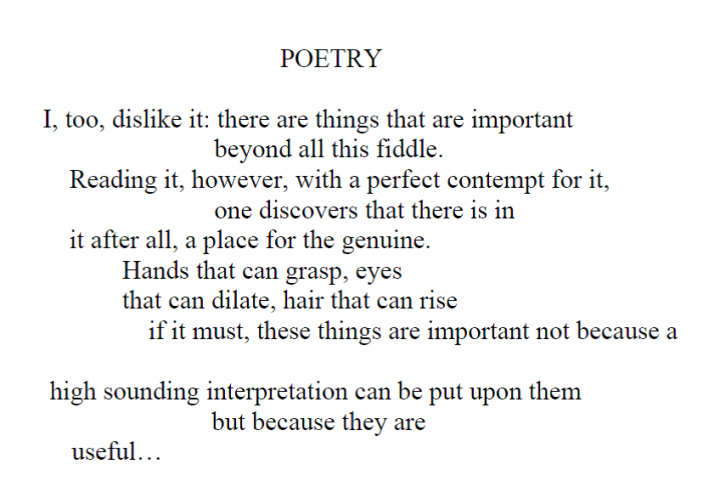
poetry1

Marianne Moore’s indictment of her own craft remains to this day a shrewd affront to critical exegesis. Piqued by ‘the immovable critic’, she treads a fine line in ‘Poetry’ between approbation and displeasure, a feeling entangled in the confession that ‘we do not admire what / we cannot understand’. Notwithstanding her penchant for axioms of this sort, Moore inclines elsewhere to a mode of expression that is dense, riddling and allusive; a poetics fit for sustained ‘inspection’, perhaps, but one whose fluid textual condition also resists ‘high sounding interpretation’. Given Moore’s tendency to revise published material – shuffling, redacting, reworking, restoring – it has often been difficult to say what ‘all this fiddle’ amounts to.

In taking Moore’s doubts about interpretation seriously, this special issue of Glossator proposes a broad approach to her verse and the stylistics of commentary. Glossing, annotating, doodling, and footnoting – Moore was always sensitive to smaller forms of labour and textual diversion, and the apparatus of her Collected Poems (‘A Note on the Notes’) bears witness to a bashful enthusiasm for marginalia, for ‘provisos, detainments, and postscripts’. Glossatorwelcomes contributions of two kinds, then: essays about the commentarial mode; and actual commentaries, queries and notes on particular poems.

Essays of 4000-6000 words may explore, but are not limited to, the following texts and topics:

  • Borrowing, allusion, and intertextuality in Moore’s verse – networks of influence – and our means of describing them
  • Moore’s critical work – for The Dial, and in The Complete Prose (1986)
  • Moore’s paratexts – ‘A Note on the Notes’ in the Collected Poems (1952); ‘Foreword’ to The Fables of La Fontaine: A Complete New Translation (1954); ‘Foreword’ to A Marianne Moore Reader (1961)
  • The significance and scope of scholarly editions by Robin Schulze (2002) and Heather Cass White (2008, 2012)
  • The relationship between life-writing and textual commentary, with particular attention to Linda Leavell’s Holding on Upside Down: The Life and Work of Marianne Moore (2013)

Contributors are encouraged to consult the journal’s general guidelines for commentary, which are detailed in the About section, and to peruse the journal’s Archive. If you are interested in contributing to this volume, please send a brief abstract to Dr Edward Allen, the issue editor, at ejfa2@cam.ac.uk

SCHEDULE

2 October 2015: Abstract proposal due to editor
1 January 2016: Decision regarding abstracts and selection of contributors
24 June 2016: Final Submission
August 2016: Publication

Categories
CFPs Postgraduate

CFP: Metamorphoses: The III International Flann O’Brien Conference


Charles University, Prague, 16-19 September 2015

Keynote Speakers
Joseph Brooker (Birkbeck, University of London)
Catherine Flynn (University of California, Berkeley)
Brian Ó Conchubhair (University of Notre Dame)

Guest Writer
Kevin Barry (City of Bohane; winner of the 2013 International IMPAC Dublin Literary Award)

Written at a time of profound transformation in post-independence Ireland and war-torn Europe, and displaying an acute awareness of the epochal changes bearing on modern notions of literature and the self, Flann O’Brien’s oeuvre offers a sustained engagement with the representation of cultural, political, and personal metamorphosis. This is a body of writing in which the human always bears the potential to be radically remade in the forms of horses, bicycles, and trains; in which genre, language, and literary form are constantly reorganised and refashioned; in which a programme of pseudonymity presents the comic writer as a master of disguise and identity as a matter of constant flux.

At Metamorphoses: The III International Flann O’Brien Conference (Charles University, Prague, 16-19 September 2015), the organisers propose to build on the current sea change in O’Brien studies to foster a scholarly and critical debate dedicated to these themes of metamorphosis in the writer’s work. At stake will be the ways in which O’Brien’s English and Irish language novels, short stories, column-writing, non-fiction, teleplays, and theatrical work:

  • Test the limits and possibilities of identity, hybridity, & concepts of post-humanity;
  • Engage and transform cultural, political, & economic upheaval at home and abroad;
  • Process radical paradigm shifts in the sciences, from Darwinian evolution theory to the “Mollycule Theory” of quantum physics;
  • Explore (anti-)modernist reconstructions of myth, whether Irish or Ovidian;
  • Attend to linguistic, generic, and formal mutations, as well as the resonances between metamorphosis, metaphor, and metafiction;
  • Present shifting views of himself, his own writing, and the figure of the Author;
  • Are transformed in the acts of reception, rewriting, translation, & adaptation;
  • Are opened up for new readings by genetic analyses of the vast and critically under-analysed collections of his works in progress (correspondence, manuscripts, drafts) housed at Boston College, Southern Illinois University, & University of Texas at Austin;
  • Are amenable to new comparative readings with Prague’s sons Franz Kafka and Karel Čapek, as well as other modernist writers and movements of transformation, from Jarry & Joyce, Borges & Beckett, to the Absurdists, Futurists, & Surrealists.

Abstracts: If you would like to propose a paper (not exceeding 20 minutes), or panel (maximum 3 speakers) please submit your title and an abstract of 250 words accompanied by a short biographical sketch to viennacis.anglistik@univie.ac.at by 1 March 2015.

Find Flann O’Brien on Amazon: US | UK

Also at A Piece of Monologue:

Categories
CFPs Postgraduate

CFP: Remaking Tradition: Present-day Perspectives on Language, Literature and Culture

2nd International Conference of the University of Banja Luka (BiH) in cooperation with Institute of English Studies, University of London (UK)

CELLS – CONFERENCE ON ENGLISH LANGUAGE AND LITERARY STUDIES

REMAKING TRADITION

Present-day Perspectives on Language, Literature and Culture.

Banja Luka, June 12th and 13th, 2015

CALL FOR PAPERS

The Department of English, at the Faculty of Philology, University of Banja Luka (Bosnia and Herzegovina) and the Institute of English Studies, School of Advanced Study, University of London (United Kingdom) are pleased to announce second conference on English language and literary studies CELLS: Remaking Tradition: Present-day Perspectives on Language, Literature and Culture.

The aim of the conference is to provide an international forum for the exchange of ideas and experiences across the fields of English language and literary studies, with particular emphasis on cross-disciplinary and interdisciplinary issues raised in the fields of literature, culture, linguistics, translation studies and applied linguistics. Topics might include (but are not limited to):

  • the study of globalisation, acculturation and migration in contemporary studies of language, literature and culture;
  • juxtaposition and interdependence of tradition and contemporariness in ideology, tradition, customs, norms, routines, etc.;
  • literature and economics/the economy;
  • tradition in translation studies: mediating between source and target language cultures and languages;
  • the place of mono/plurilingualism in contemporary approaches to the study of language, literature and culture;
  • rewriting of basic postulates in approaches to foreign language teaching.

The official language of the conference is English.


PLENARY SPEAKERS

– Wim Van Mierlo (Acting Director of Institute of English Studies, School of Advanced Study, University of London, UK)

– John Frederick Bailyn (Professor and Doctoral Program Director at Stony Brook University, New York, USA and Director of SUNY Russia Programs Network)

Guest Lecturer to celebrate the 21st anniversary of the Department of English:

– Dijana Jelača (Adjunct Assistant Professor at St. John’s University, New York, USA)

SUBMISSION OF ABSTRACTS

Please send an abstract of up to 300 words (MS Word 2003-2007) to the following e-mail address: cells@unibl.rs

Abstracts should be anonymous containing only the name of the paper, the body of the abstract and references.

Please send the following information in the body of the e-mail:

  • Title of the paper
  • Name of the author(s)
  • Affiliation of the author (s)
  • Key words
  • E-mail address
  • Bio note (no more than 100 words)

IMPORTANT DATES

1st April, 2015                      Deadline for Submission of Abstracts

15thApril, 2015                      Notification of Acceptance

1stMay, 2015                         Registration

CONFERENCE FEE
The conference fee is 60 Euros. The fee includes:

  • conference pack
  • conference break refreshments (snacks and beverages)
  • publication of selected papers in the conference proceedings

ACCOMMODATION

Accommodation can be arranged by the organisers upon request.

CONFERENCE WEBSITE

All the details and important information can be found at the conference website.

www.cellsbl.com (active from January 25th, 2015)

A selection of papers will be published after the conference.

CONTACT:

E-mail: cells@unibl.rs

We look forward to your proposals.

Organising Committee:

Dr Wim Van Mierlo, University of London, UK

Dr Željka Babić, University of Banja Luka, BiH

Dr Tatjana Bijelić, University of Banja Luka,BiH

Dr Petar Penda, University of Banja Luka, BiH

Categories
CFPs Postgraduate

CFP: The Literary London Society Annual Conference

Literary London 22-24 July 2015

“London in Love”

Confirmed plenary speakers:

Gregory Dart (University College London)
Imtiaz Dharker (poet, artist, and documentary film-maker)
Kate Flint (University of Southern California)

The annual conference of the Literary London Society hears papers, comprised panels, and roundtables that consider every period and genre of literature about, set in, inspired by, or alluding to central and suburban London and its environs, from the city’s roots in pre-Roman times to its imagined futures. 

The main focus of the conference is literary text and representation, but we actively encourage interdisciplinary contributions relating film, architecture, geography, theories of urban space, etc., to literary representations of London. Papers from postgraduate students are particularly welcome for consideration. 

While papers on all areas of literary London are welcomed, the conference theme in 2015 is ‘London in Love’. 

To submit a proposal for a 20-minute paper, a comprised panel of 3 speakers, or a roundtable with 5 participants, please choose the appropriate link in the box on the right. The deadline for receipt of submissions is 28 February 2015.

For more information, please see the Full Call For Papers

The conference location is the Institute of English Studies, University of London. For more information about the institute, please go to http://www.ies.sas.ac.uk/

If you have any queries, please contact the conference organiser Dr Peter Jones at conference@literarylondon.org