Categories
Events Postgraduate

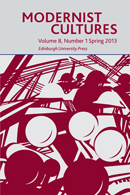
Out Now: Modernist Cultures 8.1 (Spring 2013)

Latest Issue of Modernist Cultures – out now

Modernist Cultures seeks to publish the best and most interesting scholarship in the field of modernist studies. Past contributors include Daniel Allbright, Thomas Elsaesser, Fredric Jameson, Michael Levenson, Herbert Lindenberger, Laura Marcus, Susan McCabe, Marjorie Perloff, Thomas Pfau, and David Trotter.


Free for BAMS Members

As the official BAMS journal, members of the Association receive a year’s subscription to Modernist Cultures. Becoming a member of BAMS is also a great way to keep updated on new research and support the scholarly community, including postgraduate training and and free or reduced entry to BAMS events. Membership costs £30 (£25 unwaged) for those based in the UK, and £45 (£35 unwaged) for overseas members, to cover international mailing costs.


To join BAMS go to bams.ac.uk/membership

MC8.1

Modernist Cultures Issue 8.1 (Spring 2013)

Edited by Andrzej Gasiorek, Deborah Longworth and Michael Valdez Moses

Special Issue: Musicality and Modernist Form

Guest Editors: David James and Nathan Waddell


Contents

Editorial Introduction: Musicality and Modernist Form (David James and Nathan Waddell)

Wagner as Dramatist and Allegorist (Fredric Jameson)

Modernism’s Handmaid: Dexterity and the Female Pianist  (William May)

Wyndham Lewis’s ‘Very Bad Thing’: Jazz, Inter-War Culture, and The Apes of God (Nathan Waddell)

‘Why then grieve?’: Virginia Woolf’s Mournful Music (Tanya Dalziell)

Samuel Beckett and Morton Feldman’s ‘Text-Music Tandem’ in Words and Music (Francis Hutton-Williams)

For Frank O’Hara: Morton Feldman’s Three Voices as Interpretation and Elegy (Scott W. Klein)

Koffi Kwahulé’s Coltranean Theatre of Cruelty (Eric Prieto)

Categories
Events Postgraduate

LAST REMAINING PLACES AVAILABLE: BAMS Postgraduate Training Day, Thursday 9th May

LAST REMAINING PLACES AVAILABLE

The British Association for Modernist Studies (BAMS) Postgraduate Training Day: Research Skills

The fourth annual BAMS postgraduate training day will be held at King’s College London on Thursday 9th May. Please find attached the event poster and programme.

The event is open to 70 postgraduate researchers. The day will include both practical advice and conceptual research training, covering interdisciplinary and archival research, as well as highlighting some of the socio-historical and theoretical contexts of modernism and contemporary modernist studies. Students from all relevant disciplines are welcome.

Registration deadline: Friday 26th April

To register, and for further information, please contact Chris Mourant: christopher.mourant@kcl.ac.uk

The event is free to members of BAMS and costs £10 for non-members.

BAMS Postgraduate Training Day 2013

Programme – BAMS Postgraduate Training Day 2013

Categories
CFPs Events Postgraduate

BAMS Postgraduate Training Day: Research Skills (Thursday 9th May)

The fourth annual BAMS postgraduate training day will be held at King’s College London on Thursday 9th May. Please find below the event poster and programme.

The event is open to 70 postgraduate researchers. The day will include both practical advice and conceptual research training, covering interdisciplinary and archival research, as well as highlighting some of the socio-historical and theoretical contexts of modernism and contemporary modernist studies. Students from all relevant disciplines are welcome.

As places are limited, early registration is strongly advised. Registration deadline: Friday 26th April

To register, and for further information, please contact Chris Mourant: christopher.mourant@kcl.ac.uk

The event is free to members of BAMS and costs £10 for non-members. A limited number of travel bursaries are available. Please see the poster for details.


BAMS Postgraduate Training Day 2013

Programme – BAMS Postgraduate Training Day 2013


Categories
CFPs Events Postgraduate

CFP: Edith Wharton and The Custom of the Country: Centennial Reappraisals, Liverpool Hope University

Edith Wharton and The Custom of the Country: Centennial Reappraisals

Symposium: 22 and 23 August 2013, Liverpool Hope University, UK

Symposium Directors: William Blazek (Liverpool Hope University) and Laura Rattray (University of Glasgow)

Call for Papers:

2013 marks the 100th anniversary of the publication of Edith Wharton’s much-read and much-analyzed novel The Custom of the Country. Described as the writer’s “greatest book” by Hermione Lee in her 2007 biography, and listed by Wharton herself at the end of a long and prolific career as one of her own favourite works, The Custom of the Country arguably remains the author’s most complex and controversial novel.

To mark its centenary year, the symposium directors warmly invite papers on any topic pertaining to this landmark text. Themes might include: re-readings of the novel in the light of modern economic crises, serialisation, marketing and material culture, narrative strategies, modernist aesthetics, the challenges and rewards of teaching the novel, and reappraisals of Wharton’s most controversial female protagonist, Undine Spragg. Alternatively, discussions might be framed within the contexts of leisure-class marriage and divorce, masculinity, Europe, travel, or the visual arts. We also welcome broader comparative approaches, viewing The Custom of the Country in relation to other novels of the period, to other work by Wharton in any genre, or exploring the novel’s influence on contemporary writers and popular culture.

Co-sponsored by the Edith Wharton Society, the symposium will be held on the Hope Park campus of Liverpool Hope University, located within five miles of the Liverpool city centre. Moderately priced, ensuite campus accommodation will be available to delegates for the duration of the symposium. Day rates are also available. Keynote speakers for this event will be confirmed shortly. Further information and updates can be found on the symposium website: http://www.hope.ac.uk/custom

Please send 250-word abstracts for 20-minute papers (indicating any equipment/technical requirements), and a brief biographical note by the deadline of 15 April 2013 to the directors via e-mail: custom@hope.ac.uk

Sponsors: Liverpool Hope University and the Edith Wharton Society

Categories
CFPs Events Postgraduate

CFP 15 Feb: Artistic Commitments in the UK 1880-1950, University of Burgundy

Artistic Commitments in the UK 1880-1950

An international conference to be held at the University of Burgundy
October 23 and 24, 2013

Within capitalist economics the end of the 19th century witnessed the progressive autonomy of the arts and artists alongside other fields. Autonomisation was however partial and relations between the artistic and the political fields could occasionally be conflictual. Commitment featured among a number of possible ways for artists to interfere in the political sphere. This symposium will deal with the various modes of commitment from 1880 to 1950, as the period witnessed the massive political upheavals that shaped the twentieth century.

Late nineteenth- and twentieth-century nationalisms, political crises, the Great War, the totalitarian regimes of the 1920s-1930s, World War II and its aftermath were key elements that led writers and artists to explore new expressions of commitment, to redefine the modes and practical modalities of their public positioning within ever-changing cultural and political conditions. This conference will be devoted to assessing how the confrontation between artists and the political order elicited an array of artistic responses and modes of action. It will also examine how new modes of commitment conversely inflected the political order, giving it unexpected contours.

We will welcome proposals from scholars in the humanities, including literature, history, history of art, book and media history and political science. The main focus will be on the forms of commitment of British and English-speaking writers and artists. However, their inspirational impact on other European artists may also be discussed.

Proposals should concern both the forms of commitment and the essence of the links that were established with the political sphere to fashion the artistic and intellectual landscape of the transitional decades between the long nineteenth century and the first half of the twentieth century. Proposals may also explore transitional periods as well as periods of overlapping or conflicting sensibilities, with a view to reassessing the topos of a clear break between the various phases of modernism: a topos which has so far clearly (and perhaps mistakenly) prevailed in current narratives of modernism.

Possible topics might include :

the forms of commitment characterizing the various avant-gardes;

individual and collective positioning, and their significance in the cultural and political configurations of the period;

the nature of late nineteenth and twentieth-century humanism, disenchantment and re-enchantment;

formal or informal gatherings and groupings of artists;

the practice and politics of outrage, notable manifestos and calls to action or demonstrations;

the commitment of various media: as observable through literary or art reviews, newspapers and journals, and their various responses to censorship or propaganda;

the role of illustration and images with particular emphasis on lesser-known magazines that appeared after the avant-gardes.

Papers not exceeding 25 minutes will be delivered in English or in French.

A selection of papers will be published.

Please, send 400-word proposals with names and affiliation to:

francoise.bort@u-bourgogne.fr

benedicte.coste@u-bourgogne.fr

Deadline for sending proposals: 15 February 2013

Notification of acceptance: 10 March 2013

Categories
CFPs Events Postgraduate

Problems with Authority: the International Flann O’Brien Conference, CFP 1 Feb 2013

Problems with Authority:
The II International Flann O’Brien Conference
Rome, June 19-21, 2013

KEYNOTES

Jed Esty
(University of Pennsylvania)

Carol Taaffe
(Author of Ireland Through the Looking-Glass: Flann O’Brien, Myles na gCopaleen & Irish Cultural Debate)

Dirk Van Hulle
(University of Antwerp)

The International Flann O’Brien Society is proud to announce that a conference
on the Works of Brian O’Nolan will be hosted by the Department of
Comparative Literatures, at the Università Roma Tre under the title ‘Problems
with Authority: The II International Flann O’Brien Conference’.
It is an exciting time for the expanding field of Brian O’Nolan scholarship.
Despite the significant increase in O’Nolan events and publications since his
centenary year in 2011 – and even, perhaps, because of them – a great deal of
work remains to be done in exploring O’Nolan’s under-analysed minor texts
and in closing the many critical gaps in the academic record. At the centre of
these critical projects are explorations of O’Nolan’s texts as fertile territory for
mediating between conflicting Authorities: between traditional and modern
scripts, local and international perspectives, and between avant-garde and
conservative approaches to the authorities of science, history, and literary
tradition. With these issues in mind, the conference aims to address questions of
canonicity and authority in Brian O’Nolan’s work.
2013 sees the publication of collections of O’Nolan’s short stories (Neil Murphy
& Keith Hopper, Dalkey Archive) and dramatic works (Daniel Jernigan, Dalkey
Archive). As these collections give us greater access to a rich variety of
overlooked texts in the O’Nolan literary canon, they also prompt and challenge
us to broaden and retrace its borders. Indeed, given the amount of pseudonyms
and apocryphal texts in play, we might ask whether these borders can ever be
definitively drawn. Similarly, the vast collections of O’Nolan’s correspondence,
manuscripts, and drafts housed in Illinois, Boston, and Texas, – as well as The
Irish Times’s online digital archive – have recently given rise to emerging fields of
Genetic and Cultural Materialist approaches that seek to explore the borders of
authorship and authority in O’Nolan’s ever-expanding oeuvre.
And while longer-running critical conversations continue to be finessed about
the ways in which O’Nolan’s texts are shaped by towering 20th Century figures
such as Joyce and Beckett (and the more local authorities of Church and State),
the increasingly international contexts in which O’Nolan is being read have
brought a new set of names to the table: from Calvino, Borges, and Kafka, to
Nabokov, Danielewski and Bolaño. This international gaze brings with it other
issues, such as the challenges of adaptation and translation, and the
opportunities of exploring O’Nolan’s broader canon as a fertile ground for a
range of critical perspectives, from Cultural Materialism, Queer Theory, and
Feminism, to Metafiction, Genre Theory, and Deconstruction.
As well as keynote lectures by eminent scholars Jed Esty, Carol Taaffe, & Dirk
Van Hulle, the programme will include performances by Mark O’Halloran
(Award-winning screenwriter of Adam and Paul and Garage), and Mikel Murfi
(Director of John Duffy’s Brother). For more details as they emerge, including
social programmes and accommodation and travel details visit our website:
http://www.univie.ac.at/flannobrien2011/IFOBS.html
The organisers invite proposals on any aspect of O’Nolan’s writing, but are
especially interested in papers that explore questions of authorship and authority
in O’Nolan’s work, including, but not limited to:
Broadening the Canon
– Problems of canonicity and the reception of minor works
– O’Nolan on Screen and Stage: The forgotten scripts
– O’Nolan as letter writer
– Challenges in adapting/translating O’Nolan’s writing
On Whose Authority?
– Ideological critique & the comedic subversion of authority in O’Nolan’s
writing
– Conflicting Authorities: The traditional vs. the avant-garde, the local vs.
the international in O’Nolan’s writing
– Writing Under the Influence: O’Nolan & his contemporaries
– The Clowning of Science: Menippean Satire and the encyclopaedic ideal
Theoretical Authorities
– Death of the Author: O’Nolan and Capital “T” Theory
– O’Nolan and theories of Genre
– Cultural Materialist and Genetic Approaches
– Male Authorities / Feminist Readings
– The Reception of Flann O’Brien in Ireland and beyond
Please submit abstracts and panel proposals to viennacis.anglistik@univie.ac.at by February 1st 2013.

John McCourt (Università Roma Tre)
Ruben Borg (Hebrew University of Jerusalem)
Paul Fagan (University of Vienna)

Facebook page:
https://www.facebook.com/events/481105721922267/?ref=ts&fref=ts

Categories
CFPs Events Postgraduate

Maverick Voices and Modernity, CFP 1 March 2013

‘We Speak a Different Tongue’: Maverick Voices and Modernity, 1890-1939

Website: http://www.dur.ac.uk/maverick.voices/

St John’s College, Durham University

“Maverick Voices and Modernity” is an international conference whose aim is to explore and reflect upon the wide range of writers that were caught up in the Modernist moment, but traditionally fall outside of what has been thought of as literary Modernism. Our event registers those individual voices that offer alternative visions and counter-responses to mainstream Modernism and often still remain in productive dialogue and tension with key aspects of established Modernism.

Deadline for abstracts: 1st March 2013.

Plenary speakers: Professor Chris Baldick (Goldsmiths College, University of London) and Professor Michael O’Neill (Durham University).

Call for Papers

With a focus on the fiction, poetry, and drama of the period 1890-1939, “Maverick Voices” registers the diversity of innovation beyond the traditionally defined boundaries of literary Modernism. Famously in “Mr. Bennett and Mrs. Brown” (1924), Virginia Woolf distinguishes between two literary camps: the Edwardians and the Georgians. By praising the Georgians and vilifying the Edwardians, Woolf privileges an aesthetic of what later became identified as Modernism against a continuing tradition of realism. This is indicative of both continuities and discontinuities – between Modernism and, in Yeats’s phrase, those different tongues of nineteenth-century sensibilities – which have prevailed as a persistent presence in much recent literary criticism.

“Maverick Voices” contributes to current debates about where the boundaries of literary Modernism should be drawn. In so doing, our conference explores the alternative visions of those individuals who hover at the fringes of cosmopolitan artistic milieus. Relevant questions that could be explored in relation to these marginal voices are: Does a privileging of Modernism undervalue texts that are perceived to operate outside either the parameters of its understood aesthetic and/or periodization? Are there marginalised or obscure texts whose avant-garde experiments renew a sense of the plurality of types of modernisms? Can the ascription of a proto-Modernist tag expand understandings of how texts respond in distinct ways to the pressures of modernity? Indeed, do some literary texts in their own inventive ways produce an alternative poetics to the widely recognized canon of such authors as Woolf and Pound? To what extent do these texts disrupt or engage in dialogue with critical narratives of Modernism?

By addressing these questions in relation to those responses and counter-responses to literary Modernism our conference aims at highlighting those alternative visions of contemporaneous maverick individuals. It further hopes to challenge strict periodization and suggest new points of inception. Authors of relevance to these vital questions might include, but are not limited to: Ford Madox Ford, D. H. Lawrence, George Egerton, W. B. Yeats, Katharine Burdekin, Arthur Machen, Rebecca West, Evelyn Waugh, Noël Coward, Charlotte Mew, George Bernard Shaw, John Galsworthy, Ella Hepworth Dixon, George Moore, Aldous Huxley, Walter de la Mare, James Elroy Flecker, A. E. Housman, G. K. Chesterton, Oscar Wilde, Henry James, Thomas Hardy, H. G. Wells, and Arnold Bennett.

Topics may include but are not limited to:

.           Responses to labels and manifestoes
.           Counter-experiments
.           Individual counter-subjectivities
.           Canonicity and marginality
.           Individuals, groups, and cosmopolitanism
.           Late Victorianism and modernity
.           Poetics of the fin-de-siècle and beyond
.           Continental interludes in Anglo-American modernity
.           Avant-garde and Decadence
.           Science fiction
.           Gothic revivals
.           Innovations in popular fiction
.           New Woman discourse
.           Experimentalism in Fantasy/Romance
.           Experimental Realisms
.           Mysticism/esoteric forms of modernity
.           Pornography/censorship
.           Georgian poetry
.           Writers on the periphery of Modernism
.           Utopian/Dystopian narratives

Proposals for twenty-minute papers on any aspect of maverick voices and modernity should be submitted as email attachments by Friday, 1st March 2013 to maverick.voices@durham.ac.uk

Abstracts should be between 200-250 words. Please attach a one-page CV and state name, affiliation, and contact details in the body of the email. For queries please contact co-organisers by email.

Categories
CFPs Events Postgraduate

‘Shifting Territories’: Modern & Contemporary Poetics of Place CFP 4 March 2013

SHIFTING TERRITORIES
MODERN AND CONTEMPORARY POETICS OF PLACE

Call for Papers – Deadline for abstracts 4 March, 2013

Postgraduate and Early Career Researcher conference organised by Oxford Brookes University
22nd and 23rd May, 2013 at Institute of English Studies, London, UK

CFP2

‘Shifting Territories’ will consider the recent wave of new nature writing and poetry which goes beyond traditional representations of landscape to venture into borderlands, edgelands and urban environments: a development which has been addressed in texts like Granta 102: The New Nature Writing (Summer, 2008), Tim Dee’s ‘Nature Writing’ essay in Archipelago 5 (Winter, 2010-11) and Poetry Review 102: The Poetry of Place (Spring, 2012). The conference aims to determine if this current poetic and critical interest in poetry of place is a direct response to environmental crises or whether it is merely a refashioning of what poetry has always taken as its subject. By creating a space for dialogue about modern and contemporary poets’ use of place, we seek to address the development of this subject in the 20th and 21st centuries. The conference will examine the ways in which poets use language to negotiate the relentlessly shifting concepts of identity and place and how particular locations, or states of flux, have shaped their aesthetic.

Topics for papers might include, but are not limited to:

Poetry derived from a locality / region
Belonging versus rootlessness
Challenging sentimentality, nostalgia and pastoral idylls
Uncertainty and unfixity in place and language
Outsiders and occupiers of non-place
Built environments and urban landscapes
Ecocritical approaches to place
Contested territories / postcolonial perspectives on landscape
Dialogues and distinctions between modern and contemporary poets’ use of place

The conference will feature poetry readings and will also include a postgraduate and ECR training workshop on publishing research related to modern and contemporary poetry. Abstracts of 300 words for papers of no more than twenty minutes should be submitted by 4 March, 2013 to shiftingterritoriesconference@gmail.com.
Organisers: Anna Hewitt, ahewitt@brookes.ac.uk; Niall Munro, n.munro@brookes.ac.uk; Nissa Parmar, 11111922@brookes.ac.uk

Categories
CFPs Events Postgraduate

Modernist Intimacies: CFP extended 11 February 2013

EXTENDED DEADLINE: FEBRUARY 11TH, 2013.

Call for Papers:

Modernist Intimacies

Friday May 17, 2013.

The Centre for Modernist Studies
University of Sussex

Featured Speaker: Denis Flannery (University of Leeds)

Responding to recent scholarly constellations of modernism, affect and intimacy this one-day symposium, hosted by the Centre for Modernist Studies at University of Sussex, seeks to explore new ways of thinking about modernist feeling and modernist intimacies. Are there such things as “modernist feelings”? How might different modernist narratives of emotion in psychoanalysis, literary theory, philosophy and medicine be made to collide, disrupt and form new points of contact? How do modernist bodies come together and apart?

We encourage papers from academics at all stages in their career and hope to encourage inter-generational discussions.

Topics may include, but are not limited to:

-Genealogies of modernist affect
-Narratives of (im)personality
-Modernist diaries, autobiographies and letters
– Scenes of intimacy and extimacy in modernist writing
-The role of affect in modernist cinema and/or other visual arts
-Touch, texture, and textuality
-Modernist emotional geographies
-Modernism and affective disorders
-Modernist archives of feeling
– Constructions of publicity and privacy in modernist writing

Please send abstracts of no more than 250 words (for 15-20 minute papers) and a short biography to Ruth Charnock at: rnec20@sussex.ac.uk by 11th February, 2013.

Categories
CFPs Events Postgraduate

CFP *deadline Dec 7* The British Society for Literature and Science Conference 2013

British Society for Literature and Science Conference 2013 – Call for Papers

**deadline Friday 7 December 2012**


Cardiff University and the University of Glamorgan

The British Society for Literature and Science invites proposals for papers and panels to be delivered at its eighth annual conference to be held in Cardiff, 11-13 April 2013.

The BSLS Conference does not have a theme (as it its usual practise) but especially welcomes proposals on the state of the field of literature and science as well as its relation to other fields. This year we would be particularly interested to receive proposals that reflect upon the interdisciplinary study of literature and science in the context of the debate about the present position of the humanities in academia. However, the Society remains committed to supporting proposals on all aspects of literature and science across all periods.

Proposals for papers of 15-20 minutes should be sent in the body of the email text (no attachments, please), to bsls2013@yahoo.co.uk with the subject line ‘BSLS 2013 abstract’. Submissions should include the title of the paper, an abstract of no more than 300 words, a maximum of 3 keywords (placed at the end of the abstract), and the name and contact details of the speaker.

Closing date for submissions: 7 December 2012.

(Decisions will be made in January 2013)

Contributors interested in organising a panel or other special session, or who have suggestions for alternative forms of conference presentation, are warmly encouraged to contact the conference organisers. The organisers would welcome, for example, workshops on teaching literature and science, or on specific themes in literature and science that cross period boundaries, or on specific published works with considerable influence in the field. Please email the organisers on bsls2013@yahoo.co.uk, using ‘BSLS 2013 Panel’ as the subject line in email correspondence.


Funding: a bursary of £150 will be awarded to a graduate student on the basis on the paper proposals. The student must be registered for a masters or doctoral degree on 9 January 2013. The conference fee will be waived for two further graduate students in exchange for written reports on the conference, to be published in the subsequent issue of the BSLS Newsletter. If you are interested in being selected for one of these places, please mention this when sending in your proposal.


Accommodation: please note that those attending will need to make their own arrangements for accommodation. Information on selected hotels will be available shortly on the conference website.As in previous years, we anticipate that the conference will begin at about 1pm on the first day and conclude at about 2pm on the last.


Membership: in order to attend the conference, you must be a paid-up member of the BSLS for 2013. We anticipate that it will be possible to pay the £10 annual membership fee when paying the conference fee online.


FURTHER INFORMATION

Visit the conference website at: http://literatureandscience.research.glam.ac.uk/bsls2013/