Categories
Uncategorized

Grant: Travel grants for MSA 18, Pasadena, Nov 17-20

Applications are now open for travel grants to attend MSA18 in Pasadena, California this November. The deadline for applications is July 22nd, 2016.

Who can apply

“MSA Travel Grants are open for application to anyone. We prioritize advanced graduate students, first-time grant recipients, and those with little or no access to institutional support.”

Apply here.

Categories
Uncategorized

Contribute: BAMS response to the EU referendum result

Dear BAMS members and others,

In the wake of the EU referendum result last week, where the UK voted to leave the European Union, BAMS wishes to re-affirm its commitment to supporting modernist studies across Europe and maintaining links with colleagues on the continent.

In recognition of this, we’re inviting our colleagues across modernist scholarship to share a sentence expressing what “Europe” means for their work.

This could be how the content of your research reflects transnational movements; how scholarly links with institutions overseas have informed your career; or just how friendships and collaborations with European academics matter to you.

If you want to contribute, please submit your line using the form below as soon as possible, and by July 8th at the latest.

Thank you!

Categories
Uncategorized

CFP: Edited volume on Science, Technology, and 20th-century Irish Literature

Submissions are welcomed for a volume focused on science, technology, and Irish literature of the revival and modernist period. The deadline for initial proposals is August 15th.


About the volume
Since W. B. Yeats infamously wrote in 1890 that “the man of science is too often a person who has exchanged his soul for a formula,” the anti-scientific and Luddite bent of the Irish literary and cultural revival has often been taken as a given.  Recent scholarship, however, has questioned this perspective and has begun to tease out a more complicated vision of Irish writers’ relationship to scientific and technological development. This collection seeks to provide a more nuanced view of Irish writers’ engagement with science and technology as well as the relationship between Irish revival writers and Irish modernism. It aims to capture not only the varied ways that Irish writers were plugged into the scientific and technological impulses and networks of the age but also the myriad outcomes of their representations – the ways that they shaped modern Irish attitudes, aesthetics, ideologies, and more.

Submission details
We welcome submissions on canonical and non-canonical authors, as well as those that interpret the category of “literature” in new ways. We also welcome submissions from both emerging and established scholars.

How to submit
The editors seek 250-500 word proposals for original contributions and a 100-word biography (included selected publications) by August 15, 2016.

Please copy all editors:
Kathryn Conrad, kconrad@ku.edu
Cóilín Parsons, Coilin.Parsons@georgetown.edu
Julie McCormick Weng, mccormi5@illinois.edu

Categories
Events Uncategorized

BESTIA! International conference of Italian modernist studies on “Animals!”

Details

International conference of Italian modernist studies on “Animals!”

Split, Croatia

8-9 July 2016

Organisers

Organized by the Universities of Split (Croatia), Utrecht (the Netherlands) and KU Leuven (Belgium), in collaboration with two international research teams of Modernist Studies www.MDRN.be & http://www.cemstudies.eu and with the support of official authorities such as the Italian Cultural Institute of Zagabria and the Dalmatia region.

URL

Visit  http://mdrn.be/node/307


Categories
Events Registration open Uncategorized

Registration: David Jones: Dialogues with the Past – York, 21-23 of July

Registration is now open for David Jones: Dialogues With the Past, an international, interdisciplinary conference to be held at the University of York from July 21st to 23rd, 2016.

Register here now.

About the Conference

In ‘Past and Present’ (1953), David Jones claimed:  ‘The entire past is at the poet’s disposal’. The interweaving of this ‘entire past’ with the present moment fundamentally characterises Jones’s art and thought, from his visual reimagining of historical figures, to the etymologically rich allusions of his poetry, to the unusual philosophy of history manifested in his essays and letters. The analysis of Jones’s visual or poetic works often reflects the act of excavation: the unique layering of images, words and ideas, the resonant symbolism and shades of meaning. the blending of cultural traditions and dynamic interweaving of whole civilisations.

As 2016 marks the centenary of the Battle of the Somme, which profoundly shaped Jones’s imagination and thought, it provides an ideal moment for this conference to reconsider the entirety of Jones’s engagement with the many, various, elusive and intertwined ‘pasts’ through which he conceived history and culture. It will be an opportunity to explore Jones’s own style, subject matter, allusive practice and intellectual questions including the role of ‘memory’, ‘inheritance’ and ‘history’ in art and life, while also reflecting upon Jones’s own past and contemporary moment.

Keynote speakers

Tom Dilworth (English)
Paul Hills (History of Art)
Adam Schwartz (History)

Conference cost

Conference: £65 Waged;
£45 Student/Unwaged

Dinner: £20 Waged;
£15 Student/Unwaged

More information about the conference, including accommodation options and program details, is available on the conference website.

Categories
Uncategorized

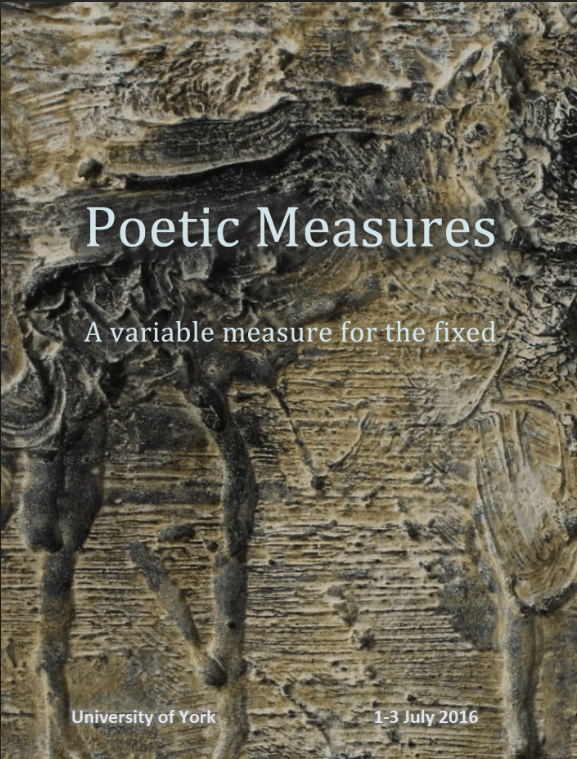
Register: Poetic Measures: a variable measure for the fixed – 1-3 July, York

Registration is now open for Poetic Measures: a variable measure for the fixed to be held at the University of York from the 1st to the 3rd of July.

Register here now.

About the conference

How do we measure poetry? The words ‘measure’ and ‘meter’, with their shared etymological origin in the Greek metron, have a long history of being used synonymously. However, when William Carlos Williams wrote that ‘[t]he key to modern poetry is measure, which must reflect the flux of modern life’, he proposed ‘measure’ as an alternative to the metrical foot in response to ‘the flux of modern life’ that demanded measures of more fluid and unstable permutations.

The measures poetry takes in response to an idea of modernity has compelled looking beyond the generic edges of the poem to other art forms. In response to the ‘formless spawning fury’ of ‘this filthy modern tide’, W.B. Yeats’s ‘The Statues’ ends with the aspiration to ‘trace / the lineaments of a plummet-measured face’, rearticulating measurement in terms of sculptural outline, rather than duration of sound. Construing the poem as a coordinated interrelation of spatial measurements, as well as a temporally continuous pattern of sound, these ‘lineaments’ also evoke the silhouette of the poetic line as a visual limit in the structure of the poem. Giorgio Agamben, for one, used this tension between the line break and the sentence to define the lyric poem, a tension Jorie Graham described as ‘the pull from the end, the suction towards closure, and the voice trying (quite desperately in spots) to find forms of delay, digression, side-motions which are not entirely dependent for their effectiveness on that sense-of-the-ending, that stark desire’. These ‘side-motions’ of a poem’s lineation resist the linearity of the sentence, using ‘forms of delay’ not to heighten suspense, but to bypass conventional expectations of closure.

The conference costs £45 or £18 for students.

Keynote speakers

Prof Simon Jarvis (University of Cambridge): ‘*Sordello*-matrix: Robert Browning and the poetics of close counting’
Dr Matt Bevis (University of Oxford): ‘Poetry by Numbers’
Dr Natalie Pollard (University of Exeter: ‘Fugitive Pieces: the poetics of variability’
For further information about the conference, including details of the conference dinner at Betty’s and accommodation, see the Poetic Measures website.
Categories
Events Uncategorized

Event: Theodore Dreiser: from Transatlantic Censorship to Scholarly Editions – 20 May, London

The British Library will host Theodore Dreiser: from Transatlantic Censorship to Scholarly Editions this Friday at the Eccles Centre for American Studies. Tickets cost £8 / £6 /£5 . The event will be followed by a wine reception.

About the event

The team behind a new critical edition of his 1914 novel The Titan reveal the intriguing story of its publication. The American novelist Theodore Dreiser fought many battles against censorship, winning some and losing others. After Harper & Bros. suddenly dropped The Titan, having already typeset and printed 10,000 copies, it was the British publisher John Lane who stepped in to bring out the book.

Drawing on new research, Roark Mulligan traces why and how this happened, focusing especially on the influence of the American-born Emilie Grigsby, herself an author and a prominent London socialite friendly with King Edward VII, Rupert Brooke, and Henry James, whose early life is fictionalised in The Titan.

Jude Davies will talk about how the historical censorship of Dreiser’s novels affects contemporary readers. Focusing on the critical editions of Sister Carrie and The Titan, he will examine how successive editors have grappled with the questions of which text to use and how to present it to readers.

About the speakers

Jude Davies is Professor of American Literature and Culture, University of Winchester, and General Editor of the Theodore Dreiser Edition.

Roark Mulligan is Professor of English, Christopher Newport University, and is volume editor of The Financier (University of Illinois Press, 2011) and The Titan (University of Winchester Press, 2016).

Details and how to book

When: Friday 20 May, 18.30-20.00

Where: British Library Conference Centre

Tickets: £8 / £6 /£5 

Further information and tickets are available at the British Library website.

This event is presented in collaboration with Winchester University Press.

Categories
CFPs Uncategorized

CFP: Minimalism: Location Aspect Moment – 14-15 October 2016, Southampton

The Call for Papers in now live for Minimalism: Location Aspect Moment, which will take place on 14-15 October 2016, hosted by the University of Southampton and Winchester School of Art. 

Proposals are due by June the 29th.

About the conference

When the object comes to itself, abstracting can end, and so can expressiveness. This is one of the thoughts underpinning minimalism in art, but far from the only one, as minimalist sculpture, in particular, began reconfiguring the gallery space, or even the space in which art could happen. The minimalist impulse is to drive creativity into forms so simple, or more accurately, so formal they had to reflect upon themselves while reflecting the viewer in a specular frenzy under cover of nothing happening. The paradoxes of minimalism suggest an equal possibility of de-formation, of formless process. For some time, critics were not happy, understandably, given the rejection of reflection that the radically simplified objects presented. But a consensus has emerged, one that focuses on, and repetitively/compulsively reproduces, a unifying vision of American key artists (Judd, Morris, Flavin, Andre…) of the 1960s. Likewise, a seamless tie binds this art with American minimalist music (Glass, Reich, Adams); but the reality of artistic production across media and forms was far more varied and geographically widespread.

One of the purposes of this Minimalism: Location Aspect Moment is to expand our conception of what minimalism was, where it happened, who was making it, why, and how it extends through time until now. It is clear that the minimalist impulse happened in cross-national encounters (such as the 1967 show Serielle Formationen in Frankfurt) and that Europe was fertile ground for explorations in serial works, in playing with the prospect of singular forms and systematic thinking. Admitting the significance of the naming of the idea of minimalism in the 1960s, we want to look back to earlier versions of the reductionist, repetitive, singularising or multiplying intents of core minimalist endeavour. In short, we wish to see what an expanded field of minimalism looks like, sounds like.

Confirmed keynote speakers

Dr Renate Wiehager (Head of the Daimler Art Collection, Stuttgart/Berlin)
Professor Keith Potter (Reader in Music, Goldsmiths, University of London)
Professor Redell Olsen (Professor of Poetics, Royal Holloway, University of London) (Keynote Performance Lecture)

Call for papers

We want to hear about literature (& writing ABC), dance, building, interior design (& Good Design), gardens (& total fields), science, cybernetics, philosophy, painting, politics, installation, video, cinema, bodily exercise. We want to think about minimalism’s relation to modernism, and how exactly post-minimalism works. We want to think about the softening of minimalism in the 1980s, a twisting of modernist ideals into décor-discipline. We want to recognise the broad scope of projects of reduction, of elimination of the conformities of difference in favour of radical recurrence and stasis.

Contributions are sought from all disciplines; collaborative, creative and cross-media proposals are welcome.

Please send an abstract of  under 300 words to minimalismLAM@gmail.com by June 29th 2016.

The conference is onceived and curated by Dr Sarah Hayden (English, Southampton), Professor Paul Hegarty (University College Cork) with Professor Ryan Bishop (Winchester School of Art, University of Southampton).

Categories
News Uncategorized

News: AFAR is a new research group for the study of EM Forster and his legacy

The Association for Forster and After Research, or AFAR, is an international group of scholars aimed at furthering knowledge of EM Forster’s works and their legacy.

AFAR seeks to bring together different research teams working on Forster. It will initially act as a hub for scholars to share news and discuss the author’s works, while also arranging to hold conferences every other year and produce publications.

The group was formed after a conference on Forster’s legacy held in Tolouse last December – from which a book is also in the works.

Organisers of events linked to Forster are invited to contact to AFAR to circulate details. International collaborations are especially encouraged.

More information is available on the AFAR website.

Categories
CFPs Uncategorized

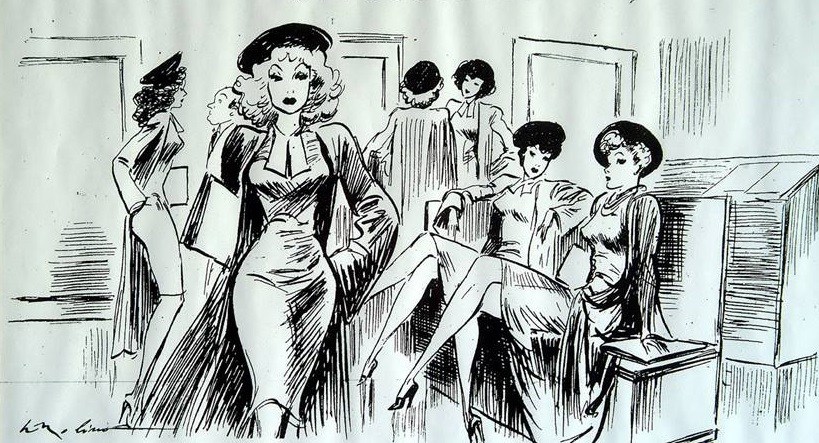
CFP: Italian Women from Unification to the Republic – Cambridge, 29-30 September

A call for papers is open for a conference on Italian women’s changing status from 1861 to 1945, to be held in the Italian department of the University of Cambridge on the 29-30 of September, 2016. 

Proposals are due by June 30th.

About the conference

On 1 February 1945, government Decree n. 23 finally granted women the right to vote in Italy and women first exercised their right as full political citizens in the elections of 1946, 70 years ago. This conference seeks to mark this anniversary by investigating the development of women’s status and their changing role and image between Unification and the founding of the Republic.

At the time of Unification, in the writings of educationalists and moralists, women were typically confined to the role of wives and mothers within the household. The 1865 Civil Code, the so-called Pisanelli Code, confirmed the legal status of women as subject to men.

However, ideas of emancipation and improvements in women’s rights spread in certain intellectual circles. Figures like Salvatore Morelli and Anna Maria Mozzoni promoted rights for women, including the vote in administrative elections, leading to the foundation of associations and journals supporting women emancipation. At the turn of the century, women’s rights were formally discussed at state level, resulting in the first decrees regulating women in the employment (1902–7) and the first petitions for the right to vote (1906). However, few changes occurred in the position of women within the wider society, and not even their participation in the Great War effort gave them equal rights. On the contrary, women’s expectations of a formal acknowledgement of citizenship were frustrated and finally rejected by the rise of Fascism.

During the Fascist era, women’s role was officially reduced once more to that of mother and wife, and although their involvement in Fascist organisations brought them outside the house, the regime silenced any emancipatory claim. Only the convulsions of the second War and civil war would finally make possible full women’s suffrage.

The conference aims to explore the tensions and contradictions in these public, official, civic and private roles in this period of transformation, to better understand the contradictions and conflicts in the status of Italian women from 1861 up to 1945. It aims to retrace the path that led to full citizenship and investigate the changes in the image of women throughout this period of emancipation.

Call for submissions

We invite papers which investigate any aspect of this evolution.

Proposals may include, but are not limited to, reflections of these historical changes in women’s status in history, politics, literature, media, visual arts, education, law, medicine and religion.

How to submit

We welcome the submission of individual papers as well as proposals for complete panels. Panels should consist of three papers and each proposal should contain a title, the names of the chair and the speakers, abstracts (max 250 words) and a short bio of the participants.

Individual paper proposals should consist of a title, an abstract (max 250 words) and a short bio.

Proposals may be presented in English or Italian and those with a comparative perspective are particularly welcomed.

Please submit your proposal for either a paper or a panel to the conference organizers Sara Delmedico (sd683@cam.ac.uk) and Manuela Di Franco (md661@cam.ac.uk), Department of Italian, University of Cambridge.

The deadline for submission is 30 June 2016.
Notification of inclusion in the conference will be sent by 30 July 2016.

More information is available on the conference website.