Categories
Events Postgraduate

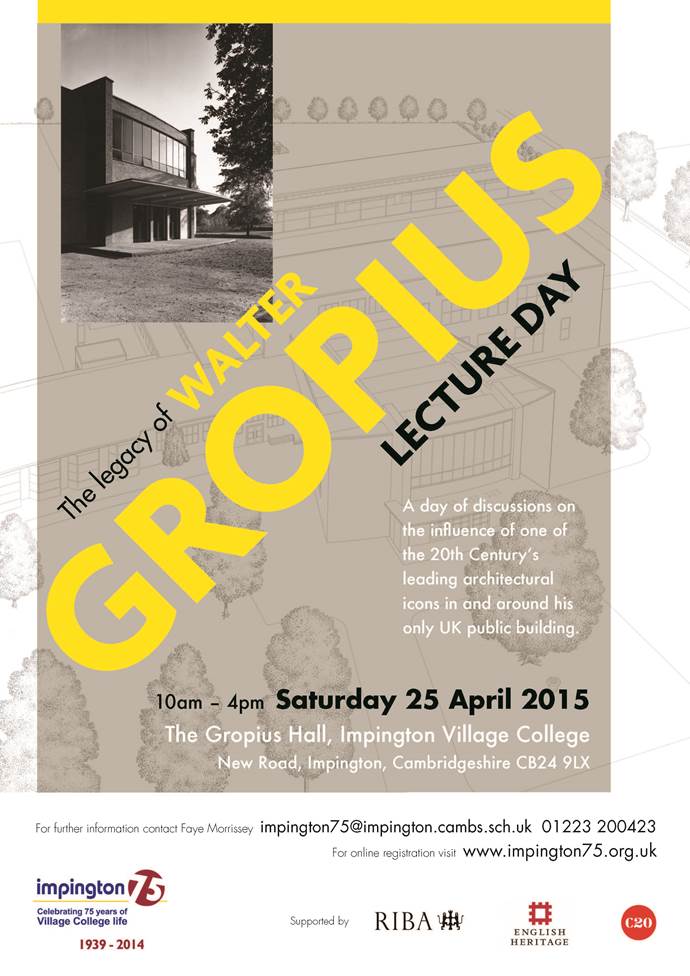
Lecture Day: The Legacy of Walter Gropius

Saturday 25 April, 10am – 4pm, Impington Village College, Cambridgeshire

This special lecture day will take place in the Grade 1 Listed Building at Impington Village College – the only public commission in the UK by Gropius.

Walter Gropius (1883 –1969), Architect and founder of The Bauhaus School, is widely regarded as one of the pioneering masters of modern architecture.  The lecture day will bring together experts from different fields to discuss the influence of Gropius’ work at Impington and how his work which penetrated the wider world is still significant today.  There will be presentations on the built environment in the 1930s, conservation principles and the impact of modernist architecture on practice today.  Speakers include leading Architectural Historian Dr Alan Powers, English Heritage and RIBA Architects.  There will include a tour of the building, an introduction about Henry Morris and panel discussion.

Adults: £25, Students: £15.

10% discount for groups of 10 or more.

Please find attached a flyer with further information including full programme. 

Buy your tickets online here

image001

Categories
CFPs Postgraduate

CFP: Relatability (MSA 17)

A specter is haunting university classrooms: the specter of “relatability.” For many teachers past a certain age, this term hardly seems a word at all. Its limitations as an analytic term are manifest: its fuzzy subjectivism treats everything as its own reflection in a manner that inhibits both critique and description. Journalists and commentators have marveled at the viral spread of this critical judgment in the last ten years, yet the sense of “relate” at its core (as in, “I can relate to what you are going through”) comes into usage in the middle of the twentieth century. This panel seeks to uncover a longer twentieth-century genealogy for “relatable” and to consider whether it might be recuperated as a meaningful critical term for thinking about twentieth as well as twenty-first century art and literature. That such recuperation might be worthwhile stems from our sense that relatability constitutes an important strain of modernist aesthetic theory, despite the latter’s association with forms of objectivity and autonomy. Something not unlike relatability seems to underlie Gertrude Stein’s claim, for instance, that “All literature is me to me, that isn’t as bad as it sounds.” From Stein to mid-century modernists such as Frank O’Hara, an aesthetic linked to forms of identification, mimesis, and likeness has been an important resource, especially for queer artists and audiences. More broadly, “relatability” indexes forms of aesthetic experience that have been associated with unschooled or amateur modes of responding to art and literature. Reincorporating such apparently preprofessional forms of relationality into professional scholarship has been an important impulse across the discipline. Indeed, many recent methodological developments in literary and cultural studies–Bruno Latour’s injunction to trace the connections between things, Wai Chee Dimock’s interest in weak ties–suggest that criticism’s job is not to uncover truths or to apprehend unities but to discover that everything is in fact relatable. We solicit papers that consider relatability a€™s modernist pasts and critical futures.
Please send a brief abstract and CV to glavey@sc.edu and l.heffernan@unf.edu by April 10.
Categories
CFPs Postgraduate

CFP for 2016 MLA Guaranteed Session for Division on Victorian and Early-20th-Century English

“Air”

Literature/art/culture and the elements, climate change, weather, air-borne particles and biological contagions, zeppelins, balloons and early aviation, cosmologies and conceptualizations of outer space. Theoretical approaches welcome: material feminist, LGBTQ, phenomenological, ecological, Anthropocene, psychological, linguistic, global.
250 wd. proposals by 20  March to David Kurnick (dkurnick@rci.rutgers.edu) and Cassandra Laity (claity@utk.edu).
Categories
CFPs Postgraduate

CFP: The mood of modernism: affect/invention/concept (MSA 17)

We invite papers which explore  modernism not in its more visible, spectacular, and externalized manifestations, but rather in unforeseen points, junctures, landscapes, interstices and borders, including the juxtaposition of intellectual and private life, past and present, the life of the mind and divided, alternative, fragmented, patched up, or precarious lives. We encourage all sorts of contributions on the significance of modernism when it is revolutionary otherwise, in more silent, dispersed ways, or when modernism itself becomes an atmosphere or a mood, thus a concept that can do its work only if it captures something as elusive as mood.

For example, through repetition over time, how might aesthetic modernism transfer to the lives we live, and become present in them? Is it plausible to think of modernism as an atmosphere of one’s daily life in the present? When? How? Where?  Given the popularity and the expandability of modernism, doesn’t the concept itself raise the question of modernism as that of passage, transit, transmission? One, therefore, can imagine a geographical transit: an Anglo-American modernism that passes, let’s say, through Italian hermeticism to re-emerge, over  time, in all kinds of Anglo-American modernism’s others.  However, one might also imagine quite a different kind of transit, a less geographical and more atmospheric transit. This less spectacular modernism may be felt to be in the air when it  impacts on us in unforeseen ways, making waves of meaning (and meaningfulness) right in the middle of our daily lives, when past intellectual and aesthetic residues, introjected verbal and visual memories of ideas, sensations, and readings, combine with our local position to open up conceptual, theoretical, creative possibilities and potentialities. It’s like being between mountains and sea, suddenly released from the limits of the local to experience an ampler, more global belonging. How does affect for/from modernism flow into public research? What are the other, improper places of modernism?

The panel is open to anyone from any discipline who wishes to explore how modernist objects—archival, textual, musical, visual, mnestic, or other– enter daily life, create sustenance, and incite creativity, conceptual and of other kinds.

Please contact panel co-organizers to discuss ideas, or send a 250-word abstract, along with a brief biography, by April 5 to:

Carla Billitteri at carla.billitteri@umit.maine.edu and Mena Mitrano at mmitrano@luc.edu, or

mena.mitrano@tin.it

Categories
CFPs Postgraduate

CFP: Berlin panel at The Rocky Mountain Modern Language Association

The Rocky Mountain Modern Language Association invites proposals for papers about any aspect of the culture of Berlin for presentation at the 2015 RMMLA convention, Oct. 8-10 in Santa Fe, NM.

The Berlin panel at RMMLA includes scholarly presentations on literature, film, language, culture and history related to Germany’s metropolis, among other possible approaches. Presentations are approximately 15 minutes in length. An abstract (1 page) is requested no later than April 1, 2015.

Please submit proposals electronically to session chair Dr. David Caldwell: david.caldwell@unco.edu . Requests for additional information and other questions may also be directed to the chair at this e-mail address.

Membership in RMMLA ($35 faculty dues) will be expected of participants. Conference registration fees will also apply.  Other information about the RMMLA and the 2015 convention in Santa Fe is available at the organization’s website:  http://rmmla.innoved.org/conferences/conf15SantaFe/default.asp
Keywords: Berlin, Germany, literature, film, culture

Categories
Events Postgraduate

LitVisCult: Prof. Laura Marcus, Wednesday 18 March

The next session of the Literature and Visual Cultures Research Seminar will take place on Wednesday 18th March, 6.00-7.30pm, Senate House, London, room 261.

We’re very pleased to have Professor Laura Marcus join us to give a paper entitled, ‘Silence, sound and city films and fictions of the 1920s and 1930s’.

Abstract:
This talk uses examples of late silent and early sound films (including F.W.Murnau’s Sunrise and Paul Fejos’s Lonesome) to explore the relationship between the visual and the aural in the cinema of the period, and the charged role played by representations of urban modernity in this context. It closes with brief discussion of novels (including works by Woolf, Graham Greene and Patrick Hamilton) in which relationships between silence and sound are played out in literary terms.

Laura Marcus is Goldsmiths’ Professor of English Literature at the University of Oxford. Her book publications include The Tenth Muse: Writing about Cinema in the Modernist Period (2007) and Dreams of Modernity: Psychoanalysis, Literature, Cinema (2014). Current research projects include a study of the concept of ‘rhythm’ in interdisciplinary contexts (with a focus on the late nineteenth and early twentieth centuries) and a book on literature and the cinema, which looks in particular at the relationship between writing and the silent/sound transition in film.

For more details and for information about other sessions, see: https://literatureandvisualcultures.wordpress.com. You can also follow us on Twitter @Litviscult.

Sarah Chadfield and Sophie Oliver

(Royal Holloway, University of London)

Categories
Events Postgraduate Registration open

Being Modern: Science and Culture in the early 20th century

Being Modern: Science and Culture in the early 20th century

22-24 April 2015

Institute of Historical Research, London

http://www.qmul.ac.uk/being-modern/

Join distinguished historians of literature, design and culture exploring how the complex interpretations of science affected the re-creation of what it was to be modern early in the 20th century.  Programme at http://www.qmul.ac.uk/being-modern/docs/145310.pdf

For those attending the conference there willl a limited number of places for an exciting performance of the  Opera ‘The Three Tales’ by Steve Reich at the Science Museum, London. Performances will take place on the 22nd and on the 24th of April. To claim your free ticket, please write to research@sciencemuseum.ac.uk stating your preferred date of attendance. Please note that we are only able to offer one ticket per attendee. Places are limited and will be allocated on a first come first served basis.

Categories
Call for submissions Postgraduate

THRESHOLDS Feature Writing Competition

We are now inviting submissions

to the 2015 THRESHOLDS International Short Story Forum

Feature Writing Competition

1st Prize of £500

2 x Runner-up Prize of £100

DEADLINE:
29 April 2015, 11:59pm (BST)


THRESHOLDS is the only online forum dedicated to the reading,
writing and study of the short story form. Entries are welcome in either of the following feature categories:

Author Profile: exploring the life, writings and influence of a single short story writer.

We Recommend: personal recommendations of a collection, anthology, group of short stories or a single short story.

One overall winner will be chosen, followed by two runners-up. The judges hope to see a range of styles and approaches in the feature essays. They will be looking, above all, at the quality of the prose in each feature submitted, the insights offered, and the author’s ability to engage his/her readers. The winning and runner-up essays and shortlist will be published on the THRESHOLDS Forum during 2015.

Previous winning essays:
2014 winner: Wolves at the Hearthside by Sharon Telfer
2013 winner: A Trio of Irish Short Stories by Nuala Ní Chonchúir
2012 winner: H.P. Lovecraft by Geoff Holder

* PLEASE READ THE COMPETITION RULES (below) AND THE GENERALTHRESHOLDS Submission Guidelines CAREFULLY BEFORE SUBMITTING *


Competition Rules:

  • All entries must be submitted by email as a PDF or Word document (.doc, .docx or .rtf only) attachment and sent to thresholds@chi.ac.uk, with the subject line ‘Feature Competition’.
  • Entries must be received by 11:59pm (BST) on 29 April 2015.
  • There is no entry fee.
  • Maximum word count is 2,000, with a minimum of 750. Writers may submit a maximum of 3 essays.
  • Please note: the Competition is open for feature essayentries only. Short story submissions will NOT be accepted.
  • Work should be double spacedand in a minimum of 11 point font. All pages should be numbered.
  • The stories or collections under discussion may be either contemporary or classic, and can be in print or out of print.
  • Entries must be accompanied by a separatetitle page (i.e. saved in a separate document) containing the following information: name and email address of the writer; title of entry(ies); category of each entry — Author Profile or We Recommend.
  • Entries will be judged anonymously. Your name, address, or email address should NOT appear on the manuscript.
  • Entries cannot be altered once they have been submitted.
  • Entries must be original and unpublished. Work that has appeared on the internet (apart from in a personal blog) is considered published and therefore is not eligible. Simultaneous submissions are NOT accepted(i.e. features submitted to multiple journals/magazines simultaneously).
  • The entrant warrants to THRESHOLDS’ editors that the essay is original to him/her, that he/she has the full power to agree to the Competition rules of entry, and that he/she is the sole author of the feature essay.
  • The entrant warrants to THRESHOLDS’ editors that his/her essay is in no way whatsoever a violation of any existing copyright and that it contains nothing libelous.
  • The judges’ decisions are final and no discussion will be entered into once work has been submitted. The judges reserve the right not to make the award if the quality of entries does not merit it.
  • The Competition is open to writers of any nationality writing in English, 16 years old and over at the time of the closing date.
  • University of Chichester staff may not apply.
  • The names of the winners, runners-up, shortlisted and longlisted writers will be published on The Forum.
  • The shortlist will be announced in May, and the winning writer will be notified soon after.
  • Copyright of the submitted essay remains with the author, but THRESHOLDS has the unrestricted right to publish any winning or shortlisted feature essays on its website and in any related material for PR purposes.
  • THRESHOLDS reserves the right to edit the winning, runner-up and shortlisted articles prior to publication, as well as any other pieces selected for publication on the site.
  • By entering the competition, you are deemed to have agreed to the above rules.
Categories
Postgraduate Registration open

Registration now open for ‘Modernist Musics and Political Aesthetics’ conference

8th-10th April 2015, University of Nottingham, UK
Modernist Musics and Political Aesthetics is a three-day conference aiming to explore interfaces between:

  •     cultural modernism (literary and visual, architectural, musical, and/or philosophical)
  •     music, musicality, and musicology in relation to modernism and literature
  •     and the political implications of art and theories of the aesthetic in the twentieth century

The conference remit is intentionally capacious. ‘Modernism’ is open for all speakers and attendees to interpret as any instance of the experimental strategies that emerged throughout cultural life at the turn of the twentieth century, though papers focusing on new interdisciplinary contexts for literary questions are sought in the first instance.

Likewise, the plural use of ‘musics’ is meant to reflect a variety of musical modernisms, but also the fact that ‘music’ as an idea meant many things to different modernist artists and critics.

Above all, the conference organizers seek interdisciplinary papers that will develop scholarly understandings of the convergences between modernism, music, and politics.

http://www.nottingham.ac.uk/conference/fac-arts/english/modernist-musics-and-political-aesthetics/index.aspx

Modernist Music and Political Aesthetics is kindly sponsored by the School of English and the Faculty of Arts at the University of Nottingham, and by the Faculty of Humanities at the University of Manchester.

Categories
CFPs Postgraduate

CFP: Global Modernism and Civil War (MSA17)

Global Modernism and Civil War

(CFP for ‪#‎msa17‬)

Wyndham Lewis’s Blast is perhaps the most famous modernist declaration of civil war: “We set Humour at Humour’s throat. / Stir up Civil War among peaceful apes.” Lewis himself was named after an eccentric English mercenary who fought in the U.S. Civil War (by his American father, a veteran of the same war), and he returns to the trope in his 1937 autobiography, Blasting and Bombardiering: “You will be astonished to find how like art is to war, I mean ‘modernist’ art…I have set out to show how war, art, civil war, strikes and coup d’etat dovetail into each other.”

This panel proposes extending recent interest in the Spanish Civil War to a comparative, structural, and intertextual analysis of internecine modernism. How does sectional conflict reframe our understanding of nationalism and world war? Papers could return to well-known national narratives, identify less familiar histories of schism, or develop new transnational or inter-historical approaches.

Read more: http://bit.ly/modcivilwar

Contact Ryan Weberling (ryanweb@bu.edu) to discuss possibilities for the panel, or send a 300-word paper proposal by April 10.