
Categories
CFPs

CFP: The Turn into the Twentieth Century and the Problem of Periodization: Critical Essays on American Literary History

Despite the substantial reconceptualization of the field of American literature in recent decades, century-based constructs typically remain in place throughout the field, particularly in relation to “nineteenth-century American literature” versus “twentieth-century American literature.” Courses are taught, textbooks sold, and academic jobs are constructed around such distinctions. Such logic particularly limits scholarship on the turn into the twentieth century, often characterized as a midpoint on a teleological trajectory culminating in literary modernism.  This collection of essays aims to complicate and challenge the conceptual divide between the 19th and 20th centuries by exploring turn-of-the-century works (“T-20” works) in light of the particular negotiations engaged in by writers from the 1880-1920 era, or those that render writing from this period irreducible to a clear periodization by century.  We are especially interested in essays that rethink boundaries denoted by century and in those that create models for extending both “19th c thought” and “modernity,” so as to interrogate the meeting of a long, late 19th century and an extended, emergent modernity.


Proposals for 25-page  essays might consider the following:

*What constructs, authors, and texts are particularly useful in exploring the unique historical and ideological assumptions about literature from the century’s turn?

* In what ways does the language we use to describe cultural and literary movements of the late nineteenth and early twentieth centuries reinscribe the logic of periodization by century?  How, for example, might rhetorics of progress and teleology reveal assumptions that undergird our approach to turn-of-the-century American literature? In what ways might these assumptions/terms be reconsidered?

*In what ways does the idea of the “turn of the century” emerge as a useful category through which to explore  continuities across centuries rather than stark divisions between them?  If there is a “long nineteenth century,” where might it end? If there is an “emergent modernity,” at what point(s) might it begin?

*In what ways does the profession of literary studies—the job market, academic conferences, scholarly journals, and book publishing—reproduce or challenge these divides in regard to specific authors or works?  In what ways can scholars and students take a less temporally restrictive view of the field?


Send abstracts of 250-500 words and short c.v.s to Melanie Dawson (mvdaws@wm.edu) and Meredith Goldsmith (mgoldsmith@ursinus.edu) by September 15, in anticipation of full-length essays being due by February 15.  Enquiries welcome.

Categories
CFPs

CFP: _Edith Wharton Review_ (deadline: on-going)

The _Edith Wharton Review_, a peer-reviewed, MLA-indexed journal is currently seeking submissions. The journal is committed to rigorous study not only of Edith Wharton, but on Wharton in the context of other authors, and on Wharton in relation to late-nineteenth and early twentieth-century culture more generally. It publishes traditional criticism, pedagogical scholarship, essays on archival materials, review essays, and book reviews. The _Review_ aims to foster emerging scholars and new approaches to Wharton studies as well as established scholarly approaches.


On the occasion of its 30th anniversary, the journal now boasts a new design and vastly expanded content. Recent special issues include “_The Custom of the Country at 100” and “Teaching Edith Wharton’s Late Fiction.” Opportunities exist to publish on Wharton’s lesser-known works, as well as her more canonical writings.


If you are interested in submitting, please contact Meredith Goldsmith, Editor (mgoldsmith@ursinus.edu). Submissions should be 20-25 pages, and prepared according to the _MLA Style Manual_.

Enquiries welcome.

Categories
Events

Scotland and Russia: Performance Since 1900 — 17 October, Edinburgh

 scot-russ

Event: Scotland and Russia: Performance Since 1900


Time: Friday, 17 October 2014

Place: University of Edinburgh, Institute for Advanced Studies in the Humanities and Reid Concert Hall


‘Scotland and Russia: Performance Since 1900’ is the inaugural event of the ‘Scotland and Russia: Cultural Encounters in the Twentieth Century’ project dedicated to exploring the history of cultural exchange between the two countries over the last hundred years.

Scotland and Russia have a long tradition of mutual engagement and influence, going back to the Middle Ages and still thriving today; and nowhere is the strength of these links more apparent than in the worlds of theatre and music. The daylong event at the Institute for Advanced Studies in the Humanities will feature talks by leading performance scholars and practitioners, including directors and musicians, and will conclude with a recital of folk and classical music at the Reid Concert Hall. The recital, ‘Glasgow Concerts in the 1930s: Performing Russian Music in Scotland’, is free and open to the public. The programme will include selections from Medtner, Mussorgsky, Shostakovich and Erik Chisholm’s Celtic Folksongs.


Please register here: https://www.eventbrite.com/e/scotland-and-russia-performance-since-1900-tickets-12498169361


PDF PROGRAMME HERE: Scotland-Russia Performance Programme


Categories
Events

Resounding Dylan Thomas: A Centenary Symposium — Cambridge, 11 October

Resounding Dylan Thomas: A Centenary Symposium

(University of Cambridge, 11 Oct 2014)


2014 marks the centenary of Dylan Thomas’s birth. As such, it provides an ideal opportunity to reevaluate a body of work that has for too long precluded scholarly consensus. The sticking point has always been a biographical one. Thomas’s untimely death in New York in 1953 makes for a juicy story, yet it has created a kind of blind spot in critical as well as popular thought. The poet’s public image – a drunk, a womanizer, a Welshman – continues to influence the way his written craft is received, as though his wild behaviour should provide the first or only means of access to the poetry.


Those involved in Resounding Dylan Thomas intend to make a change. Building on the work of John Goodby’s new monograph, The Poetry of Dylan Thomas: Under the Spelling Wall (2013), this symposium will bring together a diverse group of scholars, not only to debunk the Thomas myth, but also to determine what place he has – or could have – in twenty-first century culture. The symposium will feature papers on various aspects of Thomas’s technique – his revisionary habits, his engagement with new media, his influence on recent writing – as well as a reading of his poetry.


Speakers:

John Goodby, Leo Mellor, Rod Mengham, Jeremy Noel-Tod, Peter Robinson, Zoë Skoulding, and Amanda Wrigley

Date: Saturday 11 October 2014


Venue: Faculty of English, 9 West Road, Cambridge, CB3 9DP


For more information, and to register, please contact: Edward Allen – ejfa2@cam.ac.uk

Categories
CFPs

CFP: Beatrice Hastings essay collection — deadline 15 October

Call for Papers: Beatrice Hastings

Pleiades Press is seeking proposals for essays to be included in an upcoming collection on the life and work of Beatrice Hastings.  The book will be published as the seventh annual installment of the Unsung Masters Series, and it will include a selection of Hastings’ key works along with essays by contemporary scholars and writers.
Hastings, writing under a variety of pseudonyms for The New Age and The Straight-Thinker, had a front-row seat for the emergence of modernity.  As Beatrice Tina, she wrote poems, essays, and fiction encouraging her readers to re-imagine the political, domestic, and sexual lives of women.  As D. Triformis, she battled with the WPSU over the goals and tactics of the feminist and suffrage movements.  As T.K.L, she argued about and satirized early modernist literature.  And as Alice Morning, she wrote dispatches from Paris detailing trends in modernist painting and the horrors of the First World War.
She has appeared for decades as a supporting player in the stories of an astonishing range of twentieth century luminaries—Modigliani, Mansfield, Lewis, Radiguet, Cocteau, Max Jacob, Picasso, Orage—but her own work has been largely forgotten, and only sporadically discussed.
We welcome proposals for essays dealing with any aspect of Hastings’ work.  Proposals should be 250-500 words, and should be sent to Benjamin Johnson at bgjohnson@ucmo.edu by October 15.  Contributors whose proposals are accepted should plan to submit a 10-15 page essay by August 15, 2015.
For more information on Pleiades and the Unsung Masters Series, please visit:  https://www.ucmo.edu/pleiades/unsung_masters/


Dr. Ben Johnson

Categories
CFPs Events

CFP: Being Modern: Science and Culture in the early 20th century — deadline 19 October

Call for papers for a major conference

Being Modern: Science and Culture in the early 20th century

Institute of Historical Research, London 22-24 April 2015

Engagement with science was commonly used as an emblem of “Being modern”, across culture in Britain and the western world in the years around the First World War. Today, historical studies of literature, art, design, lifestyle and consumption as well as of the human sciences are exploring intensively, but frequently separately, on that talk of “science”.

Historians of science are exploring the interpenetration of discourse in the public sphere and expert communities. This pioneering interdisciplinary conference is therefore planned to bring together people who do not normally meet in the same space. Scholars from a range of disciplines will come together to explore how the complex interpretations of science affected the re-creation of what it was to be modern.

Please see the website for more details: http://www.qmul.ac.uk/being-modern/

Submissions for four types of presentation and discussion are sought:

  1. disciplinary panels of three x15 minute papers and discussion
  2. cross-disciplinary panels of three x15 minute papers and discussion
  3. Focus on research presentations of 5 minutes plus two minute discussion each will provide opportunities particularly for graduate students
  4. Poster sessions

Closing date 19 October 2014. Get in early – competition will be strong!

Submissions to: research@sciencemuseum.ac.uk

Enquiries to: Robert.bud@sciencemuseum.ac.uk

Dr Robert Bud

Keeper of Science and Medicine

The Science Museum, London

+44 207 942 4200

  1. makingthemodernworld.org.uk
  2. ingenious.org.uk
  3. sciencemuseum.org.uk/broughttolife
Categories
CFPs

Call for Papers: The Turn into the Twentieth Century and the Problem of Periodization — Critical Essays on American Literary History — deadline 15 September

Call for Papers

The Turn into the Twentieth Century and the Problem of Periodization: Critical Essays on American Literary History


Despite the substantial reconceptualization of the field of American literature in recent decades, century-based constructs typically remain in place throughout the field, particularly in relation to “nineteenth-century American literature” versus “twentieth-century American literature.” Courses are taught, textbooks sold, and academic jobs are constructed around such distinctions. Such logic particularly limits scholarship on the turn into the twentieth century, often characterized as a midpoint on a teleological trajectory culminating in literary modernism.  This collection of essays aims to complicate and challenge the conceptual divide between the 19th and 20th centuries by exploring turn-of-the-century works (“T-20” works) in light of the particular negotiations engaged in by writers from the 1880-1920 era, or those that render writing from this period irreducible to a clear periodization by century.  We are especially interested in essays that rethink boundaries denoted by century and in those that create models for extending both “19th c thought” and “modernity,” so as to interrogate the meeting of a long, late 19th century and an extended, emergent modernity.


Proposals for 25-page  essays might consider the following:

*What constructs, authors, and texts are particularly useful in exploring the unique historical and ideological assumptions about literature from the century’s turn?

* In what ways does the language we use to describe cultural and literary movements of the late nineteenth and early twentieth centuries reinscribe the logic of periodization by century?  How, for example, might rhetorics of progress and teleology reveal assumptions that undergird our approach to turn-of-the-century American literature? In what ways might these assumptions/terms be reconsidered?

*In what ways does the idea of the “turn of the century” emerge as a useful category through which to explore  continuities across centuries rather than stark divisions between them?  If there is a “long nineteenth century,” where might it end? If there is an “emergent modernity,” at what point(s) might it begin?

*In what ways does the profession of literary studies—the job market, academic conferences, scholarly journals, and book publishing—reproduce or challenge these divides in regard to specific authors or works?  In what ways can scholars and students take a less temporally restrictive view of the field?


Send abstracts of 250-500 words and short c.v.s to Melanie Dawson (mvdaws@wm.edu) and Meredith Goldsmith (mgoldsmith@ursinus.edu) by September 15, in anticipation of full-length essays being due by February 15.  Enquiries welcome.
Categories
CFPs Events Postgraduate

CFP: Katherine Mansfield and Antipodean Modernism – deadline 29 September

Call for Papers
 
Katherine Mansfield and Antipodean Modernism
 
The Katherine Mansfield Society Postgraduate and Early Career Researcher Conference,  held in conjunction with the Centre for Modernism Studies in Australia
 
29 January 2015
 
University of New South Wales
 
Keynote Speaker: Emeritus Professor Angela Smith (Stirling)
 
 
When Wyndham Lewis described Katherine Mansfield as ‘the famous New Zealand Mag.-story writer’
in September 1922, it was not meant as a compliment. Yet this disparaging remark gives a hint as to
what makes her such a fascinating figure today. In the context of the recent scholarly extension of
modernism’s borders in terms of geography, gender, class, and time, as well as such diverse new
interests as the roles of literary networks, periodicals, and popular and material cultures, Mansfield is
more important than ever.
 
These developments encourage new approaches to Katherine Mansfield, new ways of reading her not
only as a short-story writer but as also an editor, a literary critic, a translator, and a poet. Recent
criticism has also turned to considering Mansfield as a transnational modernist, whose antipodean
origin influenced and affected her even after she emigrated to Europe, and whose legacy continues to
inspire succeeding generations of writers and artists in New Zealand and beyond.
This, the third annual Katherine Mansfield Society postgraduate and early career researcher conference,
aims to explore the place of this complex literary figure in terms of both modernist and antipodean
writing: the ways that she and her works have crossed national, professional, and linguistic boundaries.
Proposals are invited, on these topics or any other topic related to Mansfield, from postgraduate
students and early career researchers. Please submit abstracts of 250 words with a brief biography of 50
words to mansfield.unsw@gmail.com by 29 September 2014.
KM & Antipodean Modernism CFP
Categories
Events

Anna Kavan Symposium Programme — 11 September, Bloomsbury

Please see below programme and registration details for the Anna Kavan Symposium and Evening Event (speaker Maggie Gee), plus details of an Anna Kavan Wikipedia edit-a-thon taking place the following day.
 
 
ANNA KAVAN SYMPOSIUM PROGRAMME
11 September 2014, Institute of English Studies, Russell Square, London, UK
 
09.30-09.50     Registration
 
09.50-10.00     Welcome Remarks
 
10.00-11.15     Panel 1:  Feminist Approaches to Kavan
Chair: Tory Young (Anglia Ruskin)
 
”Learning to know in the night way”: Night-Time Life and Language in
Anna Kavan’s Sleep Has His House
Hannah Van Hove (Glasgow)
 
Anna Kavan and the Mirror Alone
Natalie Ferris (Oxford)
 
Anna Kavan’s Geographies of Control
Jules Bentley (New Orleans)
 
11.15-11.45     Coffee Break
 
11.45-12.30     Panel 2:  Postcolonial Kavan
Chair: Michèle Barrett (Queen Mary)
 
Anna Kavan and the New Zealand Connection
Janet Wilson (Northampton)
 
Anna Kavan’s Postcolonial Masculinities
Kate Houlden (Liverpool John Moores)
 
12.30-13.30     Lunch Break
 
13.30-14.00     Catherine Lenoble Performative Reading
 
14.00-15.15     Panel 3:  Reading Kavan
Chair: Helen Carr (Goldsmiths)
 
Mental Illness, Pathos and Dogs in Anna Kavan’s Asylum Piece
Angelos Evangelou (Kent)
 
The Horse’s Tale: Hybridity, Heterotopia and Canonic Marginality
Nikki Sheppy (Calgary)
 
The Lost Girl in Ice
Helena Fagertun (Gothenburg)
 
15.15-15.45     Coffee Break
 
15.45-16.30     Panel 4:  Kavan Contextualised
Chair: Victoria Walker (London)
 
Anna Kavan and the Angry Young Women Discourse
Freya Buechter-Greiner (Giessen)
 
Anna’s Addiction
Christopher Hallam (London School of Hygiene and Tropical Medicine)
 
16.30-17.45     Round Table Discussion and Concluding Remarks
                        Chair:  Kate Houlden (Liverpool John Moores)
 
Michèle Barrett (Queen Mary); Helen Carr (Goldsmiths); Victoria Walker (London); Tory Young (Anglia Ruskin)
 
17.45-18.00     Break
 
18.00-19.30     Evening Event & Wine Reception
                        Maggie Gee in Conversation – Anna Kavan: It’s Cold Outside 
Anna Kavan’s legacy can be seen in the admiration of her work expressed by writers of her time and those that followed her, among them Jean Rhys, Anaïs Nin, J G Ballard and Brian Aldiss. The Anna Kavan symposium will close with a public event in the evening at which writer Maggie Gee will discuss Kavan’s writing, and consider points of comparison with her own work and her experience as a contemporary author.

Maggie Gee has written twelve acclaimed novels, including The Ice People, My Cleaner, My Driver and The White Family, a collection of short stories, The Blue, and a memoir of her life as a writer, My Animal Life. She was the first female Chair of Council of the Royal Society of Literature, 2004-2008, and is now a Vice-President. Her new novel, Virginia Woolf in Manhattan, has just been published. She is Professor of Creative Writing at Bath Spa University

 
Conference fees: £30 standard rate/ £20 IES members & friends, students, unwaged/ £7 evening event only
For further information and to register see: http://annakavansymposium.wordpress.com/ or http://www.ies.sas.ac.uk/ies-conferences/AnnaKavan
@AnnaKavan
 
WHO ARE YOU?  ANNA KAVAN EDIT-A-THON
09.30-13.00, 12 September 2014, Wikimedia UK, 4th Floor, Development House, 56-64 Leonard Street, London EC2A 4LT
To coincide with the Anna Kavan Symposium, writer Catherine Lenoble will be facilitating a collaborative-writing workshop to edit the Wikipedia pages associated with Anna Kavan.  For further details and registration (to join in person or remotely), please see https://wikimedia.org.uk/wiki/Anna_Kavan_Edit-a-thon
 
 ANNA KAVAN SYMPOSIUM PROGRAMME
 
Dr Victoria Walker
Anna Kavan Society
info@annakavan.org.uk
Categories
Events

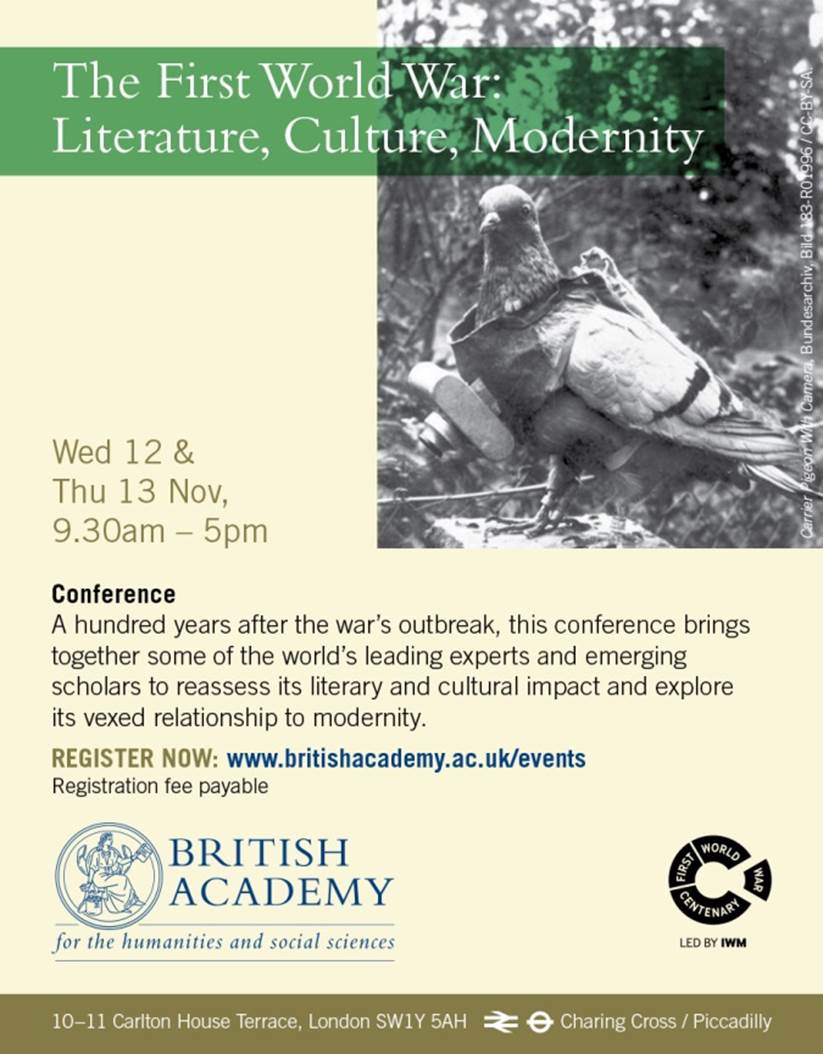
The First World War: Literature, Culture, Modernity — 12-13 November, British Academy

A British Academy Landmark Conference

The First World War: Literature, Culture, Modernity

Organisers: Santanu Das & Kate McLoughlin

12-13 November 2014 at The British Academy, London

Speakers: Fran Brearton, Geert Buelens, Sarah Cole, Laura Doan, Ann-Marie Einhaus, Sandra Gilbert, Margaret Higonnet, Tim Kendall, Britta Lange, Hermione Lee, Laura Marcus, Jane Potter, Jahan Ramazani, Eugene Rogan, Max Saunders, Vincent Sherry, Hope Wolf.

On the evening of 11 November 2014, there will be an evening of music and readings at the Chapel of King’s College, London, featuring the tenor Andrew Kennedy and the poet-critic Angela Leighton.  On the evening of 12 November 2014, there will be a poetry reading featuring Sir Andrew Motion, Michael Longley and Jon Stallworthy at the British Academy.

You can register at http://www.britac.ac.uk/events/2014/The_First_World_War_Literature_Culture_Modernity.cfm.

Details of the performance on 11 November are here: http://www.britac.ac.uk/events/2014/Terrible_Beauty.cfm
Details of the poetry reading on 12 November are here: http://www.britac.ac.uk/events/2014/The_Past_Hovering.cfm

A flyer is attached.  Do come and do spread the word!

BA flyer