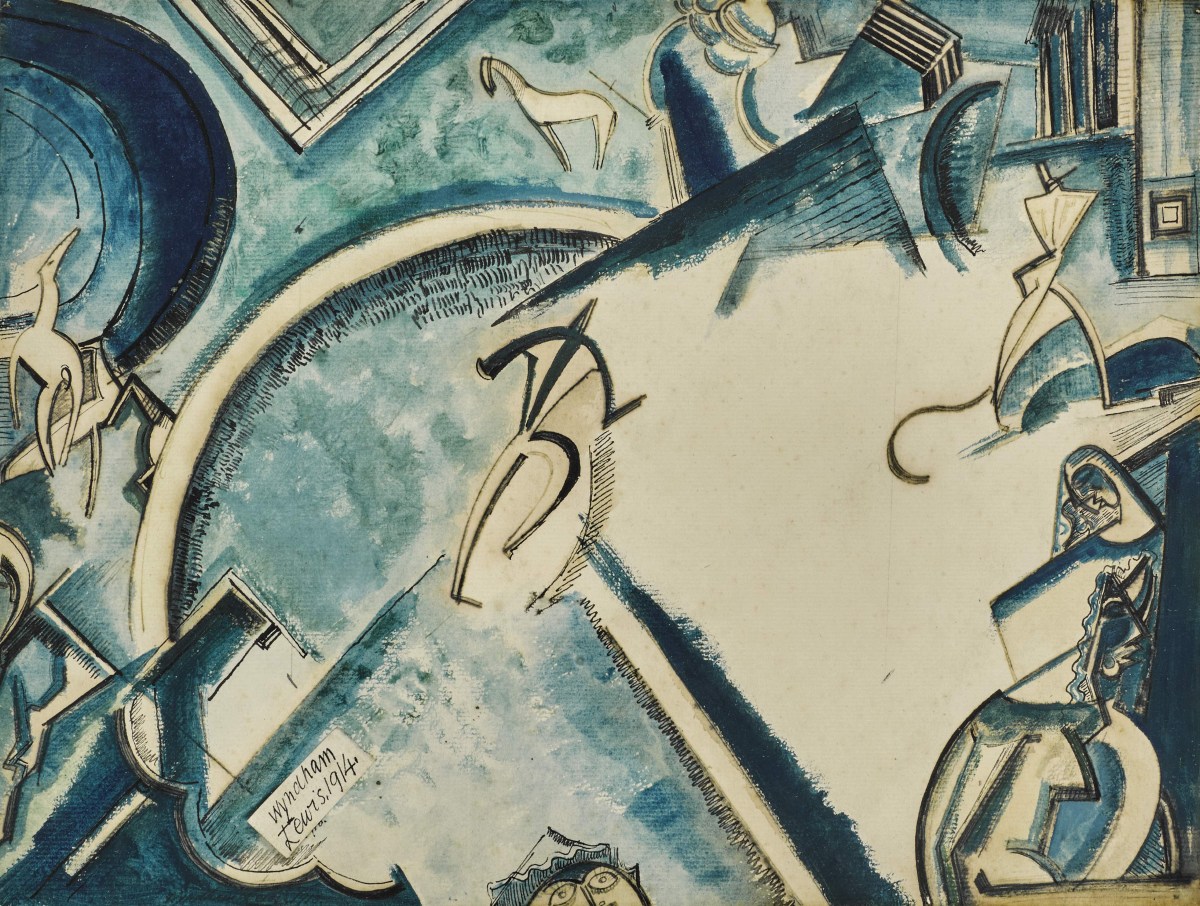
The call for papers is now open for “Benign Fiesta: Wyndham Lewis’s Texts, Contexts, and Aesthetics”, to be held at the University of Nottingham from the 11-13 September, 2017.
 British Association for Modernist Studies - Website Designed and Developed by Callum Leith
The call for papers is now open for “Benign Fiesta: Wyndham Lewis’s Texts, Contexts, and Aesthetics”, to be held at the University of Nottingham from the 11-13 September, 2017.
This is a CFP for a panel proposal to the Modernist Studies Association (MSA) conference in Amsterdam, August 10-13, 2017. Please send abstracts to Michelle Rada at the e-mail address indicated below.
About the proposed panel
Modernism’s preoccupation with form is no secret. While modernist texts are often characterized by their formal opacity, density, and increasing demands on readerly attention, modernist design and architecture tends toward simplicity of form, functionality, sleekness, and transparency. Examining these two distinct and often mutually exclusive versions of form alongside one another sets up an encounter not just between two disciplines or discourses, but between alternative models for imagining the subject’s encounter with an aesthetic object—be it through reading, viewing, or inhabiting. This panel will explore the interpretative pathways opened up by situating a discussion of modernist literary form alongside modern design in its various tenets and iterations.
What theoretical, historical, and discursive linkages and/or rifts emerge when we examine modernist texts with design and architecture? What are the relationships between textual versions of interiority and the structures or interiors subjects inhabit, frequent, and transgress? How might we think of aesthetic experience in the modernist novel through theories of spatial design and setting, instead of paying heed only to its formal innovations in temporality? Can modern design’s careful attention to the surface tell us something about how to read textual surfaces? Does the novel as a technology for storing, converting, and transmitting information undergo significant changes alongside technological advancements and their uses for/as aesthetic practices and objects? Building on recent work by authors such as Anne Cheng, Caroline Levine, and David Alworth, this panel seeks to enter conversations on “new” formalism and forms of reading by asking how, in modernist studies, we might think literature and design together.
Among other topics, proposals might address: the role of emerging media and technology across design practices and literary works; the relationship between free indirect discourse, stream of consciousness, and different ways of understanding interiority in modernist texts and the interiors, spaces, settings, and sites subjects inhabit; how new models for reading can engage with spatial concerns in literary form; how specific works or authors converse with aesthetic practices and design principles; the ways that subjective experience is affectively, phenomenologically, or cognitively theorized by modern authors, designers, and architects.
How to submit
Please send abstracts of 200—300 words along with a brief bio to michelle_rada@brown.edu no later than January 10th, 2017.
The Call for Papers is now live for the Katherine Mansfield Society Postgraduate Conference, to be held in Oxford on 10 April, 2017.
About the conference

The Call for Papers has been extended for the 2017 International D.H. Lawrence Conference, London Calling, to be held in – where else? – London in July 2017.
About the conference
London played a crucial role in Lawrence’s early life: he taught here, got his first literary breaks here, and even got married here in 1914. It was in London that he met the friends and patrons who launched his career and facilitated his travels, and whenever he and Frieda returned to England, it was to London that they came first.
Lawrence visited London around fifty times – for the first time in October 1908 for his interview for a teaching position in Croydon, and for the last time in September 1926. Over those eighteen years he visited or lived in London in every single year, apart from during his travels in 1920-22.
He saw the city grow from seven to eight million people, and become the metropolis we know today, with its buses, trams, private cars, bridges, Underground stations, West End theatres, and electric street lights. He knew London as it was approaching the historical peak population; this was followed by decline, and which has only just (in 2015) been exceeded.
He knew the London of the Edwardian period, of the War, and of the jazz age. He knew middle-class outer-suburban Croydon, but also some of London’s most fashionable districts, where his friends lived: Hampstead (Edward Garnett, Dollie Radford and Catherine Carswell), St. John’s Wood (Koteliansky), Mecklenburgh Square (H.D. and Richard Aldington), and Bedford Square (Lady Ottoline Morrell).
London was the legal, as well as the literary, artistic and theatrical, centre of England. In 1913 Frieda’s divorce hearing was heard there; in 1915 Lawrence was examined for bankruptcy at its High Court; in the same year The Rainbow was tried at Bow Street Magistrate’s Court; in 1927 David was produced at the Regent Theatre; in 1928 Catherine Carswell oversaw the typing of part of Lady Chatterley’s Lover there; in 1928 Lawrence explained ‘Why I Don’t Like Living in London’ in The Evening News; and in 1929 his paintings were exhibited at the Warren Street gallery and impounded.
Given his hatred of London’s intellectualism and authoritarianism, and his objections to metropolises in general, it is not surprising that much of what Lawrence writes about London is negative. But, as he admitted in 1928, ‘It used not to be so. Twenty years ago, London was to me thrilling, thrilling, thrilling, the vast and throbbing heart of all adventure.’
For such a nodal city – the world’s biggest city, the heart of the world’s biggest empire, and a centre of international modernism – it has a peripheral place in his work and in work about him. But Lawrence could not have become the person and writer he did without having known his native capital city.
The 14th International D. H. Lawrence conference will be held in London at the College of the Humanities, Bedford Square, and nearby venues. It is authorized by the Coordinating Committee for International Lawrence Conferences (CCILC) and organized in collaboration with the D. H. Lawrence Society of North America and the D. H. Lawrence Society (UK).
The conference welcomes papers on topics including but not limited to:
Papers are welcome from Lawrence scholars, graduate students, and the public.
Papers should last no longer than 20 minutes, and will be followed by 10 minutes of questions. They will be presented in a panel together with two other papers.
How to submit
If you would like to contribute, please send an abstract of up to 500 words to the Executive Director, Dr. Catherine Brown at catherinelawrencelondon@gmail.com
The deadline for submissions is midnight on 31st December 2016 (unless you are a graduate student who wishes to apply for a Graduate Fellowship, in which case please follow the alternative procedure described below).
Submissions will be assessed by the Academic Program Committee detailed below, and responses will be issued by 15th February 2017.
The abstract should include the following information as part of the same file (in either MS Word or pdf format):
Feed and funding
The Conference Fee is expected to be approximately £280-320 for the week.
The Fee includes payment for attendance at academic sessions, four lunches, all tea/coffee breaks, and two dinners including the Gala Award Dinner on Thursday evening.
More information will become available on the conference website.
Graduate Fellowships
One Graduate Fellowships is available for Graduate Fellows.
A Graduate Fellowship covers conference fees (which include five lunches, two dinners, all tea/coffee breaks, the Gala Award Dinner on Thursday evening, and the full-day excursion to Eastwood and environs on Saturday 8th) – and cheap accommodation will be made available.
Graduate Fellows will be required to help with registration and other duties during the Conference.
If you would like to apply for one of these, please fill out the Graduate Fellowship Application form available on the conference website.
Submissions are to be sent to lawrencegraduatefellowship@aol.com by 31st December 2016.
This competition will be assessed by the Graduate Fellowships Committee chaired by Dr. Andrew Harrison.
Welcome to “News and Views”, a newsletter from BAMS that will bring you updates on publications, conferences, and other tidbits from modernist studies around the globe, direct in to your inbox.
We hope you enjoy this first round-up, and please do send us your news to share: whether you’ve got an article in print, a new job to shout about, or just spotted a great exhibition that your colleagues might enjoy.
Best,
Helen & Stephanie
Brave New World
Congratulations to Jonathan Greenberg and Nathan Waddell on the publication of Brave New World: Contexts and Legacies (Palgrave, 2016). The book features a Foreword by the late David Bradshaw.
Make it New (Work in Modernist Studies)
For the last time: registration for New Work in Modernist Studies closes TODAY (Monday December 5). Registration is open now; if you can’t join us in person, follow along with the hashtag #nwims2016.
Please do encourage your postgraduates to attend!
Historical Modernisms
This conference will be taking place next Monday (12th) at London’s Senate House. The keynote speaker will be Jean-Michel Rabaté; download the programme here.
See you all next Monday!
Got news or thoughts to share? Share them with us at info@bams.ac.uk, subject line: “news and views”.
Welcome to “News and Views”, a newsletter from BAMS that will bring you updates on publications, conferences, and other tidbits from modernist studies around the globe, direct to your inbox, every Monday.
We hope you enjoy this round-up, and please do send us your news to share: whether you’ve got an article in print, a new job to shout about, or just spotted a great exhibition that your colleagues might enjoy.
Best,
Helen & Stephanie
Make it New (Work in Modernist Studies)
Registration is still open for our postgraduate conference on December 10th. This will also include our AGM, so please get in touch if there’s something you’d like to be put on the agenda.
The Modernist Review
A reminder for those who haven’t yet seen it of our sister site, The Modernist Review. It’s been designed with modernist postgrads and ECRs in mind, so please have a look and consider submitting. Ideal for those little ‘offcuts’ of work that need a loving home.
MSA
The MSA may be over for now, but you can still catch up with it on #MSA18. Plans are underway for next year’s conference, to be held in Amsterdam.
The Clothes on their Backs
Congratulations to Celia Marshik (Stony Brook) on her new publication, At the Mercy of their Clothes: Modernism, the Middlebrow, and British Garment Culture. Our copy arrived this week!
Our summer conference
The CFP for BAMS’ 2017 conference is due to go live very, very soon….watch this space!
See you all next Monday!
Got news or thoughts to share? Share them with us at info@bams.ac.uk, subject line: “news and views”.
Join BAMS: https://bams.ac.uk/membership/
The 2016 AGM of the British Association for Modernist Studies will take place at the New Work in Modernist Studies conference at Queen Mary University of London, on Saturday 10th December 2016.
If there are any items that you would like to suggest for the agenda, please contact either the BAMS Secretary, Alex Goody (agoody@brookes.ac.uk), or Chair, Jeff Wallace (jwallace@cardiffmet.ac.uk), by Wednesday 7th December.
We look forward to seeing you at NWiMS and the AGM,
The BAMS Executive Steering Committee.
The call for papers is now open for a conference on Twentieth-Century British Periodicals to be held at the Museum of English Rural Life, University of Reading, on July 4, 2017.
About the conference
Current scholarship on twentieth-century periodicals is moving beyond the study of the ‘little’ magazine and avant-garde publications. Many mainstream and specialist periodicals, including tabloids, broadsheets, illustrated newspapers, illustrated magazines, fashion magazines, ‘slick’ magazines, women’s magazines, art periodicals, trade and specialist periodicals, pulps, reviews, and political and campaigning magazines have yet to receive sustained critical attention.
This interdisciplinary one-day conference, coordinated by Dr Kate Macdonald, University of Reading, and Emma West, Cardiff University, will bring together scholars and collectors to discuss the magazines, newspapers, journals, dailies, weeklies, fortnightlies, monthlies and quarterlies of British cultural life in the pre-Internet twentieth century. The focus of the discussion will be on the producers and consumers of these ephemeral products, to attempt to map out their networks. By focusing on both words and images, this conference aims to bring the specialist collector and the art historian to the table, to share knowledge of commercial and artistic figures and movements with publishing and book historians.
How to submit
We invite abstracts relating to these topics:
Please send abstracts of 300 words or less, plus a brief account of your teaching, publications or research in these fields, by 31 January 2017, to k.macdonald@reading.ac.uk.
Welcome to “News and Views”, a newsletter from BAMS that will bring you updates on publications, conferences, and other tidbits from modernist studies around the globe, direct in to your inbox, every Monday.
We hope you enjoy this first round-up, and please do send us your news to share: whether you’ve got an article in print, a new job to shout about, or just spotted a great exhibition that your colleagues might enjoy.
Best,
Helen & Stephanie
A sexy new edition
Benjamin A Kahan from Louisiana State University has published a new edition of Heinrich Kaan’s Psychopathia Sexualis. Originally published in 1884, Kahan calls is “the first sexological text”, noting that Foucault claimed it as marking “the birth date . . . of sexuality and sexual aberrations”.
You can check out the edition on the Cornell University Press website. Congratulations, Benjy!
I’m so board with the MSA
Hands up who else needs a drink after this week? Stephen Ross writes to remind everyone that the Modernist Studies Association will be holding their board drinks downstairs at the hotel bar on the 17th of November at 08:30. Election talk is strictly forbidden.
Make it New (Work in Modernist Studies)
In case you’ve not heard us banging on, this year’s New Work in Modernist Studies will be held at Queen Mary, University of London on December 10. Registration is open now.
Please do encourage your postgraduates to attend!
From avant-garde to architecture
Professor Tyrus Miller will speak on the couple interactions of historic avant-gardes with the symbolic idea, theory and practice of modern architecture next Monday at Senate House.
Check out the event details here – it’s free, but you need to register.
See you all next Monday!
Got news or thoughts to share? Share them with us at info@bams.ac.uk, subject line: “news and views”.
Studentships are available for the University of Brighton’s PhD programme. The deadline for applications is January 16th, 2017.
About the studentships
The School of Humanities is pleased to invite applications to its PhD programme in Literature. There are currently two opportunities for doctoral funding: AHRC-funded TECHNE studentships and University of Brighton studentships. Both of these offer a stipend and fee waiver (amounting to approximately £20000 a year). Applications can be made in a wide range of fields, including women’s writing and theory, creative writing, Early Modern literature, nineteenth-century literature and twentieth/twenty-first century literature, Modernism, Marxism and Post-Colonial histories and theories, digital fictions and global publics.
About the department
The School of Humanities is the home of Literature in the University of Brighton. It includes a vibrant postgraduate research community, working on topics from the contemporary novel to contemporary forms of the self in fiction and politics, creative writing as practice and as aesthetic, and romance fiction as a site of agency rather than oppression.
Find out more
For details about how to apply for the two schemes, see: http://arts.brighton.ac.uk/research/doctoral-centre-arts/studentships
For details about doctoral research with the Literature team, see: http://arts.brighton.ac.uk/study/english-literature-studies-brighton/phd-literature-brighton
For more information on the research communities in the School of Humanities, see
http://arts.brighton.ac.uk/study/humanities
For details of individual supervisors in Literature, see http://arts.brighton.ac.uk/faculty-of-arts-brighton/staff-finder
Contact details
For further information about the studentships, potential applicants can contact Dr Andrew Hammond at A.N.Hammond@brighton.ac.uk
 British Association for Modernist Studies - Website Designed and Developed by Callum Leith