Categories
Call for submissions CFPs Events Postgraduate Registration open Uncategorized

CfP: Making Sense of Violence in the Digital Age, Gdansk, 24-26 Feb 2020 (deadline 20 Nov 2019)

Call for papers

Making Sense of Violence in the Digital Age

University of Gdańsk (Poland), 24–26 February 2020

Confirmed Keynote Speakers: Prof. Jeff Hearn and Dr Nena Močnik

Organizers: Marta Laura Cenedese and Helena Duffy

We invite scholars, students, practitioners and activists from all fields to take part in the inaugural symposium of the Study Circle Narrative and Violence (2020–2022). The Circle is run under the auspices of the Nordic Summer University, a migratory, non–hierarchical group of international researchers that is a forum for experimentation and cross–disciplinary collaboration welcoming members from both within and outside universities and other institutions.

We will launch our Study Circle in a city that last year was the stage of an outrageous act of violence. As evidenced by the hate-speech-motivated public murder of Paweł Adamowicz, the Mayor of Gdańsk, in the digital age violence calls for an urgent redefinition, and its hermeneutics for a rethinking within theoretical, sociological and cultural perspectives. Bringing together scholars and practitioners (journalists, politicians, political analysts, activists, criminologists etc.), we will discuss the ways in which the newly arisen media have become powerful vectors for violent acts.

We are interested in contributions dealing with various narrativisations of digital violence and the ethical issues they bring to the fore, approached through interdisciplinary perspectives. Some of our research questions are (but not limited to):

  • What new guises does violence take in the digital age?
  • How is violence articulated through social media (FB, Twitter, Instagram, etc.)?
  • How is digital violence narrativised in cultural productions (literary, cinematic, artistic etc.)?
  • How has sexual violence changed with the onset of digital technology?
  • How can digital media diffuse/counteract violence (e.g. bloggers suffering domestic abuse, violence experienced by minorities, etc.)?
  • What are the negative impacts of digital technology on the animal world and the natural environment?
  • What are the forms and impacts of cyberbullying?
  • What are the potential negative implications of violent video games? How to use them, instead, as non-violence learning tools?
  • Can digital surveillance be considered a form of violence and what are the possible alternatives?

Please send proposals (max. 300 words) with a title and a short biographical statement (100 words) to Marta Laura Cenedese (marta.cenedese@utu.fi) by 20th November 2019. We encourage participants to craft their presentations in the format that they find most suitable, but please specify details of required equipment. If you wish to attend without presenting, contact Marta. PhD and MA students are eligible for up to five ECTS points for participation and presentation of a paper. The preliminary programme will be announced in mid–December 2019 at www.nordic.university. There you will also find more information about NSU and may sign up for the newsletter.


Conference participation fee:

The participation fee includes lunches, coffee/tea during breaks, and the conference dinner.

€ 80 – standard fee (€ 65 – early-bird registration by 20th January)

€ 60 – students, self-financed/freelance/independent scholars and artists (€ 50 – early-bird registration by 20th January)


Membership:

To participate in the symposium you need to become member of the Nordic Summer University (NSU). The annual membership fee facilitates the existence of NSU, which is a volunteer-based organisation. As a member you can sign up for all events organised by NSU, take part in the democratic decision-making process on which NSU is based, and become part of the extensive network of NSU. There are two rates: a standard fee of € 25 and a discounted membership of € 10 for students, self-financed/freelance/independent scholars, and artists.

The Nordic Summer University builds on the values of equality, inclusion, and sustainability by combining two traditions: the continental ideals of learning and cultivation of the self, and the Nordic heritage of folkbildning and self-organization, with its investments in open–access education and collaboration through participation and active citizenship.

Circle 4 is actively committed to implementing sustainable practices at its events. At our symposia we offer vegetarian/vegan food only and aim towards zero waste. We thus invite members to bring their own reusable coffee cup and water bottle to the symposia and to consider carefully the carbon footprint of their travel choices.

Categories
NWIMS Past Events

New Work in Modernist Studies, Liverpool, 6 Dec 2019 (register by 25 Nov)

NWiMS 2019 draft programme

Registration is now open for the ninth one-day graduate conference on New Work in Modernist Studies, which will take place on Friday 6 December 2019 at the University of Liverpool, in conjunction with the Modernist Network Cymru (MONC), the London Modernism Seminar, the Scottish Network of Modernist Studies, the Northern Modernism Seminar, the Midlands Modernist Network and the British Association for Modernist Studies (BAMS).

BAMS is dedicated to fostering a culture of diversity and inclusion. As in previous years, this conference will take the form of an interdisciplinary programme reflecting the full diversity of current graduate work in modernist studies.

The day, which also marks the relaunch of the Northern Modernism Seminar, will include a plenary session with Dr Beryl Pong (Sheffield) and will close with a discussion of the legacies of modernism, for which we’ll be joined by writers Preti Taneja (We That Are Young, 2017) and Chris McCabe (Dedalus, 2018), and Eloise Millar, editor and co-founder of Galley Beggar Press. This will be followed by a drinks reception.

The main part of the day will run from roughly 10am-5.30pm, followed by the evening plenary session and drinks, which will finish by 8 pm.

Registration deadline: Monday 25 November.

To join BAMS, and receive a discounted rate to attend New Work in Modernist Studies, please visit https://bams.ac.uk/membership/

If you have any questions about the conference, email: sophie.oliver@liverpool.ac.uk

Categories
Events Postgraduate

Imprints of the New Modernist Editing Workshop, Glasgow, 5 Dec 2019 (apply by 14 Nov)

Imprints of the New Modernist Editing

Yapping with Cutbush: A one-day practical workshop on letterpress typography and print, led by Edwin Pickstone (project CoI)

Glasgow School of Art, Thursday 5th December 2019

The early twentieth century saw great waves of reform, standardisation and professionalisation move through the European and American print industries. However, the period is also of great consequence for the breaking down of formal and orthodox barriers, with artists, authors and designers finding new senses of ‘authorship’ in the production of the printed word. In exploring these historical contexts, workshop participants will be able to better appreciate the practical and aesthetic considerations at play in the creation of modernist texts through hands on experience of the technologies which were used in their production, and through the creation of their own new printed material. Held in the Caseroom, Glasgow School of Art this workshop is intended to give participants an experience of how independent printers such as the Hogarth Press found new forms as they grappled to combine language and aesthetics with the practical restrictions of letterpress printing. Over the course of the day each participants will move through the roles of Editor, Designer, Printer and Binder to produce their own unique edition of Virginia Woolf’s currently unprinted short story ‘Ode written partly in prose on seeing the name of Cutbush above a butcher’s shop in Pentonville’.

The Caseroom, Glasgow School of Art, is the largest collection of letterpress printing equipment in a higher education institution in Scotland. Dedicated to the art of moveable type this fully functioning workshop houses a wide range of typefaces in both metal and wood, multiple printing presses and associated machinery, the oldest of which was produced in the mid nineteenth century. Amongst other credits, The Caseroom is a listed member of the International Association of Printing Museums and European Association of Printing Museums.

Edwin Pickstone is Lecturer, Typography Technician and Designer in Residence at The Glasgow School of Art, where since 2005 he has cared for the school’s collection of letterpress printing equipment. Focusing on the material nature of print Pickstone uses letterpress technology, collaborating with artists and designers on a wide range of projects. His work spans academic, artistic and design worlds, with particular interest in the history of typography, graphic design, the nature of print and the book.

Due to limited space at the workshop, we ask those interested in attending to complete and return this form to imprintsnme@gmail.com by 9am on Thursday 14th November. Participants will be informed by Friday 15th November as to whether their application
has been accepted. All expenses for workshop participants, including UK travel, catering, and accommodation if required, will be covered. Please note that due to location and the practical nature of the workshop, some aspects of the event may not be suited to those with limited physical mobility – if you require further information regarding this, please contact imprintsnme@gmail.com .

Please complete the application form available at https://newmodernistediting.glasgow.ac.uk/the-imprints-of-the-new-modernist-editing/ (Imprints of the NME > Activities).  You must apply by Thursday 14 November 2019.

Categories
Uncategorized

CFP: Politics and Desire in a Decadent Age: 1860 to the Present

A one-day symposium —
Call for Proposals

Hosted by the Department of English and the Sexual Cultures Research Group

Queen Mary University of London

Friday 15 May 2020

Keynote Speaker: Dennis Denisoff (McFarlin Chair of English, University of Tulsa,

author of Aestheticism and Sexual Parody and Sexual Visuality from Literature to Film)

The symposium committee invites papers from a diverse range of disciplinary backgrounds, including literature, sexuality and gender studies, history, visual art, film, and environmental studies, that interpret any aspect of the symposium theme of ‘Politics and Desire in a Decadent Age’.

Topics may include (but are not limited to):

  • Urban sexual communities or conflicts
  • The sexual imagination and colonial decadence
  • Sexual identity in mass consumerism
  • Desires and the environmental humanities
  • Trans politics
  • Feminist fantasies
  • Desires and the decadent movement
  • Science and medicine of decadence
  • Gendered and erotic ecologies
  • Cultural rot
  • Intersections of race, indigeneity, and gender
  • Ignored, invisible, and secreted desires
  • Decadent occultures
Proposals of up to 250 words for 15-minutes papers

(along with a 100-word biographical note) should be

submitted by 1 February 2020 to

Catherine Maxwell: c.h.maxwell@qmul.ac.uk.


Categories
CFPs Postgraduate

CfP: Figuring Out Feeling, Paris, 1-2 July 2020 (deadline 31/1/20)

Figuring Out Feeling
 
International Conference
Université de Paris, 1st-2nd July 2020
Deadline for submissions:
January 31, 2020

Since the affective turn in the early 1990s, the humanities and social sciences have witnessed a profound and renewed interest in how feelings operate; their relationship to both the human, the nonhuman (or more than human), and other feelings. As researchers, teachers and artists, we often struggle with the place and status of emotions in creative processes, institutions, the workplace, classrooms, and in our own research. How do we feel about all of this?

The title of this conference favours the word ‘feeling’, because of its flexibility and ubiquity in everyday speech; we want to allow contributors the freedom to name, explore and redefine slippages and intersections between theoretical frameworks. ‘Figuring out’ suggests an ongoing process, a movement from the inside out, an attempt to image and imagine, to shape and bring into light; but it doesn’t carry the necessity of a resolution. This conference encourages you to stay with the trouble, sit with the discomfort, dwell in the in-between and embrace the slippage in a collective, open-ended process of figuring out feeling.

​We welcome papers on feeling across eras, genres and mediums, with a relation to the arts and literature of the anglophone world (19th-21st century)​.

For more information, please see our conference website.

Topics may include (but needn’t be limited to):

– Thinking about feeling​: theories and methodologies of emotions; the semiotics of emotions; emotions and the intellect (or the history thereof). Vague, fuzzy, confusing, ineffable and ungraspable feelings; irrational or ambivalent feelings.

– Sounding feeling​: emotions in music and poetry; emotional rhythms, echoes, and silences.

– Feelings and the body: ​feeling, touching and moving; emotionally loaded gestures; emotions and (dis)ability; the place of emotions in sense and perception studies.

– Feelings of intimacy​: relationships, communities, social networks, platonic feelings, family feelings and sexual feelings.

– Disturbing feelings: d​iscomfort, disgust, dismell, emotionally troubling texts or images.

– Disordered feelings​: mental illness, the pathologisation of emotions, the invention of madness, hysteria, numbness.

– Lingering feelings: e​motions through time and space, emotional memories, nostalgia, trauma, grief; persistent or haunting emotions.

– Slippery feelings: ​the relationship between feelings; layered, multiple, clashing feelings; sympathy, empathy, transfers of emotions; liminal feelings, emotional development; emotions in translation.

– Feelings in style:​ (anti-)sentimentalism, melodrama, soppiness; dryness, flatness; experimental approaches to feelings.

– Political feelings:​ emotions in the public sphere and power structures; (un)feminist, queer, intersectional feelings; emotional labour, activism.

– Ecologies of feeling​: post-human feelings, animal and more-than-human feelings; emotional objects; emotions and the built or natural environment, eco-anxiety.

We also encourage discussions of:

– Scholarly feelings​: the affects of research, critical objectivity and subjectivity, academic communities, the emotional burden of academic precarity.

– Teaching and feeling:​ collective vs. individual emotions within the classroom, (un)safe spaces, the growing role of expressing feelings in the advisor/advisee relationship.

– Creative & crafty feelings:​ obstructing, liberating, disturbing or comforting emotions in creative processes.

How to apply​​

Papers: ​individual papers should be 15 minutes long. To apply, please send an abstract of no more than 300 words along with a short bio (max. 100 words) to figuringoutfeeling@gmail.com​​by 31st January ​2020​.

Panels and roundtables​: panels should consist of three 15-min paper presentations. To apply, please send a proposal of no more than 400 words along with short bios of participants (max. 100 words) to figuringoutfeeling@gmail.com​​by 31st January​ 2020​.

Non-traditional formats (​performance, screening, small exhibition, workshop): please feel free to contact us ahead of the deadline (​31st January 2020)​ with any thoughts or initial enquiries.​

Paper guidelines​

​Papers should be written ​in English,​ with oral delivery in mind, in a clear, easily digestible style. The approximate length of a 15-min paper is 6 to 8 pages (double spaced), or about 2,000-4,000 words. If you would like to see examples of successful abstracts, check out the Modernist Review’s Community Resource Pack. We look forward to reading your work!​

Attendance and fees​

We welcome contributions from all: students, researchers, artists, activists, academics, and enthusiasts!

Fees for the conference, and details of how to pay, will appear shortly on the conference website.

If you have any questions, feel free to email us or tweet at us @f​iguringfeeling​.

Categories
Call for submissions CFPs Essay Prize Featured Past Events Postgraduate Uncategorized

BAMS ESSAY PRIZE 2019

CLOSING DATE FOR ENTRIES: 31 JANUARY 2020

The British Association for Modernist Studies

Essay Prize 2019

The British Association for Modernist Studies invites submissions for its annual essay prize for early career scholars. The winning essay will be published in Modernist Cultures, and the winner will also receive £250 of books.

 The BAMS Essay Prize is open to any member of the British Association for Modernist Studies who is studying for a doctoral degree, or is within five years of receiving their doctoral award. You can join BAMS by following the link on our membership pages: https://bams.ac.uk/membership

Essays are to be 7-9,000 words, inclusive of footnotes and references.

The closing date for entries is 31 January 2020. The winner will be announced in March 2020.

Essays can be on any subject in modernist studies (including anthropology, art history, cultural studies, ethnography, film studies, history, literature, musicology, philosophy, sociology, urban studies, and visual culture). Please see the editorial statement of Modernist Cultures for further information: http://www.euppublishing.com/journal/mod.

In the event that, in the judges’ opinion, the material submitted is not of a suitable standard for publication, no prize will be awarded.

 Instructions to Entrants

Entries must be submitted electronically in Word or rtf format to modernistcultures@gmail.com and conform to the MHRA style guide.

Entrants should include a title page detailing their name, affiliation, e-mail address, and their doctoral status/ date of award; they should also make clear that the essay is a submission for the BAMS Essay Prize.

 It is the responsibility of the entrant to secure permission for the reproduction of illustrations and quotation from copyrighted material.

Essays must not be under consideration elsewhere.

Enquiries about the prize may be directed to Tim Armstrong, Chair of the British Association for Modernist Studies, at T.Armstrong@rhul.ac.uk

Categories
Events Uncategorized

ORWELL, POLITICS & JOURNALISM NOW

ORWELL, POLITICS AND JOURNALISM NOW
10th and 11th October 2019, Oxford

Organised by Dr David Dwan (Oxford) and Dr Lisa Mullen (Cambridge)

FULL SYMPOSIUM PROGRAMME AND FREE REGISTRATION https://www.eventbrite.co.uk/e/1984-now-tickets-72167110771

All welcome!

1984 now poster .png

Categories
Events Uncategorized

Northern Modernism Seminar Programme 2019-20

NMS Keele Schedule.pdf.jpgNMS Keele Schedule

Categories
Events Uncategorized

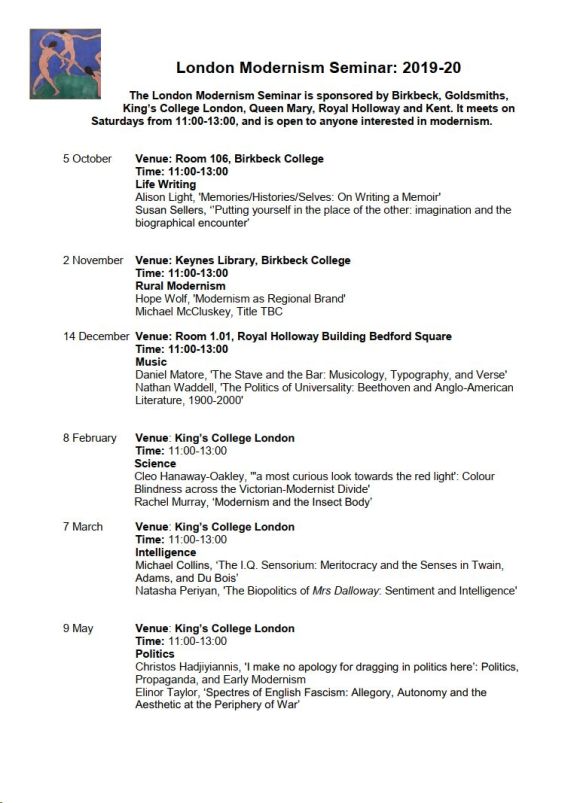
London Modernism Seminar Programme 2019-20

LMS programme 2019-20


LMS programme 2019-20.jpg

Categories
CFPs Uncategorized

CfP Attending to Literature, University of Nottingham, 3 December 2019

ATTENDING TO LITERATURE

We invite paper proposals for a British Academy funded interdisciplinary symposium on the concept of attention, to be held at the University of Nottingham School of English on the 3rd December. The symposium has three aims:

1. To allow researchers who work on similar questions from different disciplines to interact for the purpose of developing future collaborations and networks;

2. To provide a training opportunity for ECRs in engagement and outreach, allowing participants to practice bringing the specifics of their research to bear on an issue of public concern (attention);

3. To engage non-specialist audience members, in particular those who work in related professions (e.g. teachers, programmers, psychologists) in the exploration of humanities-based perspectives on the problem of attention.

We invite a wide range of interpretations of the concept of attention, but would particularly encourage submissions on any of the topics below. In keeping with the symposium’s public-facing emphasis, we are seeking contributions which aim to present research in a manner that is sufficiently detailed to be helpful to specialists but written with an eye to a wider public audience.

Please email a 250 word abstract and 250 word bio to attendingtoliterature@gmail.com by 20th October. Papers from ECRs will be particularly welcome. We will also be running a session online allowing interaction by participants who are unable to travel to Nottingham or are minimising flying: please indicate on your email if this applies to you. For participants in Europe we encourage train travel rather than flying to the event where possible and can offer a limited number of travel bursaries.

TOPICS 

1. ’Attention Panic’

Public anxieties about digital distraction and the threat to attention.

2. Historicising attention

How do the present digitally-fuelled anxieties about attention relate to earlier thinkers on attention and distraction, from Pascal through, for instance, Nietzsche, Simmel and Benjamin?

3. The attention economy

Has attention itself become a commodity, and how has this commodification taken new forms with the development of digital technology?

4. Attending to the body

Various moral philosophers have emphasised embodiment in their discussions of attention: might engaging in certain physical practices and manual or craft work help cultivate certain forms of perception and attentiveness?

5. Attention and attentiveness in ethics

What is the role of attentiveness as a concept in ethics?

6. Compulsory Attentiveness

Drawing on Manne’s recent work on ‘The Logic of Misogyny’, we might ask: what moral hazards arise when attentiveness becomes an expectation that is applied to some groups more than others?

Topics focused on attention in literature:

1. Attention in literary ethics: How might the concept of attention be bound up with accounts of literature’s moral work?

2. Attending in and to the text: What kinds of attention do different literary forms demand or cultivate in the reader? Is the reader’s attention to the text the same as the attention required to write it? Or the interpersonal attention depicted in it?

3. Attention in critical traditions: How do different moments in the history of literary criticism rely on the concept of attention?

4. Poetry analysis and attention

What forms of attention are produced in sustained moments of literary analysis? Might the concentrated and immersive nature of close reading induce states of meditative attention that are distinctive?

Twitter: @attendingtolit

Website: attendingtoliterature.wordpress.com