Categories
Events Uncategorized

ORWELL, POLITICS & JOURNALISM NOW

ORWELL, POLITICS AND JOURNALISM NOW
10th and 11th October 2019, Oxford

Organised by Dr David Dwan (Oxford) and Dr Lisa Mullen (Cambridge)

FULL SYMPOSIUM PROGRAMME AND FREE REGISTRATION https://www.eventbrite.co.uk/e/1984-now-tickets-72167110771

All welcome!

1984 now poster .png

Categories
Events Uncategorized

Northern Modernism Seminar Programme 2019-20

NMS Keele Schedule.pdf.jpgNMS Keele Schedule

Categories
Events Uncategorized

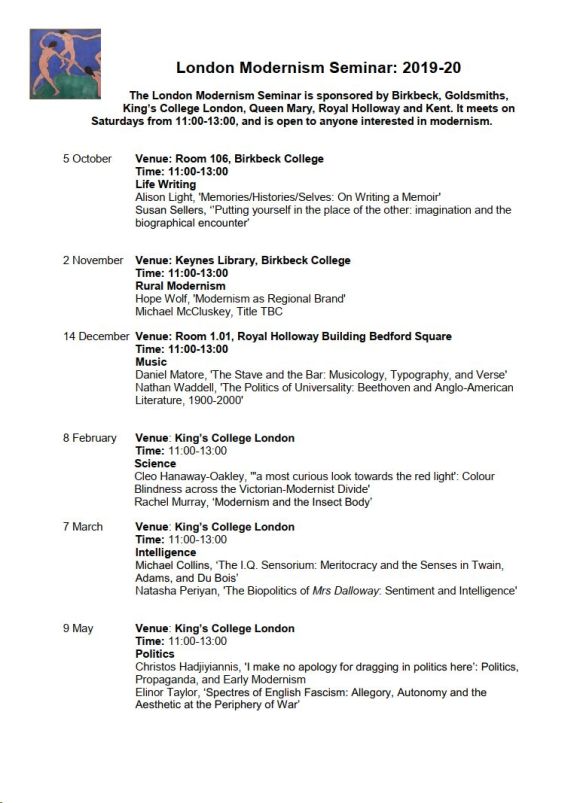
London Modernism Seminar Programme 2019-20

LMS programme 2019-20


LMS programme 2019-20.jpg

Categories
CFPs Uncategorized

CfP Attending to Literature, University of Nottingham, 3 December 2019

ATTENDING TO LITERATURE

We invite paper proposals for a British Academy funded interdisciplinary symposium on the concept of attention, to be held at the University of Nottingham School of English on the 3rd December. The symposium has three aims:

1. To allow researchers who work on similar questions from different disciplines to interact for the purpose of developing future collaborations and networks;

2. To provide a training opportunity for ECRs in engagement and outreach, allowing participants to practice bringing the specifics of their research to bear on an issue of public concern (attention);

3. To engage non-specialist audience members, in particular those who work in related professions (e.g. teachers, programmers, psychologists) in the exploration of humanities-based perspectives on the problem of attention.

We invite a wide range of interpretations of the concept of attention, but would particularly encourage submissions on any of the topics below. In keeping with the symposium’s public-facing emphasis, we are seeking contributions which aim to present research in a manner that is sufficiently detailed to be helpful to specialists but written with an eye to a wider public audience.

Please email a 250 word abstract and 250 word bio to attendingtoliterature@gmail.com by 20th October. Papers from ECRs will be particularly welcome. We will also be running a session online allowing interaction by participants who are unable to travel to Nottingham or are minimising flying: please indicate on your email if this applies to you. For participants in Europe we encourage train travel rather than flying to the event where possible and can offer a limited number of travel bursaries.

TOPICS 

1. ’Attention Panic’

Public anxieties about digital distraction and the threat to attention.

2. Historicising attention

How do the present digitally-fuelled anxieties about attention relate to earlier thinkers on attention and distraction, from Pascal through, for instance, Nietzsche, Simmel and Benjamin?

3. The attention economy

Has attention itself become a commodity, and how has this commodification taken new forms with the development of digital technology?

4. Attending to the body

Various moral philosophers have emphasised embodiment in their discussions of attention: might engaging in certain physical practices and manual or craft work help cultivate certain forms of perception and attentiveness?

5. Attention and attentiveness in ethics

What is the role of attentiveness as a concept in ethics?

6. Compulsory Attentiveness

Drawing on Manne’s recent work on ‘The Logic of Misogyny’, we might ask: what moral hazards arise when attentiveness becomes an expectation that is applied to some groups more than others?

Topics focused on attention in literature:

1. Attention in literary ethics: How might the concept of attention be bound up with accounts of literature’s moral work?

2. Attending in and to the text: What kinds of attention do different literary forms demand or cultivate in the reader? Is the reader’s attention to the text the same as the attention required to write it? Or the interpersonal attention depicted in it?

3. Attention in critical traditions: How do different moments in the history of literary criticism rely on the concept of attention?

4. Poetry analysis and attention

What forms of attention are produced in sustained moments of literary analysis? Might the concentrated and immersive nature of close reading induce states of meditative attention that are distinctive?

Twitter: @attendingtolit

Website: attendingtoliterature.wordpress.com

Categories
CFPs Uncategorized

CfP Annual BCLA Postgraduate Conference, St. Edmund Hall, Oxford, 29th November 2019

Annual British Comparative Literature Association Postgraduate Conference

Call for Papers

‘Radical Retellings: Fairy Tale, Myth, and Beyond’

Friday 29th November 2019

St. Edmund Hall, University of Oxford

Keynote lecture:

‘High Mountains are a Feeling: Queering Ice and Snow’

Professor Diane Purkiss (Keble College, Oxford)

Vladimir Nabokov once provocatively remarked that ‘great novels are great fairy tales… literature does not tell the truth but makes it up’. This year’s BCLA postgraduate conference takes this statement as its point of departure and aims to interrogate the influence, legacy, and enduring significance of fairy tale and myth, as well as acts of retelling and reworking across a wide range of literary forms. If, as Marina Warner has argued, the recurrence of fairy tale, mythic structures and forms across the ages acts as a ‘connective tissue between a mythological past and present realities’, how does this recurrence manifest itself in literary works from various national, linguistic, and cultural contexts? How do stories travel across historical and geographical spaces? How do they form or challenge forms of identity?

In an era of fake-news and twisted truths, can fairy tale and myth offer new (or, indeed, old) perspectives on our contemporary world? To what extent do our turbulent historical moment, current crises and violent events give rise to particular instances of creativity drawing on myths and legends of old? In a present scarred by multiple ongoing conflicts and mass migratory movements can the fantastic and the mythical create new modes of comprehending trauma, alternative paths to the future? Or have the birds now eaten all of the breadcrumbs dropped along the way, leaving us lost in the woods?

What is to be gained (or, perhaps also, lost) by conceiving of fairy tale and myth as foundational paradigms for literature across history, up to and including contemporary works? What forms do such radical retellings take in particular linguistic, cultural, and historical contexts? If fairy tales and myth have been and continue to be a fundamental repository of human understanding and culture, who are their gatekeepers?

We invite postgraduate researchers working in the field of comparative literature, defined in its broadest sense, to submit abstracts for 15-minute papers. Papers may be presented on literature from any cultural context, although the lingua franca of the conference will be English. We welcome broad and creative interpretations of the conference title, including, but by no means limited to:

– Revised and reworked fairy tales and myth

– Modern myths / New myths of our time

– Aesthetics and forms in myths and fairy tales

– The politics of myths and fairy tales

– Non-Western myths and fairy tales

– Postcolonial readings of fairy tales

– Feminist and queer re-imaginings of myths and fairy tales

– Fairy tales and children’s literature

– Fairy tales and myths in other media (film, TV, comic books, music, and video games, etc)

Please send paper proposals of up to 300 words and a short bio to bclapgrepresentative@gmail.com by Friday 25th October 2019.

Applicants need not be current members of the BCLA, although the opportunity to join will be available during the conference and beforehand. For members of the BCLA the conference attendance fee will be reduced to £10. The fee for non-members will be £15. Registration fees cover administrative costs as well as refreshments.

Financial support for postgraduates

The BCLA offers a number of postgraduate travel bursaries to its members in order to cover attendance at conferences. For further information, see: https://bcla.org/postgraduate-events/postgraduate-bursaries/

Postgraduate members of the BCLA can expect the following benefits:

– Online access to the three issues published per annum of Comparative Critical Studies.

– A monthly newsletter via e-mail featuring up-to-date news and events relevant to our members’ interests.

– The opportunity to apply for one of the travel bursaries awarded twice annually towards attendance at conferences and research events.

– You can also contribute an entry for the annual Arthur Terry Prize awarded for an essay written in English on any aspect of Comparative Literature.

– One free entry to the John Dryden Translation Competition, sponsored jointly by the BCLA and the British Centre for Literary Translation. Winners are also eligible for free membership of the BCLA for one year.

– Attendance at regular half days and seminars for postgraduate students, led by top scholars in the field together with besides a BCLA-sponsored postgraduate reception and one-day conference, held at regular intervals.

– Other opportunities for networking, including through social media, with the national and international community of postgraduate students and collaboration with all scholars in the field who share an interest in comparative literature and related fields.

Categories
CFPs Uncategorized

CfP Randomness,Queens University Belfast, 15-17 September 2020

Randomness CfP

Queens University Belfast

15-17 September 2020

Keywords

Accidental, arbitrary, incidental, slapdash, hit-or-miss, unplanned, unintended (e.g. consequences), unexpected, unanticipated, unpredictable, contingent, volatility, excitement, wonder, fantasy, imagination, creativity, serendipity.

Chance encounters, unforeseen opportunities, and impulsive decisions play a bigger role in our life and work than we wish to acknowledge. Is reading not always random to some extent? It is only retrospectively, in shifting scale from the individual to social or perspective from reading to interpreting, that randomness becomes regularity and can get explained away as purpose and design.

Randomness and chance play a leading role in historical accounts, in narratives of war and battles, victory and defeat, in biographies and travelogues, in narratives of arrivals, encounters and departures. They resurface in stories, setting characters onto a course or hurtling them into the great unknown, towards their fate. People’s bookshelves, readers’ memories, and second-hand bookshops can produce a similar, puzzling – even dizzying – sense of randomness.

Fortunes of literary works and theory are not immune to the dictates of chance. What are the forces that get literary works published, translated, circulated locally or internationally, and nominated for and winning literary prizes? When do managed search algorithms fail and serendipitous connections appear? How do chance encounters with a literary work, a theory, or lead to translations or adaptations, new creative adventures, or additional and alternative theories?

Artists and writers can be more comfortable with randomness than scholars; they break away from the space of the familiar and the already-known and place trust in the process of the work itself. Critics are driven by institutional pressures to present their work as an execution of purpose, design and method. But randomness persists even in grand geo-political schemes. Randomness overcomes censorship and solutions are always found to circulate books without the support of publishers or the state. Randomness happens despitecontrol, and may be the more attractive for it. It is often random finds that are the most treasured with a sense of delight. Random encounters excite imagination and creativity.

Randomness is also openness; it stands more often at beginnings and turns of the road of many literary and critical careers. How do we cultivate a sense of wonder and open up our critical discourses and theories of comparative literature and world literature to more inclusive and elastic modes of thinking and writing? Can we use randomness in and outside texts and oeuvresproductively, to our advantage?

We seek panels that will work with the idea of randomness, particularly in relation to:

–      Encounters with literary works, theories and cultural others

–      Adaptations, new writings, performances, visualizations within the same literary/cultural field, or outside.

–      Representing randomness through visualisations and digital interfaces.

–      Multilingualism, heterolingualism, plurilingualism, translanguaging

–      Performance, performativity

–      Politics of the literary/cultural market, including publication, translation, circulation, literary prizes and literary festivals (and book fairs)

–      Critiquing randomness in the age of search algorithms

–      Unpredictable futures

–      Ecocritical approaches to randomness and unpredictability

–      Translation and translation studies, choice of work and language, choice of method and style

–      Theories and Methods of Comparative Literature and World Literature

Deadlines: 15 November 2019 for Panel proposalsand 15 December 2019 for Paper proposals.

Submit your proposal to: randomness2020bcla@gmail.comor through the conference website https://randomness2020.wordpress.com/call-for-papers/

Categories
CFPs Uncategorized

CfP “Out of the Archives” section in Feminist Modernist Studies

“Out of the Archives” section in Feminist Modernist Studies

We are looking for previously unpublished and/or unknown material that illustrates modernism’s vibrant global presence. Fiction, poetry, drama, photography, visual art, advertisements, political propaganda, little magazines, diaries, personal and professional correspondence: Feminist Modernist Studies wants to connect your archival discoveries with ongoing conversations in modernist studies.

Submissions should be accompanied by an introduction which can be as brief as a few pages or up to 4000 words.

Inquiries should be sent to

Cassandra Laity, founding editor claity@utk.edu

or

Urmila Seshagiri,  Out of the Archives editor sesha@utk.edu

Best, Cassandra Laity

Prof. Cassandra Laity

Editor, Feminist Modernist Studies (FMS; Routledge; 2017–

Former Co-Editor, Modernism/Modernity (JHUP; 2000-2010)

Currently, Visiting Scholar
English Department
University of Tennessee-Knoxville
e-mail claity@utk.edu

Categories
CFPs Uncategorized

CfP 30th Annual International Conference on Virginia Woolf June 11th–14th, 2020 University of South Dakota

Profession and Performance

30th Annual International Conference on Virginia Woolf

June 11th–14th, 2020

University of South Dakota (Vermillion, SD, USA)

“Profession and Performance,” the theme of the 2020 Annual Conference on Virginia Woolf, calls to mind not only Woolf’s sense of herself as a writer (her profession) but also the set of specialized occupations she takes up in A Room of One’s Own (1929) and Three Guineas (1938), areas of study and livelihoods traditionally reserved for the sons of educated men. It also invokes the ACVW’s commitment over the past three decades to the arts, to theater, to music, to the spoken word, and to the resonances of these media with the performance / performativity of Woolf’s life and writing. “Profession and Performance” might also encourage us to reflect on the ACVW’s rich history and to consider the ways in which the professions of those who support and attend the conference might be changing. As an event open to all scholars, students, and common readers of Woolf and Woolfian connections, we encourage 2020 participants to sound and explore echoes of past professions and performances in our present ones.

The 30th Annual International Conference on Virginia Woolf invites papers addressing these issues as well as other topics addressing “Profession and Performance,” including, but not limited to:

  • contemporary adaptations of Woolf, her circles, or her work on stage / screen (e.g., Vita and VirginiaLife in Squares; etc.)
  • the dynamic link between Woolf’s social critique (what she professed) and her art (its performance)
  • the rich archive of scholarship that brings together studies of the avant-garde, modernism, and the middlebrow
  • intersections of modernist studies and performance studies
  • modernism’s role in the professionalization of literature and criticism
  • the livelihoods and lifestyles of Woolf and the Bloomsbury Group
  • investigations of identity and community
  • Woolfian meditations on professions (i.e., on occupations, commitments, allegiances, and declarations)
  • interpretations of Woolf-inspired performance art (e.g., music, dance, theater)
  • profession as (public) performance
  • questions of affect and attachment
  • strong and weak performances / professions / modernisms
  • reflections on the selves and the worlds we profess / perform in daily life, in politics, in ethics, in institutions, and in ongoing efforts to teach and learn
  • the performative life of professionalization (or the subversion of professionalization)
  • life-writing as performance of self, professionalization of self
  • gendered performances / performances of gender (on stage / page, in life)
  • professions for women (history of, literary treatments of, performances of)
  • Woolf and developments in medical sciences and psychology
  • teaching Woolf / Woolf as Teacher
  • performing Bloomsbury / performative Bloomsberries
  • the life of the feminist academic; the professionalization and/or institutionalization of feminism outside of academia

Abstracts of maximum 250 words for single papers and 500 words for panels should be sent to Virginia.Woolf@usd.edu by February 1st, 2020. In addition to traditional presentations, we encourage proposals for workshops (such as bookmaking, translation, publishing, forming writing groups, etc.) and proposals for roundtable or group discussions (such as feminist / queer perspectives, Woolfian pedagogy, staging / performing Woolf, etc.).

For accepted proposals, we ask well ahead of time that presenters bring access copies of their presentations to their panels.

The conference welcomes proposals for presentations in languages other than English to foster a more open exchange at this international conference. A few caveats: the organizers ask that all abstracts and proposals be submitted in English. Also, to ensure a more effective exchange among all participants, we ask that non-English presentations be accompanied by a handout of main points in English as well as (if possible) a PowerPoint presentation in English. Note that Q&A sessions will be conducted in English as well.

Website: https://www.usd.edu/arts-and-sciences/english/annual-conference-on-virginia-woolf

Twitter: @vwoolf2020

Categories
CFPs Uncategorized

CfP 22nd Annual Conference of The Space Between Society: Literature and Culture, 1914-1945 University of Virginia, Charlottesville, June 4-6, 2020

Proposals requested for the 22nd Annual Conference of

The Space Between Society: Literature and Culture, 1914-1945

University of Virginia, Charlottesville, Virginia

June 4-6, 2020

Keynote Speaker: TBA

Join the Space Between Society in Charlottesville, June 4-6, 2020, for our 22nd annual conference, Race in the Space Between, 1914-1945. Our conference this year focuses especially on questions and problems related to race and racial formation in the years between 1914-1945. Please send abstracts (300 words) along with a short biographical statement (100 words) to conference organizer Carmenita Higginbotham at ch6sv@virginia.edu by December 1, 2019.

In the Space Between Society, scholars who study literature, history, media, art, society, and culture between 1914 and 1945, or between and during the two world wars of the twentieth-century, exchange ideas about their approaches and their objects of study. This year’s conference addresses the key roles that race—including racial formation, racial ideologies and racialist practices—played in creative, intellectual, ideological, and political conversations from 1914-1945. Self-consciously or not, interwar and wartime authors, artists, political figures, public intellectuals, and public officials around the world invested in the concept of race. For some, race was a means to assert social identity (white, black, Asian, American Indian, Pacific Islander). For others, race informed concepts of modernity and/or modernism. For still others, race shaped views of time and place, structuring how interwar and wartime cultures were interpreted, received, deployed, and exchanged.

We invite conference participants to consider:

–  What different cultural and scientific assumptions about race shape various sites during this period and our knowledge about it?

–  What methods can we utilize in our particular fields to analyze race as a component of cultural production?

–  What are the challenges of thinking about race and bringing such work into conversation with scholars in the wide range of fields represented in the Space Between Society?

We welcome paper and session proposals that engage with multiple forms, definitions, and investments in race in the space between and during the two world wars, across all disciplines and media, on research and/or pedagogy.

Possible presentations or panel topics include

Race, place, and regionalism

Race and memory (monuments, storytelling, recollections)

Race and art, media, sound

Racial performance, racial spectacle

Race and science (Eugenics, technology, innovation)

Racial self-fashioning (passing)

Racism and racial hierarchies

Racial invisibility and absence

Language (slang, racialized vernacular)

Segregation, isolation, and confinement

Intersectionality (e.g. race and gender)

International and comparative contexts of race and movement (migration, immigration, relocation)

Interracialism and cross-racial cultural production

Race and the metropolis

International and comparative contexts of race and politics/political systems

Economies of race (labor, consumption, commercialism)

Race, violence, war, and social movements

The Holocaust

Anti-Semitism

Racial genocide

Whiteness

Marginality and the “other”

We welcome longtime Space Between Society participants and invite new members to join us in Charlottesville in 2020. Our conference will be supplemented with tours, museum visits, performances, and walks in the greater Charlottesville area (with proposed visits including Monticello, the Fralin Museum of Art, the Jefferson African American Cultural Center, and sites at the University of Virginia). The 2020 conference seeks to offer mentoring workshops and 1:1 mentoring sessions for its participants. Some travel grant funding will be available for graduate students and international and independent scholars; please indicate your interest in your cover letter.

Keynote Speaker: TBA

Categories
CFPs Uncategorized

CfP Connections: Exploring Heritage, Architecture, Cities, Art, Media Conference: 29-30 June, 2020, University of Kent

CONNECTIONS: EXPLORING HERITAGE, ARCHITECTURE, CITIES, ART, MEDIA
CONFERENCE: 29-30 JUNE, 2020

ABSTRACTS: 10 FEB, 2020

https://architecturemps.com/canterbury-conference/

This event welcomes delegates in architecture, urban planning, history, art and design, digital and representational studies

Present in-person, pre-recorded films, skype, written papers.

Themes: architectural theory, urban planning, smart cities, digital design, history and heritage, digital arts and the city

CALL:
Today the digital is ubiquitous across all disciplines connected with the physical environment in which we live. In architecture, computational design uses algorithms to replicate biology. Coding produces self-generated architectural form. Information modeling presents planners with interactive design in real time. The city is seen as ‘smart’.

In addition to informing design today however, the digital age also informs how we understand the past. State-of-the-art equipment for geophysics, laser scanning, and compositional analysis are now key tools for archeologists. Data mapping is used by historians and digital technologies of all forms allow filmmakers, animators and photographers to record the past and the present in new ways.

As the tools we use to create the future and explore or preserve the past merge and blur, this conferences asks educators and professionals from deign, heritage and digital disciplines to compare their ways of working and critique contemporary practices from a cross-disciplinary perspective.

Highlight Notice 1:
This event is part of the conference and book series ‘Mediated Cities’. Previous events in London, Los Angeles, Bristol, Istanbul. Four books in the Intellect Book series “Mediated Cities”. Book five will come from this event.

Highlight Notice 2:
In addition to a book as part of the Intellect “Mediated Cities” series, delegates submitting papers related to teaching and learning will be considered for Routledge book series: “Focus on Design Pedagogy”.

https://architecturemps.com/canterbury-conference/

Organisers: University of Kent, UK | Intellect Books | Routledge | AMPS | PARADE