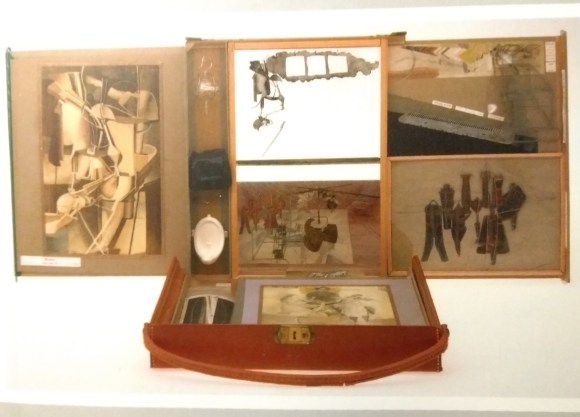
Barnes wrote in a letter, “there is always more surface to a shattered object than a whole object”: the surfaces of Barnes’s literary and art objects are reflected in myriad ways in the chapters here. Essays consider Barnes’s work in relation to mass media; the promotion, publication, and reception of modernism; modernists as critics; wit; authorship, legitimacy, and genealogy; anachronism; late style; the reception of metaphysical poetry; the queer grotesque; the representation of humans, outcasts, animals, and selves; sovereignty; borders of nation and language; the book as object in film remediations; the affects involved in reading and criticism; and structures of queer community. The introduction surveys the relationship between Barnes criticism and criticism of modernist writing from the early twentieth century to the present, and the afterword reads Barnes’s style against Eliot’s modernism. Shattered Objects introduces a Barnes who is full of possibility for current and future work in the literary critical discourses of the twenty-first century.
Category: Uncategorized
We are seeking essay proposals for an edited volume focusing on Conrad’s politics in relation to ideas of fear and/or hope. The postcritical turn encourages us to consider what literature does in the world—the social, emotional, and political effects of reading. The last two MLA panels organized by the Joseph Conrad Society of America reflect this approach: Conrad’s Politics of Fear in 2018 and Conrad’s Politics of Hope in 2019. Both panels examined Conrad’s texts in relation to recent events, offering new perspectives on literature’s contribution to political understanding.
For this volume we are particularly interested in essays that use Conrad’s writing to engage with postcritique, either constructively or critically, or that in other ways reflect Conrad’s continuing relevance today.
Essay proposals should be 250–300 words, accompanied by a brief CV. Essays will be 5000–7000 words, including notes and citations. Please email proposals and CVs to both jayparker@hsu.edu.hk and Jwexler@luc.edu by 30 March. Accepted authors will be notified by 30 May and invited to submit completed essays by 1 January 2020. Please note that final acceptance will be confirmed upon receipt of the finished version of the essay.
Identifying Value(s) in Literature, Culture, and Society
20─21 June 2019
In November 2018, US Secretary of Defense Jim Mattis defended the deployment of thousands of troops along the Mexican border as an “obviously moral and ethical mission”. In doing so, he aligned the enforcement of sovereignty through rigorous policing of borders as a specifically moral value. However, the criticism of the Trump administration’s border policy for violating US and family values provides a contradictory interpretation of what constitutes moral values. Despite the implication that values constitute a set of universally agreed principles, the controversy over the US-Mexican border is only one example that value is anything but ubiquitous. Common Ground invites scholars to Queen’s University Belfast in June 2019 to explore what we value, who we value, and why we value them. We seek to pull apart the concept of value to expose the multifaceted ideologies and rationalities from which competing values are derived. At the most basic level, the nationalist rhetoric deployed by Mattis and by Brexiteers poses the question of who has value to a nation. And often the individual’s value is predicated upon the economic concern of how they can add value to the nation. As such, nationalist rhetoric reveals the tension between the two most prominent understandings of “value” that dominate political and ethical discourse—morality and economics.
We are delighted to confirm Dr Kevin Power of Trinity College Dublin and Professor Margaret Topping of Queen’s University Belfast as keynote speakers.
We seek proposals for twenty-minute papers from postgraduate and early career scholars across a diverse range of disciplines in the humanities to explore the negotiation between different conceptualisations of value and values in literature, culture, and society from the Medieval period to present day, including moral, economic, mathematical, linguistic, environmental, literary, and aesthetic values. We would especially like to encourage papers from MA students. Potential topics include but are not limited to:
- What are the identifying values of a society and how are these conveyed, questioned, or challenged through literature and/or culture?
- How does economic value influence questions of literary and artistic value?
- The tension between economic value and environmental values.
- Are values spontaneously generated by people in society or are values created and regulated by the state?
- To what extent is the public value of the Humanities under threat? How do we measure literary value, artistic value, value of popular culture, etc?
- The value and impact of religious thought and/or religion-derived morality in literary works and an increasingly secular society.
- The negotiation of the conflict between artistic value and moral values: reading the work of authors whose behaviour is unacceptable.
- The value of natural/artificial landscapes and boundaries as the result of a chain of social, historical and natural processes.
- Family values and pedagogical values.
- Post-truth and the value, exploitation, or weaponisation of “truth”.
- The value and exploitation of emotions.
- To what extent is the individual defined by the values of others, or defined by that which others value?
- The valuation of gender/sexuality/queerness.
- What value is given to identity and how does this change across historical time periods?
- To what extent does literature shape moral, social, and individual values.
- The value of politeness/manners/political correctness.
- Value of progress ─how do we measure “progress” whether social, political or economic?
Please submit all proposals to commonground2019@outlook.com by 31 March 2019.
Submissions should include:
- 250-word abstract
- Brief bio
- Contact details (email address)
We aim to respond to all submissions by 12 April.
Please advise us of any technical or accessibility requirements at the time of submission.
Common Ground 2019 Committee
Lillie Arnott, Jaime Harrison, Niall Kennedy, Lee Livingstone, Irene Tenchini
We’re delighted to announce that the winning essay in the BAMS Essay Competition 2018 is “Humphrey Jennings’s ‘Film Fables’: Democracy and Image in The Silent Village” by Masashi Hoshino. Masashi has recently been awarded his PhD by the University of Manchester. The essay will be published in a forthcoming issue of Modernist Cultures and Masashi will receive £250 of book vouchers. The runner-up essay is “Anglo-French Poetic Exchanges in the Little Magazines, 1908–1914” by Sze Wah Sarah Lee. Sarah successfully completed her doctorate at Goldsmiths in 2016. Congratulations to both!
‘out of the air’: Women, Creativity and Intelligence Work | Bletchley Park | Friday 8 March 2019
This one-day symposium will bring together writers, artists, scholars and technologists to explore the role of women in surveillance, transcription, cryptography, espionage, translation, observation, visualisation and recording. It will consider how this work influenced and inspired creativity following World War II, in art, science, and literature, and how it continues to place pressure on emerging technologically-enhanced means of expression and creative practices. What new modes of seeing, speaking, reading or writing have arisen? How have women creatives challenged and been challenged by this?
The day’s speakers and panellists will include Dr Khanta Dihal (Cambridge), Dr Natalie Ferris (Edinburgh), Dr Adam Guy (Oxford), Dr Julia Jordan (UCL), Dr James Purdon (St Andrews), Dr Sophie Seita (Cambridge), the artist Nye Thompson, the writer Joanna Walsh and a keynote lecture from Professor Laura Salisbury (Exeter).
Hosted by Bletchley Park in collaboration with the school of Literatures, Languages and Cultures, University of Edinburgh, the Leverhulme Trust, and Kellogg College, University of Oxford.
The Mansion, Bletchley Park
10am – 5.30pm
Followed by readings and wine reception.
REGISTER HERE:
The European Avant-Gardes
Keynes LibrarySubmissions are invited for the 2019 Transatlantic Studies Association Annual Conference.
Plenary guests confirmed include:
Professor Brian Ward (Northumbria University)
“The Beatles in Miami, 1964: Race, Class and Gender in the Atlantic World”
AND
Professor Kevin Hutchings (University of Northern British Columbia)
“Transatlantic Romanticism and British-Indigenous Relations: 1800-1850”
PLUS
A Roundtable discussion on:
Transatlantic Relations in the Age of a Rising China
Following its first trip across the Atlantic for last year’s annual conference at the University of North Georgia, the TSA is returning to the UK for its eighteenth annual conference at the University of Lancaster.
The TSA is a broad network of scholars who use the ‘transatlantic’ as a frame of reference for their work in a variety of disciplines, including (but not limited to): history, politics and international relations, and literary studies. All transatlantic-themed paper and panel proposals from these and related disciplines are welcome.
The conference is organised around a number of subject themes, each of which is convened by members of the conference programme committee (indicated below). If you would like to discuss your paper or panel proposal prior to submission, please contact the relevant programme committee members. This year’s subject themes are:
- Diplomatic and international history
(David Ryan, david.ryan@ucc.ie, Chris Jespersen, christopher.jespersen@ung.edu, Thomas Mills, t.c.mills@lancaster.ac.uk)
- Political and intellectual history
(Gavin Bailey, gjzbailey@gmail.com, Philip Pedley, p.pedley@lancaster.ac.uk)
- Social, cultural and religious history
(Kristin Cook, kc31@soas.ac.uk, Constance Post, cjpost@iastate.edu)
- International Relations and Security Studies
(Luis Rodrigues, luis.rodrigues@iscte-iul.pt, David Ryan, david.ryan@ucc.ie)
- Literature, film, and theatre
(Donna Gessell, donna.gessell@ung.edu, Finn Pollard, fpollard@lincoln.ac.uk, Constance Post, cjpost@iastate.edu)
- Business and finance
(Thomas Mills, t.c.mills@lancaster.ac.uk, Philip Pedley, p.pedley@lancaster.ac.uk)
- Latin America in a transatlantic context
(Thomas Mills, t.c.mills@lancaster.ac.uk, David Ryan, david.ryan@ucc.ie)
- Ethnicity, race and migration
(Kristin Cook, kc31@soas.ac.uk, Gavin Bailey, gjzbailey@gmail.com)
Special subject theme: Transatlantic Romanticisms
Proposals are welcome for papers on any aspect of Romanticism in a transatlantic context. Possible topics might include (but are not limited to) comparative romanticisms, ecological romanticisms, romantic natural histories, romantic travel and exploration, romanticism and colonialism, romanticism and critical theory. Please send a 300-word abstract, 100 word author biography, and 2-page CV to Kevin Hutchings, University Research Chair, Department of English, University of Northern British Columbia (kevin.hutchings@unbc.ca).
In addition to the subject themes above, we welcome papers and panels on any aspect of transatlantic studies. Interdisciplinary papers and panels are particularly welcome, as are innovative formats, such as roundtables / multimedia presentations.
Submission Instructions
Panel proposals should constitute three or four presenters and a Chair (as well as a discussant if desired). Panel proposals should be sent by email as one document attachment, and include:
- 300-word overview of the panel theme;
- 300-word abstracts for each of the papers;
- 100-word author biographies;
- 2-page CVs for all participants.
The subject line of the email for panel proposals should read: ‘TSA Proposal-[Last name of panel convenor]-[Subject theme]” (state ‘Other’ if not falling under listed themes) (E.g. “TSA Proposal-Smith-Diplomacy and International History”).
Individual paper proposals should be sent by email as one document attachment, and include:
- 300-word abstract for the paper
- 100-word author biography;
- 2-page CV.
The subject line of the email for paper proposals should read: “TSA Proposal-[Last name of presenter]-[Subject theme]” (state ‘Other’ if not falling under listed themes) (E.g. “TSA Proposal-Smith-Other”).
Travel Grants
The TSA particularly welcomes proposals from new members and junior scholars. Travel grants are available to support early career scholars presenting a paper at the conference. If wishing to apply for a travel grant, applicants should indicate this in the body of the email when submitting their paper or panel. In addition to the materials requested above, travel grant applicants should include a brief statement explaining why it is important for them to attend the TSA conference, and an outline of the principal costs entailed. For further details about TSA travel grants, see the TSA website: www.transatlanticstudies.com.
All paper and panel proposals, and travel grant applications, should be sent to the conference email: tsalancaster2019@gmail.com
Deadline for panel and paper proposals: 20 January 2019
Contact details and further information
Vice-Chair of TSA / Local Organiser: Thomas Mills: t.c.mills@lancaster.ac.uk
Chair of TSA: Christopher Jespersen: christopher.jespersen@ung.edu
‘Shifting Notions of Modernity in Modern and Contemporary Scholarship’
University of Birmingham, 21 February 2019
A one day symposium hosted by the Modern and Contemporary Forum and the Centre for Modern and Contemporary History at the University of Birmingham.
The focus of this one-day symposium is to bring together experienced scholars, early career researchers, and postgraduate students, to facilitate interdisciplinary discussion and debate on shifting notions of modernity.
Papers on any aspects of history from the late-eighteenth century to the twenty-first will be considered. To encourage a broad range of papers the invited topics of the conference include, but are by no means limited to, those listed below.
- Time and temporalities
- Material Culture
- Literature and literary influences
- Place, space, and architecture
- The state and structural hierarchies
- Class/gender/race in the global context
- Museum studies
- Medical humanities
- Newspapers and the media
- Emotions
- Senses
- Popular culture, film, TV, music, fashion
- Religion, spiritualism and occultism
- Art history
Please send abstracts of up to 300 words along with a CV for 15 minute papers, or a 150 word abstract for a poster presentation, to uobmacforum@gmail.com by 14 December 2018.
The MAC forum is part of the Centre for Modern and Contemporary History at the University of Birmingham, and is run by postgraduate researchers from a range of disciplines within the university. The forum encourages discussion and networking across disciplines and institutions, for those who have an interest in modern and contemporary history.
Dorothy Richardson Editions Project Public Workshop
New College, University of Oxford
18 January 2019
11am-5pm
This free public workshop will present new findings about Richardson’s life, letters, fiction, and non-fiction. There will be presentations on the implications of publishing a new Pilgrimage, the significance of Richardson’s epistolary networks, and the Dorothy Richardson project’s developing methodology.
Over the last five years the Arts and Humanities Research Council-funded Dorothy Richardson Editions Project has been preparing new editions of Richardson’s letters and fictions. The first volumes of a new edition of her long novel Pilgrimage and of her correspondence are forthcoming with Oxford University Press in 2020.
The preparatory work for the edition has involved new archival work, intensive study of Richardson’s manuscripts and drafts, and wide-ranging discussions with other editors of modernist texts.
Following the AHRC workshops 2016-17 on the New Modernist Editing and the conference held at Queen Mary University of London in July 2017 on ‘Modernism and Textual Scholarship’, the workshop will discuss the Richardson project’s contribution to new developments in the theory and practice of editing modernist texts.
Programme
11.00
Adam Guy and Laura Marcus
Welcome
11.15
Dirk van Hulle
“Genetic Relations” in Modernist Editing: From Stemma to Genetic Map
12.15
Lunch
13.15
Scott McCracken
Introduction – What We Know Now about Dorothy Richardson
13.45
Rebecca Bowler
When is a Tangent not a Tangent?
Adam Guy:
Three Dispatches from a Modernist Scholarly Editions Project
Leonie Shanks:
From Icy Gales to Storms in Teacups: Richardson’s Epistolary Constructions of Cornwall
15.00
Coffee
15.30
Laura Marcus
Bryony Randall
Jo Winning
Participation is free, and includes a buffet lunch. Please fill in the following short form if you would like to attend: https://goo.gl/forms/oFBqS9a1prdJDNDA3
Directions to New College can be found here: https://www.new.ox.ac.uk/directions
For further enquiries, please contact adam.guy@ell.ox.ac.uk.
More details here: http://dorothyrichardson.org/society/workshop2019.htm
The 2019 North American James Joyce Symposium will be jointly hosted by the National Autonomous University of Mexico (UNAM) and the Metropolitan Autonomous University (UAM). This will be the first annual gathering of Joyceans in the global south, as well as the first to host panels in both English and Spanish, and will thus foreground the excellent work on Joyce being done in both languages. Joyce has had a major impact on Latin American writers, who have found much to admire in Joyce’s bold experimentalism; his fusing of experiential details with universal concepts; his baroque profusion of words, languages, and styles; his critique of hegemonic structures of family, nation, and creed; and his resistance to myriad manifestations of imperialism.
Borders, boundaries, barriers: Joyce bowed to none. That is why this year’s Symposium is dedicated to the many ways in which Joyce was an artist without borders; to the ways in which his work, like his life, transcended conventional divisions. As Stephen Dedalus famously puts it, “I will not serve that in which I no longer believe, whether it calls itself my home, my fatherland, or my church: and I will try to express myself in some mode of life or art as freely as I can and as wholly as I can, using for my defense the only arms I allow myself to use — silence, exile, and cunning.” By celebrating Bloomsday in Mexico at this historical moment, the Symposium seeks to honor Joyce’s spirit of artistic freedom and exilic statement.
And yet, exile can have its pleasures. In 2016, the New York Times named Mexico City its number one tourism destination, atop a list of 52, calling it “A metropolis that has it all.” Among the many cultural, culinary, and architectural attractions the article describes, it mentions the “French-style 19th-century mansions of La Roma”, arguably the city’s most beautiful and cosmopolitan neighborhood. One of those mansions, the UNAM’s exquisite “Casa Universitaria del Libro”, will be the Symposium’s main venue. And since Mexico, like Ireland, is renowned for its hospitality, this Symposium aims to make good on that reputation, while also showcasing for attendees the deep influence Joyce’s work has had in this country.
The Symposium is proud to announce its confirmed keynote speakers:
As with all annual conferences, this Symposium “without borders” is open to all kinds of contributions that address Joyce, directly or indirectly, in the form of scholarly papers as well as creative or multi-media presentations and installations. It welcomes proposals for paper presentations, fully-formed panels, and roundtables, as well as exhibitions of artistic, multimedia or digital work. Presenters are limited to one paper and one other type of participation (artist, panel-chair, respondent, etc.).
**The deadline to submit proposals is Monday, 25 February 2019**
We are particularly interested in contributions that engage with the transcendence of borders, broadly conceived, such as those pertaining to nation, language, identity, race, religion, gender, class, psychology, artistic form, literary genre, avant garde movements, historical periods, and popular culture. Possible topics include:
The Symposium invites proposals for individual papers, fully-formed panels, and roundtables, in English or Spanish, as well as multi-media/digital exhibitions, and roundtable proposals. Please send to joycewithoutborders@gmail.com, beginning the subject line with the word “PROPOSAL” for English proposals, and “PROPUESTA” for Spanish proposals.
For individual papers (no more than 20 minutes in length), please submit the following information:
First and last names, academic affiliation (if applicable), title of paper, a brief abstract (maximum 300 words), and a brief bio (maximum 250 words).
For fully-formed panel proposals, the panel chair should submit the following:
Panel title, first and last names of all participants (no more than four), academic affiliations of all participants (if applicable), email addresses of all participants, titles for each paper, name and affiliation of chair (if applicable) and any respondents (maximum 2), a brief abstract for the panel as a whole (maximum 500 words), and a brief bio for each participant (maximum 250 words). Individual speakers on these panels need not submit abstracts separately. The panel chair has the option to present a paper, but please note it is customary for the chair to be scheduled last. Panels must be entirely in English or Spanish.
Most panel sessions will last 90 minutes. Certificates of participation in the conference will be made available to those who present and subsequently request documentation. We encourage participating scholars to be paid-up members of the International James Joyce Foundation.