
:: British Poetry of the First World War
:: Wadham College, Oxford
:: 5–7 September 2014
http://englishassociation.ac.uk/conference/
The English Association’s 2014 conference includes keynote speakers Edna Longley, Jay Winter, and Jon Stallworthy and a concert recital by world-famous baritone Roderick Williams.
Programme:
http://englishassociation.ac.uk/conference/programme-2/
This international conference has been convened to enable all those with a serious academic or non-specialist interest in war poetry to come together at the start of the Great War Centenary to listen to leading speakers and to exchange views about this body of literature, so appealing and yet still so controversial.
@EnglishAssoc
www.le.ac.uk/engassoc
Category: Events
The next session of the Modernist Magazines Research Seminar will take place on Thursday 15 May from 6pm, in room 234, Senate House, London.
We are very lucky to have Charlie Dawkins speaking on the feminist weekly ‘Time and Tide’. We look forward to welcoming lots of you for wine and lively discussion!
Charlie Dawkins (Oxford), ‘Why Start a Weekly Magazine? Time and Tide and Modernism, 1920.’
Time and Tide, a new political weekly run by a group of newly enfranchised women, was first published in May 1920. Why did these people choose to start a magazine like this at this historical moment, and what might Time and Tide have to say about modernism? This talk will argue that the cultural role played by primarily political magazines of this type has been undervalued. Drawing on Francis Mulhern’s model of ‘metaculture’, I hope to explore how Time and Tide, as a new magazine in a post-war, post-suffrage world, attempted to understand literary culture, and by doing so contributed to the development of modernism as a recognized literary category in interwar Britain.
Categories
Northern Modernism Seminar
Friday 2 May 2014
MODERNISM AND TRUST
Launch of the Cultures of Trust Network
University of Teesside
Speakers: Rob Hawkes, Rod Rosenquist, Suzanne Hobson, Paul Crosthwaite
Speakers include:
Michael Bell, Eveline Kilian, Jeremy Tambling, Tim Armstrong, Kate McLoughlin
Contact: s.mccracken@keele.ac.uk
THE BRITISH ASSOCIATION FOR MODERNIST STUDIES
INTERNATIONAL CONFERENCE 2014
MODERNISM NOW!
26–28 June 2014
Institute of English Studies
Senate House, London
Keynote Speakers
Tyrus Miller (University of California, Santa Cruz)
Jacqueline Rose (Queen Mary, London)
Modernism Now! is a three-day international, interdisciplinary conference organised by the British Association for Modernist Studies, designed to explore modernisms throughout the late nineteenth, twentieth and twenty-first centuries. The conference aims to discuss the past achievements of modernism, its possible futures, and to provide a review of current activity in the field. In Modernism and Theory, Neil Levi has recently suggested that in thinking about modernism we consider ‘the idea of a contemporary perpetuation of artistic modernism’ and that we see ‘modernist works as events whose implications demand continued investigation.’
Modernism Now! will explore these issues in three distinct ways:
- The conference aims to represent the diversity of modernisms, and calls for papers assessing modernist writers, artists, texts and performances from a variety of disciplinary backgrounds, methodological standpoints, and theoretical perspectives.
- The conference will explore the ongoing use of ‘modernism’ as a cultural, philosophical, and artistic category, analysing how and where modernism functions as a continuing aesthetic in the twenty-first century, across multiple disciplines, geographies, and traditions.
- The conference hopes to provide a review of current research in modernist studies, inviting panels and papers (joint or individual) that report on the work of research projects, editions, exhibitions, societies, and institutions.
Topics might include (but are not restricted to):
- Modernist futures and legacies
- Past and previous modernisms
- The idea of a contemporary modernism e.g. how modernism informs the practice of contemporary artists/ writers/ performers
- Modernism as a continuing event
- Issues in presenting modernism today (new editions, exhibitions, etc)
- Current debates in world literature and global modernist studies that stretch the historical/geographical framework of modernism
- The ‘nowness’ (Jetztzeit) of modernism; the new and the now
- Assessments of individual writers, artists, performers, texts, works of art that explore their status and relevance today
- Historical assessments of the term ‘modernism’
- New trends in modernist studies
- Anachronism
- Disciplinary borders and boundaries around modernism today
- ‘Early’ and ‘late’ modernisms; periodizing modernism
- Current theorisations of modernism as a social/ cultural/ philosophical/ political category
- Modernism and the tradition of the avant-garde
- Singular and plural modernism(s)
The conference is open to anyone working on modernism, with reduced registration for BAMS members. Current annual membership rates (which include a subscription to Modernist Cultures) are £30 standard; £25 student; £45 international standard; £35 international student. Join BAMS here: https://bams.ac.uk/membership/
We will be offering some bursaries to enable postgraduate members of BAMS to attend the conference.
Proposals are welcomed for individual 20 minute papers, or panels of 3-4 speakers. Proposals for papers should be 250 words long. Panel proposals should include a short paragraph naming the organiser of the panel and explaining its rationale as well as a 250 word abstract for each paper. Panels from single institutions are acceptable. For all proposals, please also include a short biographical statement in the same document. Word format preferred.
Proposals should be emailed to modernismnow@bams.ac.uk by February 28th 2014. The organising committee will be in touch with delegates by mid-March.
Conference Organising Committee
Sarah Chadfield (Royal Holloway, University of London)
Suzanne Hobson (Queen Mary, University of London)
Chris Mourant (King’s College London)
Sophie Oliver (Royal Holloway, University of London)
Cathryn Setz (University of Oxford)
Andrew Thacker (Nottingham Trent University)
Ethnography and American Culture in the Gilded Age and Progressive Era, 1870-1920
Call for Papers
19th May 2014
University of Kent, Canterbury
Organiser: Dr. Michael J. Collins (University of Kent)
Plenary Lectures by Professors Nancy Bentley (University of Pennsylvania)
and Brad Evans (Rutgers, New Jersey)
Recent scholarship on the relationship between social science and the creative arts in the Gilded Age and Progressive Era USA has sought to question more traditional understandings of the era as the moment when scientific inquiry and artistic expression finally “broke” from one other. The perception that ethnography became a scientific discipline whose reach extended solely to universities and specialist periodicals is belied by the period’s rich and vibrant use of ethnographic materials and concepts in a huge variety of different artistic and cultural settings, including literature and mass-market periodicals (Harper’s, Scribner’s, Century), early film and photographic exhibitions, illustration, design, and architecture.
In other words, renewed attention has begun to be paid not just to the work of Gilded Age and Progressive anthropologists within their own institutional and disciplinary contexts, but how that work was diffused and circulated in the period’s popular culture. These questions of diffusion invariably raise further questions relating to the dangers implicit in the cultural appropriation, aestheticisation or marketisation of ethnographic subjects.
This one-day symposium will attempt to unite literary studies and print culture with intellectual history, anthropology, the history of science and visual culture studies in order to explore how mainstream media related to emergent social-scientific disciplines in the Gilded Age and Progressive Era United States. As such, we welcome proposals for 20 minute papers on any topics related to the themes and concerns of the conference.
Please send a CV, brief biography and an abstract of no more than 300 words to: ethnographyandamericanculture@kent.ac.uk by April 17th 2014.
The symposium will conclude with the first British screening of a new version of the American photographer Edward Curtis’s important, 1914, silent feature film, In the Land of the Head Hunters (the first major motion picture to star Native North Americans) at the Gulbenkian Cinema on The University of Kent campus. Based on recent archival research, in 2008 a collaborative team led by Aaron Glass (now at the Bard Graduate Center), Brad Evans (Rutgers), and Andrea Sanborn (of the U’mista Cultural Centre in BC) oversaw a new restoration of the film that returned the film’s original title, title cards, long-missing footage, color tinting, initial publicity graphics, and original musical score—now thought to be the earliest extant original feature-length film score in America.
http://www.curtisfilm.rutgers.edu/
Professor Brad Evans, who served on the team restoring the film, will be providing an introductory lecture. A Q&A will follow the screening.
Sponsored by The School of English, Centre for American Studies, and Kent Institute for Advanced Studies in the Humanities.
CFP: COSMOPOLITANISM, AESTHETICISM, AND DECADENCE, 1860-1920
* DEADLINE APPROACHES* March 3rd2014
UNIVERSITY OF OXFORD, 17-18 JUNE 2014
STEFANO EVANGELISTA – JONATHAN FREEDMAN – MICHÈLE MENDELSSOHN
Over the past twenty years, the term “cosmopolitanism” has been the focus of intense critical reflection and debate across the humanities. For some, it represents a potential remedy for oppressive and antagonistic models of national identity and a means of addressing the ethical, economic, and political dilemmas produced by globalisation. Others consider it a peculiarly insidious form of imperialism, and argue that it advocates an untenable ideal of a privileged, rootless observer, detached from — and disposed to romanticise or commodify — very real injustices and inequalities. Meanwhile, the “transatlantic” has emerged as a popular critical framework and field of inquiry for historians and literary scholars. But the “transatlantic” is also sometimes perceived as a problematic category insofar as it can serve to reinforce the narrow focus on Anglo-American culture that the “cosmopolitan” ideal aspires to overcome.
Aestheticism and decadence, which flourished as broad artistic tendencies in the late nineteenth and early twentieth centuries, speak directly to the issues at stake in contemporary debates about “cosmopolitanism” and “transatlanticism”. This is firstly because they evolved out of transnational dialogues between artists, writers, and critics. But it is also because aestheticism and decadence tended to celebrate an ideal of a disaffiliated artist or connoisseur whose interests ranged freely across history, language, and culture, and who maintained an ironic distance from the conventional determinants of identity. Over the last two decades, nineteenth- and early twentieth-century aestheticism and decadence have become established and extremely lively areas of research in the fields of literary studies, cultural studies, and art history. Our conference aims to bring together established as well as emerging scholars in these fields, and to explore how the attractions and problems of “cosmopolitanism” illuminate, and can be illuminated by, current scholarly debates about aestheticism and decadence.
Plenary Speakers:
Dr Stefano Evangelista (Trinity College, Oxford)
Professor Jonathan Freedman (University of Michigan)
Dr Michèle Mendelssohn (Mansfield College, Oxford)
Possible topics for papers include, but are not restricted to:
Border crossing/flânerie/tourism/expatriatism
Aestheticism/Decadence and the Ideals of World Citizenship/Literature
Cosmopolitan Communities and Identities
Cosmopolitan Forms and Formalisms
The Poetics of Cross-Cultural Influence/Translation
The Politics of Aestheticism, Decadence, and/or Cosmopolitanism
Networks of Artistic and Scholarly Exchange
Anti-cosmopolitanisms: Nationalism, Philistinism, and Xenophobia
Visual Culture and the Consumption of Art
Salons, coteries, and clubs
Print culture and the circulation of texts beyond national borders
Exile, Hospitality, Assimilation, and Strangers
Consumerism and Mass Culture
Elitism, Democracy, and Culture/Kultur
Transatlantic Fashion and the Circulation of Commodities
The ethics of Aestheticism, Decadence and/or Cosmopolitanism
World Religions, Alternative Spiritualities, and Cosmopolitan Secularisms
Regional Writing/Forms of Localism/Homelands
Cosmopolitan Detachment/Aesthetic Disinterest
Decadent/Aesthetic Cities
The aesthetics of particularity/universality
The pathologisation of Decadence/Cosmopolitanism
Transatlantic Celebrity/The Cult of the Artist
We will provide four fee-waiving places at the conference: two are reserved for graduate students who wish to attend and serve as conference reporters, and two are reserved for early career researchers (i.e., graduate students or scholars who have recently completed a PhD but do not currently have a supportive institutional affiliation) who wish to deliver a paper and would otherwise struggle to attend. If you would like one of these fee-waiving places, please write to us and briefly explain (in fewer than 500 words) how the conference relates to your research.
Please send proposals (of 500 words or fewer) as pdf or Word attachments to cosmopolitanism.conference@gmail.com by March 3 2014.

Objects of Modernity
Centre for the Study of Cultural Modernity
The University of Birmingham, 23-24 June 2014
Confirmed Keynote: Dr Ulrika Maude (University of Bristol)
Conference blog: http://objectsofmodernity.wordpress.com/

What were the objects that shaped modernity? How did they function? Who created them, used them and reflected on their significance?
This two-day conference, hosted by the Centre for the Study of Cultural Modernity at The University of Birmingham and partially funded by the British Academy, seeks to bring together researchers from a range of disciplines in order to reflect upon a cultural history of modernity by way of its objects. This burgeoning field of study, which encompasses scholarship on material cultures, the history of technology, social theory and psychoanalysis and which has been pioneered by the ‘cultural phenomenology’ of Steven Connor and the ‘thing theory’ of Bill Brown amongst others, has spawned new, interdisciplinary research from literary critics, art historians, philosophers, sociologists and cultural historians. Yet this work has often not been drawn together in such a way as to reflect upon its specific significance as a subject of study or its relevance for more traditional forms of historical analysis. Answering the question of how a particular object should be read entails an assumption about its readable qualities and interpretive value. Reflecting upon the key interpretive tools that allow objects to become meaningful in this way will therefore be a fundamental component of the conference and, while the nature of the final panels cannot be predicted in detail, it is envisaged that several methodological or thematic strands will run throughout. These will include, but are not limited to:
- The Phenomenal. How do ‘the things themselves’ of phenomenology shape our being-in-the-world? How do they throw us into a world of cultural practices that make our experience precisely what it is?
- The Phantasmagoric. How do objects both display and hide their inherent traits? How do they circulate? Who possesses them?
- Obsolescence and Waste. What happens when apparently ‘modern’ objects become obsolete? What kind of an object is rubbish?
- The Materiality of Art. What kind of object is the book, painting or sculpture? How does its ‘thingness’ mediate the experience of art?
- Subject and Object. In what ways can human bodies (or their parts) be considered objects? How have technological innovations altered bodies and subjectivities? Are objects invested with human traits?
The approach of this conference is therefore both thematic and methodological rather than period specific. However, it is also true that the range of questions referred to above can be most effectively addressed when given some limited terms of reference. As such, the organizers are looking for papers that deal broadly with the period 1850-1950.
The second day of the conference features a research networking forum, generously supported by the British Academy, which will run parallel to the academic conference.
At this forum, we are seeking Early Career Researchers in academia, in heritage management and in the creative arts to talk about their professional and creative encounters with objects of modernity. The forum will provide an opportunity for ECRs working across different disciplines to come together to talk about the ways in which objects of modernity (physical, phenomenological, imagined) function in art, literature and culture, and will offer researchers a space in which the challenges of such objects (hermeneutic, methodological and curatorial) can be debated in an interdisciplinary way. ECRs from the heritage sector in particular will be encouraged to bring along information about their institutional collections, particularly in areas they consider to be untapped. The aim of the forum is to help unlock some of the resources, archives and collections of objects, things and artefacts of the industrial and post-industrial heritage of the UK to ECRs, and to help forge new professional, cross-disciplinary connections that will shape a growing and fertile field of study in the coming years.
We welcome all participants to both events at a reception and buffet dinner on Monday 23rd June.
Those interested in speaking at the academic conference should submit a 500 word abstract, together with a brief biography, to Dr. Rex Ferguson (r.ferguson@bham.ac.uk) by 14 April 2014. Those interested in presenting at the networking event should send the same information to Dr. Dan Moore (d.t.moore@bham.ac.uk) by the same date.
British Society for Literature and Science Conference 2014: Registration Open
Registration is now open for the ninth annual conference of the British Society for Literature and Science, which will take place at the University of Surrey, Guildford, on 10-12 April 2014. Keynote talks will be given by Professor Jim Al-Khalili (University of Surrey), Professor Bernard Lightman (York University, Toronto), and Professor Mary Orr (University of Southampton). The conference will finish with an opportunity to visit Down House, the home of Charles Darwin, on the afternoon of Saturday 12 April.
Accommodation: please note that those attending the conference will need to make their own arrangements for accommodation. Information on local hotels is available on the conference website.
Membership: conference delegates will need to register as members of the BSLS (annual membership: £25 waged / £10 unwaged). It will be possible to join the BSLS when registering for the conference.
To register for the conference please visit the University of Surrey online store at http://tinyurl.com/p92lleg. The deadline for registration is 27 March 2014.
Information about how to get to the University of Surrey is available here:http://www.surrey.ac.uk/about/visitors/travel/.
For further information and updates about the conference, please contact Gregory Tate (g.tate@surrey.ac.uk) or visit the conference website at http://tinyurl.com/pp6ubz5.
Aestheticism and Decadence
in the Age of Modernism: 1895 to 1945
17-18 April 2015
Institute of English Studies, Senate House, London.
Confirmed Keynote Speakers:
Nick Freeman (Loughborough University)
Michèle Mendelssohn (Mansfield College, University of Oxford)
Call For Papers
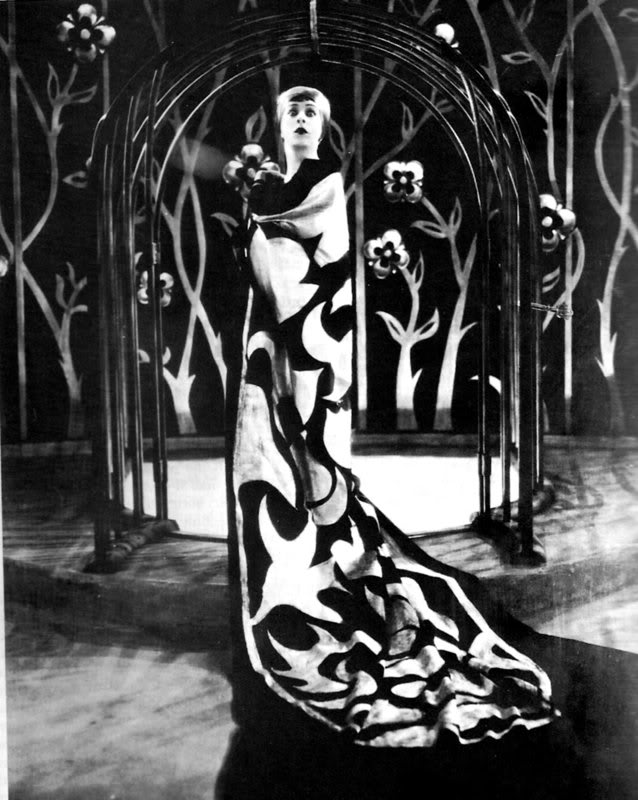 This interdisciplinary conference intends to open discussions about the meaning and significance of Aestheticism and Decadence as these movements evolved between 1895 and the mid-twentieth century. Aestheticism and Decadence were not vanquished with Wilde’s imprisonment but, rather, continued as vital and diverse forms in twentieth century aesthetics and culture. Their influence was in some cases openly acknowledged by the authors in question, but often it was oblique and obscured as many later writers, most famously the High Modernists, eschewed any admissions of such a debt.
Image: Alla Nazimova in Salomé (1923)
This conference considers Aestheticism and Decadence from three main angles:
- the continuing evolution, diversification and internationalisation of Aestheticist and Decadent ideas and forms;
- how writers, artists, critics, musicians engaged with the figures and ideas of nineteenth century Aestheticism and Decadence.
- the production of the ‘Yellow Nineties’ and the posthumous representation of Decadent and Aestheticist writers, particularly Wilde and Pater, in memoir, biography and literary criticism
We encourage proposals that address these Aestheticist and Decadent afterlives in the context of their cultural, political and social moments, and which engage with the problematics of these terms.
Subjects might include but are not limited to:
• Decadents and Aesthetes publishing after 1895 (e.g. Machen, Beerbohm, Lee)
• Decadents and Aesthetes who refashioned themselves and are now considered Modernists (e.g. Yeats)
• The concept of ‘art for art’s sake’ in post-1895 literature and art
• The cultural and artistic legacies of fin de siècle decadence in ‘Modernist’ works
• Reappraisals of Decadent tensions such as deviant sensuality and ‘reserve’
• The Decadent/Aesthetic individual in the modern city
• Decadent tropes and characters in the ‘middle-brow’ novel
• Reworkings of Decadent literary forms
• Decadence/Aestheticism on film/in photography
• Decadence/Aestheticism in Music
• Critiques and denunciations of nineteenth century Aestheticism/Decadence
• The influence of and engagement with Aestheticism/Decadence in non-Western cultures
• Decadence/Aestheticism in the United States
• The presentation of Decadents/Aesthetes in monuments, biographies, histories, memoirs.
Writers who could be explored within these contexts are legion, but some notable cases include:
• Arthur Symons
• Max Beerbohm
• Arthur Machen
• Victor Plarr
• Ernest Rhys
• Ronald Firbank
• W.B. Yeats
• Thomas Sturge Moore
• Vernon Lee
• T.S. Eliot
• Ezra Pound
• H.D.
• James Joyce
• Edith Wharton
• Evelyn Waugh
• Cyril Connolly
• Ford Madox Ford
• Virginia Woolf
• Christopher Isherwood
• John Betjeman
• Carl Van Vechten
• Ben Hecht
• James Huneker
Please send Abstracts of 250 words with a short bionote to Dr. Kate Hext & Dr. Alex Murray at decadence.modernism2015@gmail.com by the 30th of November 2014.
 British Association for Modernist Studies - Website Designed and Developed by Callum Leith